05 East of Laughter, Chapter 2, "Camel's Nose"

Updated: 12 hours ago

And the story FAITH SUFFICIENT is tied in with the Ministry business. I am a strongly believing Catholic myself, and one sentence of Christ that I never forget is "Other sheep I have that are not of this flock." He also says (through Saint Paul) that we should preach the faith 'in season and out of season.' But the manner of the preaching is left to each one. There is lots of grotesque preaching done, and I believe that it may be a subject of humor. And John Salt and his friend the Mouse also believed that it was or might be the subject of humor. The mouse, for his weight, was one of the finest missionaries in the world.
“Camel’s Nose,” the second chapter of East of Laughter, deepens Lafferty’s world-as-dream premise by entangling it with fairy tale, history, and anthropology, then passes each through one of his favorite scriptural passages: Christ’s mysterious statement in the Fourth Gospel that he has other sheep (John 10:16). It was an endlessly generative passage in Lafferty’s hands. It licensed bridging the fantastical and the real.
John 10:16 has always invited questions. What did Christ mean? Conservative exegetes usually say that Christ speaks here of the Gentiles, who will be brought into the fulfilled covenant, which makes the image one of unity in the human world. All who belong to Christ will become one living flock under one shepherd.
Lafferty did not accept that explanation, or at least did not find it sufficient. Instead, he preferred to treat John 10:16 as profoundly mysterious, as though it pointed toward beings like those scattered through Irish folklore; as though it referred to creatureliness both other than the heavenly host and outside of the recension of fallenness.
What he never took seriously, however, was the notion that Christ’s other sheep might be aliens. He was quick to emphasize that he set the probability of alien life at just about zero, if not zero. It can seem strange, but this difficult combination of ontological openness and extreme skepticism about alien life is one signature of his imagination. One finds it in his incandescent contempt for science fiction as usually written.
He explains why he puts the possibility so low in “More Worlds Than One?” In that essay, he imagines how his hostile view will be received by True Believers:
Science Fiction also has a vested interest in there being a multiplicity of inhabited worlds and civilizations. That is one of the small number of things that Science Fiction is about. But Science Fiction is, after all, only a fiction. It is, isn't it? And persons will not defend the tenets of a fiction as stubbornly as they will defend the beliefs of their core institutions. They won't, will they? Then why are all those people picking up jagged rocks when I give my belief that our Earth is very likely unique, that our carbon-based life is almost certainly unique in our universe and is the only life there is, and that our human species is absolutely unique and its equal is not to be found in all of material creation no matter how many billions of billions of planets are examined? Why are you people cutting my ham-string muscles and breaking my thighbones? Oh, to immobilize me and make it easier to stone me to death, your aim not being very good. And why are you putting out my eyes with those whetted knives?
His full explanation in the essay comes down to the cosmological argument and a rejection of abiogenesis as a teleological non-starter. Yet I am inclined to think he equally disliked the numbing idea of plenitude as merely numerical plenitude. The bad infinite.
Imagine a universe vast enough, and SF can become pinning butterflies or conducting a cosmic census, or what he called heroic tedium. Lafferty obviously enjoyed imagining aliens. He made much of the fictional game of pretending that such beings might exist. But fiction is not life. What appealed to his deeper imagination was not plenitude spread thinly across space as additional taxa. It was moral plenitude superimposed upon itself. A topological plenitude not spatialized like apple butter across a cosmic piece of toast but knotted until no abyssal bottom could be seen by mortal eye.
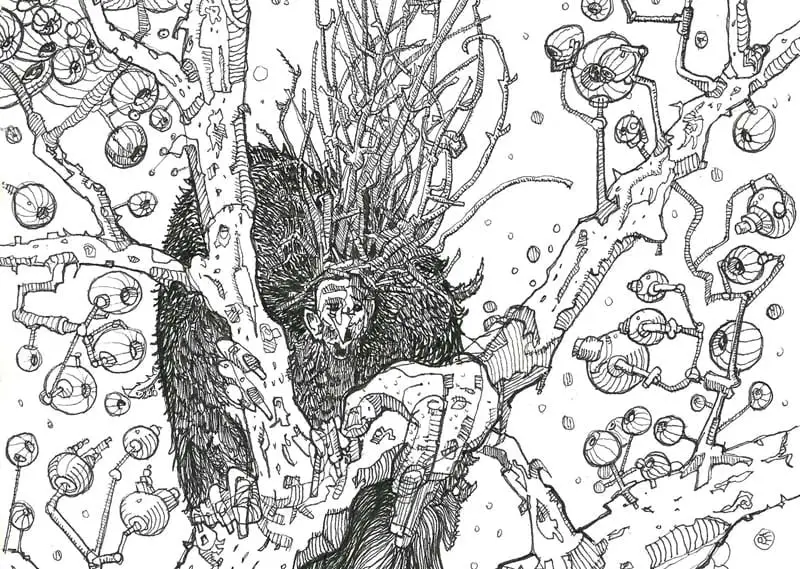
In Lafferty’s fiction, plausible figurations of the “other sheep” show up often. They include beings such as the returnees (if they can be redeemed), the puka, the dorg, that heart-attack-inducing gnome, or the creatures in this chapter, the shoga. In his later work, Lafferty increasingly turns away from the generic conceit of the SF alien and toward the fabula of fairy tale. The change makes sense: a fairy tale always says that the world has wondrous depth beyond what the innocent imagination can gin up on its own. In East of Laughter, this aspect of the novel first appears in the Giants in Chapter One. It then begins to be rounded out in Chapter Two.
Chapter Two also introduces five more members of the company known as the Group of Twelve, while pressing more firmly on the presence of Atrox Fabulinus, the ancient, supposedly dead Giant-writer who still shapes the modern world. We meet Laughter-Lynn Casement, a marine biologist and artist of Irish and Dutch-Friesian descent. Through a dense sequence of academic and mythological paratexts, the largest such cluster in the novel, we begin to see how wide the world’s dream is as fiction and as a displaced correlate of Prime.
Laughter-Lynn explains that she has Kabouter blood, which caused her to pass through a human larval stage known as a Shoga. She spent fifty-five years developing underground inside a giant goose egg, though those fifty-five years amounted to only a single day in ordinary world-time, and emerged as a fully formed sixteen-year-old genius. For Lafferty readers, the episode is a private reward, since it returns to one of the most memorable passages about Atrox in The Fall of Rome, a variation of something like the interrupted stairway sequence in Sterne’s Tristram Shandy:
Atrox Fabulinus, the Roman Rabelais, once broke off the account of his hero Raphaelus in the act of opening a giant goose egg to fry it in an iron skillet of six yards’ span. Fabulinus interrupted the action with these words: "Here it becomes necessary to recount to you the history of the world up to this point."
Over the course of the chapter, Lafferty sets up another one of his vertical cosmologies. Beneath the earth are the Little People, who frequently breach the upper world: these are beings like the one in “Rang Dang Kaloof,” or like what the protagonist of “For All Poor Folks at Picketwire” becomes, or what the protagonist of “Funnyfingers” simply is.
The paratextual documents and excerpts that establish this lower realm offer a shaggy, often contradictory body of lore about the Shoga, also called Siog, Kobalds, Kabouters, or fairies. If this is the novel’s lower floor, the upper floor (in the novel found in attics or up stairways) belongs to the Scribbling Giants.
It is therefore fitting that, at the end of the novel, the usurping Solomon Izzersted stages his appearance as a projection in the sky, from a multistoried building where he has set up the East of Laughter publication racket and his little production studio. All that comes later in the book, and it merges with the Fortean sea above from which objects fall, objects such as giant feathers, or, in the upside causal structure of the cosmology, the skyward source of the world’s scenarios.
So, right here, early in the novel, Lafferty first gives us an elaborate account of the Little People.

According to these varied sources, the Shoga have a pre-human mythological origin. They were exiled from their own Eden, Gaire, eleven years before the biblical human exile, and they survive the Flood as antediluvian beings sealed within provisioned mountain caves. Biologically, however, Lafferty’s invented authorities, figures such as Peter Tompkinson and Hieronymous Talking-Crow, classify the Shoga not as a separate mythic species but as an exceptionally rare human larval stage.
Lafferty returns to one of his old themes: childhood as qualitatively different from adulthood. Butterflies are more like caterpillars than adults are like children. In East of Laughter, children enter this pupal state at age ten for as many as 250 “larval years” and emerge either dead, given a ninety-percent mortality rate, or as graceful geniuses.
This human-larva theory is then contradicted by other texts Lafferty invents. The Enniscorthy Chronicle treats the creatures as chromosomal proof that fairies are a species of monkey, while townspeople and historians describe them as subterranean pests to be trapped underground by ritual arrangements of stone. People arrange the earth, or their own ambients, with rocks that pin plenitude down, insulate their consensus reality, and keep the Oceanic invisible. This, in turn, allows the Giants to impose their master narratives onto the ambient, the rules that people like you and me must live by. As The Back Door of History notes:
. . . .in all these places of the belt there are families who renew the rocks so they say, who keep the piles of rocks in their ritual arrangements that compel the Sioga-Kobalds to remain underground. But in reality these families make new arrangements of the rocks which still keep the Sioga-Kobalds underground, but let far worse peoples than the Sioga-Kobalds come to the surface. And in these places also were families of giants who renew the tales so they say, who maintain the giant writing on the cliffs: but in truth they introduce new giant writing which all the people will have to obey.’
Lafferty also plants deliberate inconsistencies in the demographic and temporal data. His sources disagree about whether the Shoga occur once in a million births or once in a hundred thousand, and they note that Shoga “larval time” may be either incredibly brief or drastically extended in relation to ordinary world-time. The texts finally add that, despite their intermediate developmental state, Shoga can mate and produce outwardly normal human infants, whom historical populations called changelings. Eventually, we learn that this kind of temporal anomaly belongs to the ninth day of the week, which can occur on any other day and last only minutes.
After this background, which establishes the presence of the Little People throughout the novel, the chapter turns to Leo Parisi, a teenage nuclear scientist who underwent in utero learning experiments and retains vivid memories of life before birth. All the characters profiled in the chapter, apart from Laughter-Lynn, have Catholic names that point toward the history of the Church: Leo, Perpetua, Monika, Gorgonius. Leo is frustrated because he knows that the atoms of the physical universe, the fiction Lafferty is drawing from the ambient of the white page, are “empty boxes.” They lack the intricate interior detail he remembers them once possessing:
“Yes, to all appearances, the atoms are empty boxes,” he would rant. “They lack detail. They contain only such scribbles as a three-dimensional cartoonist might make . . . I remember every atom as having a totality of interior detail equal to the total detail of the universe exterior to it. Someone has short-changed me.”
His scientific pursuits are interrupted when he discovers a bloodied, nine-foot-long feather that he determines belongs to Atrox Fabulinus. And importantly, Leo does not bother to examine it. Had he done so, he would have verified that the instrument of writing, if not the scenario he is in, is constituted by detailed atoms.
Leo's wife, Perpetua, who will eventually become one of the Scribbling Giants, is a behavioristic logician who meticulously arranges her husband's daily environment to predict and trigger his scientific breakthroughs; she relies on her symbolic logic to manipulate his routines and believes she can similarly influence God's actions. She herself is a kind of fictioneer who scripts Leo’s days.
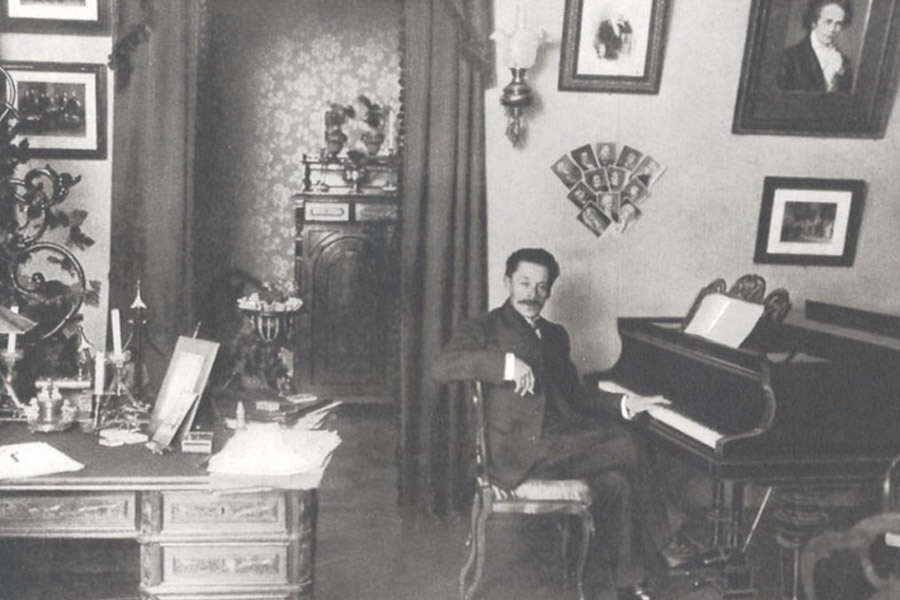
The final two characters detailed in the chapter are Perpetua’s parents, Gorgonius and Monika Pantera. They live in a vast estate in the German Alps known as Piano Castle. Gorgonius is a centuries-old craftsman and composer who builds massive player pianos from rare Klavierholtz wood. He uses hundreds of them simultaneously to perform his continuous musical suites.
At this point, Lafferty takes us deeper into the world of fairy tale, for Gorgonius’s seventh wife, Monika, oversees the estate's layout, which includes several secret rooms that cannot be opened with conventional keys. To enter the rooms, Monika must perform supernatural rituals, which sometimes means she has to kill an Alpine eagle for its wing-bone and temporarily resurrect Gorgonius’s deceased wives from beneath the floorboards to forge tools or recite magical passwords:
Allerdings, allerdings, allerdings, all! Machen die Pforte auf immer fur mich! Weil sie aufmachen nicht, breche ich mal, Breche das Zimmer und breche ich dich! [However, however, however, all! Open the gate for me forever! Because they do not open it, I will break it, Break the room, and I will break you.]
And, here, in the second chapter, the book becomes more metafictional, with Lafferty pointing out that the giant is forcing his way into the text:
It is plain by now that Atrox Fabulinus has intruded his slurpy wet Camel’s nose into the tent of this account and soon will own the place.
Within the chapter, this is reified as the bloody quill that Perpetua and Leo hang in their kitchen at Sora and that Leo does not investigate, but metafictionally, it is Lafferty heightening the fictional plane while dropping clues that his greater interest lies in what the novel calls the substratum of reality itself.