04 Aurelia, Horn and Antler

Updated: 2 days ago

“Who wants to die? Everything struggles to live. Look at that tree growing up there out of that grating. It gets no sun, and water only when it rains. It's growing out of sour earth. And it's strong because its hard struggle to live is making it strong. My children will be strong that way.” ― Betty Smith, A Tree Grows in Brooklyn
“I heard you talking to Herr Boch about antlers and horns. You believe that horns are more predilected to evil than antlers are, and that is the truth of it. You also believe, from what you said yesterday, that strong and horned men are a rarity on this world. You are mistaken there. There are whole legions of them; they are dedicated to evil and destruction; and they will destroy you. But I left their company several millennia ago, and it was then that I had myself polled or dehorned. I have saved my two horns though. The evil has gone out of them by now, and they have a strong and carrying tone.”
The abandoned draft that became Aurelia survives in Tulsa in the file called “To Aurelia With Horns.” It shows few signs that its Aurelia, Aurelia McDermott, was yet to be postfigured christologically; its central concern seems to have been the horn as sexual emblem. When Lafferty returned to the material, lifting large pieces and discarding others, he kept the horns but made them serve the new plot. They became more complicated, more interesting, and far more charged, until Horn is almost a character in the novel.
Open the book, and one finds a horn, or some horn-related image, on nearly every page. As I noted in the first thinking-aloud post, horns appear first on Aurelia’s ship, whose seven horns roar, howl, and holler discordantly at her arrival. From there, they proliferate. They become a pop-musical fashion on Earth in the form of “Aurelia-type horn tunes.” They survive Aurelia’s death in the ballads “Bolide” and “Silly Week.”
They are also worn. Herr Boch, in his youth, had horns that fell away after a year, while Dionysus once wore horns until he polled himself millennia earlier and became a magus. He preserved the pair, whose evil had by then drained out of them. One of these horns he gives to Cousin Clootie, the other to Aurelia. Aurelia blows cock-crow on hers; Clootie answers from around the bend with his. The same call-and-response returns at the climactic assault, when noisome clouds of creatures and prodigies pour forth from both.
By this point in his career, Lafferty had developed his own symbolic economy of horns, visible in stories such as “Horns on Their Heads.” Yet horns had always belonged, in his work, to ritual, myth, and ordinary life. In “Horns on Their Heads,” he counterfigures them, turning devil horns into the horns of Moses, postfiguring them through the Book of Daniel. In Aurelia, however, horns are not simply counterfigured. They convey several meanings at once, the most significant of which is their negative role in the drama of salvation.

They sound the meal calls at ientaculum, prandium, merenda, and the fourth-corner cena. They also release one of Lafferty’s abiding obsessions: the pleroma of being, the flesh between the lines, the Fortean damned facts that turn out to be marvels. When Aurelia sounds her goat-horn, an impossible menagerie spills out:
Out of the horn came flying-dragons, flying-reptiles, sky flying fish. There were winged spiders and hydras. There were also sea-stallions and sea-cattle, and deep-sea tigers. Sea serpents also, and land-serpents. There were the ancient three humped camels of Arabia Felix. Behemoths, Leviathans, Mammoths, Mastodons! . . . There were fire-foxes and muscular apes. But mostly there were the horned animals, trumpeting and squawling.
At the same time, horns carry a strong moral and doctrinal charge. They are "more predilected to evil than antlers are"; horned men are "justly under the suspicion of evil"; and the proper function of horns is "to kill." This helps explain the strange horned people, the cornutus, who encircle Cousin Clootie.
Their horns are "invisible to the eyes, but sensed by every other sense," glimpsed only at the periphery of vision:
The people hadn’t visible horns, except corner-of-the-eye visible when you weren’t quite looking at them. . . . Rams’ horns, goats’ horns, bulls’ horns, buffalo horns’, and all of them were unnaturally sharp. But were they unnatural? What is the nature of horns anyhow, and what is their function? Their function is to kill.
Horns are thus instruments, weapons, emblems, and agencies of spiritual force.
The novel also plays with horns musically and verbally. A French horn appears in the Iowa-biography passage in the middle of the novel. Another horn, given by the cave conspirators, is played by Aurelia "as if it were seven horns," in a dissonance that reveals who she is. Saint Cecilia is reidentified by the Bad Music League as "horn-lady all the way." All this is to say, Lafferty’s novel keeps returning to the same cluster of associations: Aurelia is warned that she may provoke a "horned-animal reaction"; she is said to be "the Star who horned down from the sky," "the horniest of the horns," and "the Girl Next Door blown inside-out by the power of trumpets." By the end of the book, horns have become a dangerous image: musical, apocalyptic, erotic, violent, and cosmological all at once.
In Aurelia, just as important as horns are antlers. Antlers in Aurelia are the novel’s counter-image to horns. They are sprouted, theorized, shed, and finally grown out of the grave. Herr Boch develops "small, velvety, branching antlers" after meeting Aurelia and ceasing to use the blue caustic powder that had prevented their return; at the assault, he brings the fallen antlers to her and discovers that he "would not be an antlered man after all." The distinction between these parallel growths is laid out explicitly in an epigraph attributed to the fictional historian Arpad Arutinov’s The Back-Door of History:
Through natural exuberance and curious mental exploration, certain men have grown into a peculiar curiosity and classification themselves, and have had a most singular sign placed upon them. This is sometimes understood to be one of the evil signs, but it is not so. Careful examination will always reveal that the two manifestations are quite different. The antler is rather the sign of excellence and achievement in a rational way, but in an unusual field of action or study. It is a sign of real discovery or rediscovery of forgotten things. While horned men are justly under the suspicion of evil, antlered men should not be.
Unlike horns, which kill, antlers fall and grow again. They carry the image of renewal, and finally of resurrection. At one point, Aurelia likens Herr Boch to the deer, or odocoileus, family. By the end of the book, when branched antlers grow from Aurelia’s grave beside the ailanthus tree, the image has deepened. Antlers are no longer only a comic mark of eccentric discovery. They have become a sign that the person may branch, flower, die back, and return in another form.
With this symbolic economy of horns and antlers established, the final image of Aurelia’s grave—with its antlers and ailanthus tree—comes into clear focus and we can speed through it. The setup for this image occurs late in the novel, when Aurelia’s death is imminent and the day is beginning to fragment. The planting of the tree prepares for what comes after death:
A lady brought some ailanthus seeds to Aurelia. “If you set them now, some of them will grow out of your mouth after you are dead and decomposed, and there will be a large ailanthus tree to show where you are,” she said. "But doesn’t the ailanthus tree smell funny?" Aurelia asked. "Yes, it does. But it’s pretty. It’s the tree that most reminds me of you." Aurelia ate the ailanthus seeds.
By eating the seeds, a eucharistic trope, Aurelia ensures her own post-mortem life. The imagery here rests on a dual foundation. First, the antler imagery, which has long been a part of the Christian tradition. It has been depicted countless times in the iconography of St. Eustace and St. Hubert, who both experienced a vision of the crucifix shining between the antlers of a stag. The antlers are the promise of resurrection, the shedding of the old and the branching of the new.


But what about the ailanthus tree? Literate Americans of Lafferty’s generation would have immediately associated it with one of the most famous symbols in twentieth-century writing. It is the title species of Betty Smith's A Tree Grows in Brooklyn—the tree that can grow anywhere, out of cement and adversity. It is an invasive, stubborn, frustratingly resilient species. Its botanical name translates to the "tree of heaven."
The grave image is a double promise: a theological promise of resurrection, and a terrestrial promise of Aurelia’s message. Early in the novel in the Hoffmannesque game of symbols where the powers and principalities play their card game in the Floating World plane of reality, Aurelia says that she does not want to govern ("Somehow I don’t want to dominate it, not right now," she tells her blood-singing self; "It’s like a crooked story, it’s like a crooked song, it’s like a crooked ever-blooming happening. I want to watch it, I want to taste it, I want to hear it"). The ailanthus postfigures the cross, and takes one back to the novel's major theme of governorship, which is one way of saying, What does it mean to be a lord or servant?
At the beginning of the novel, the Shining World kids look down on people from other worlds as weeds. They sing a Nietzschean song:

Lafferty gets in a joke about them being horny teenagers, but by the end of the novel, that joke about their horniness circulates within the symbolic economy of more than randy horns, which Dionysus abandons when he gives up his pagan horns and becomes a Christianized figure. Their horns are a grotesque libido dominandi. Lafferty had used this kind of transformational device several times by this point in his career. One of my favorite examples is what he does to Socrates in "Rainy Day in Halicarnassus." Socky to St. Peter’s Rocky.
Yet from Planet Nietzsche's point of view, Aurelia is a Shining World failure. She ended up being an uncivilized weed who could not impose her will on the world. Of course, it is postfiguring someone else who was uncivilized. Paul Kingsnorth puts this well:
When we read the life of Jesus of Nazareth, in fact, it is impossible not to see a man who was, in some fundamental sense, uncivilized. He did not tell us to get good jobs and save prudently. He told us to have no thought for the morrow. He did not tell us to generate wealth, so that economic growth could bring about global development. He told us to give everything away. The rich, he said repeatedly, could never attain the Kingdom of Heaven. He did not tell us to defend our frontiers, or to expand them. He told us never to resist evil. He did not tell us to be responsible citizens. He told us to leave our dead fathers unburied and follow him instead. He told us to hate our own parents and to love those who hated us. Every single one of these teachings, were we to follow them, would make the building of a civilization impossible.
The weed, of course, is the ailanthus, often regarded as a weed in tree form, and by the end Aurelia is permanently associated with it. She has come very far from the horn-conquer song of the Shining World children: “We are the gardeners / They are the weeds.” Betty Smith, again, is the person behind the image. In A Tree Grows in Brooklyn, she writes: “Some people call it the Tree of Heaven. No matter where its seed falls, it makes a tree which struggles to reach the sky. It grows in boarded-up lots and out of neglected garbage cans. It’s the only tree that grows out of cement. It grows lushly . . . survives without sun, water, or earth.” The novel ends with the tree of the cross and the antlers of salvation:
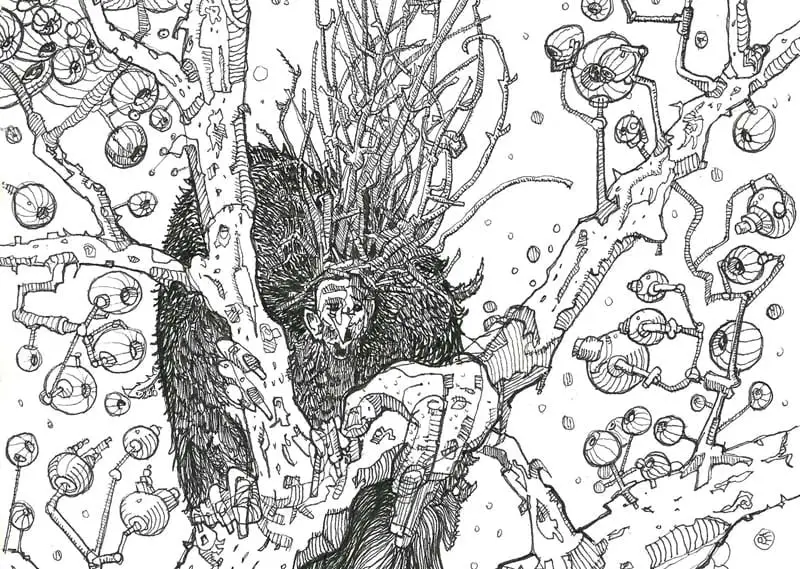
After Aurelia had been dead for a year, an ailanthus tree did grow there. It did smell funny, but it was pretty. It was the tree that should have most reminded people of Aurelia, but there was no memory of her left to be revived. A set of branched antlers also grew out of the ground there, and people do stop to look at them.


Comments