05 Aurelia and Yin-Yang

Updated: 1 day ago

“All these things are possible. If you will worry about them, then I will cease doing it. I hate duplication.” “I will worry about them,” the bodyguard said. “It is my job to worry about them. Are you also going on a peripateticus, as Rex calls it, when Aurelia goes?” “Yes. Today. And that is all the questions that I will answer, Mr. Bodyguard.” “But I would like to know—” “Black lightning of which you felt only a sample, man! Black lightning to burn you to a cinder!” Cousin Clootie the Dark Counterpart said. And then Cousin Clootie walked away with his awkward shamble.
Fifth thinking-aloud post. A post on antagonist mapping.
Aurelia is another of Lafferty's novels featuring devils and a demonic conspiracy. One would have to look closely at the Floating World and the “trolls” to make the case fully, and show how the materials that became Aurelia emerged from the German-set E. T. A. Hoffmann pastiche that had been the original draft.
What seems to have happened is this. Lafferty started working with Hoffmann in mind, and he wrote the riverboat scenario, which survived and became a part of the final novel. That material is dreamy and odd, partly because of the history of Aurelia's compositional process. It is obscure. What I can say is that Lafferty wrote the basis for the scenes and most of the material itself before he knew he was going to write a postfiguration of Christ. He started with a book about art and magic, and he worked himself into a corner. That was when Aurelia was still Aurelia McDermott. He needed a way to make Aurelia centripetal. Postfigure her through the Christian tradition.
First, there is the original German setting of "To Aurelia With Horns.” This is from the original abandoned manuscript:

Second, there is the very important reference to E. T. A. Hoffmann.
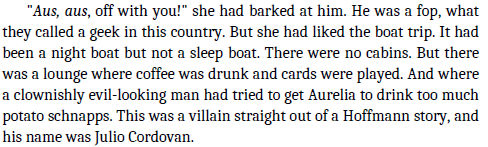
Third, there is the fact that Lafferty takes the description of Julio Cordovan straight from E. F. Bleiler. In the original MS, this is explicit inspiration:

This is Bleiler on Hoffmann, from page v of his introduction to the tales. Lafferty kipes Bleiler:

Finally, in the published version of Aurelia, Bleiler and Hoffmann have disappeared. Julio Cordovan remains:

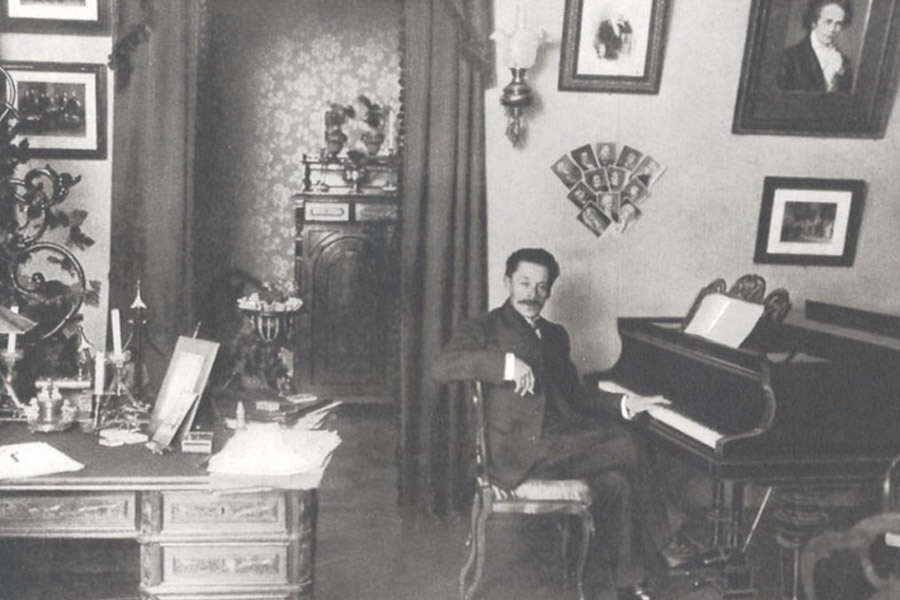
I point this trivia out because the devils in the book have passed through a filter of Hoffmannian fantasy before becoming part of the Aurelia that was published. If you haven't read him, E. T. A. Hoffmann (1776–1822) was a German Romantic writer, composer, artist, and critic best known for difficult fantasies such as “The Sandman.” Wonderful and weird, Hoffmann is as tricky to read as Lafferty. Nowadays in the U. S., he is best remembered for The Nutcracker and the Mouse King, which became the subject of Tchaikovsky's famous work.
What I am calling Hoffmannian fantasy is a style of fantasy in which ordinary reality becomes unstable, uncanny, and dreamlike, often blending the supernatural, madness, doubles, automata, and psychological fear, leaving readers unsure whether events are magical, delusional, or both. That is Hoffmann but it is also RAL. Lafferty had read Bleiler's introduction to Hoffmann's tales closely, and he was experimenting with the Hoffmannian mode, no doubt because so much of Hoffmann is so Lafferty adjacent.

Consider a small point. Why the gory blood drinking scene in the novel? I suspect it is because of the mention of wine drinking in Bleiler and because Hoffmann wrote a novel called The Devil's Elixir.

In any case, the riverboat people are the powers and principalities, in my view. They show up in Sandaliotis in the Fortean intelligences. A devilish conspiracy in a Lafferty novel is about as surprising as a twist in an O. Henry story, so that isn't surprising. What is surprising in Aurelia is the presence of another set of antagonistic forces, all gathered under the sign of the yin-yang. This becomes the main set of antagonists outside of the Floating World passages, although the Floating World people will play their role. Lafferty associates yin-yang with the New Age counterculture.
Before getting into the yin-yang disgusto dialectic (the novel’s term for love-hate as the bad infinite), I think Aurelia becomes much easier once one appreciates how much doubling is going on. A few examples, from my notes on the categories of doubling in Lafferty:

By the time one is well inside the novel, two primary obstructions stand before Aurelia: the people of the Floating World and the yin-yang. What is the yin-yang within the novel? It is not merely a symbol. It is a spiritual worldview, one Lafferty plainly disliked, and it proves even more hostile to Aurelia than the power politics of the Floating World. It imagines reality as a necessary balance of complementary opposites: light and darkness, good and evil, life and death. Neither side is absolute; harmony comes from holding them in equilibrium.
Lafferty writes from a different metaphysical world. For him, God is absolute light and goodness. Evil is a corruption to be defeated, not a partner to be accommodated. To the Christian imagination, the claim that good needs evil in order to be whole is not wisdom but a dangerous lie.
Aurelia, of course, is not a theological essay. It makes the point by turning the yin-yang into a physical object: a weird and deadly weapon that kills both Aurelia and Cousin Clootie. The cultists wield “yin-yang yo-yos,” double-spiked darts used for assassination. By turning a symbol of spiritual balance into a murder weapon, Lafferty suggests that inviting evil into one’s metaphysics does not bring peace. It brings death. At the same time, the yo-yo is deliberately ridiculous. It mocks the cyclical shape of the philosophy it embodies. A yo-yo spins out and returns to the hand. It achieves nothing. It goes nowhere. That is the opposite of Aurelia’s teaching on fulfillment in “Final Happiness.”
Here is how Lafferty describes the weapon:
“Those double-dart yo-yos could be sailed with a flick of the hand, and they would go straight to a selected target-tree and embed themselves in it . . . they would go back and kill the thrower if he had any reservations about the yin-yang philosophy. There were many mysteries about these murderous toys.”
Aurelia recognizes the spiritual trap. We see this when a dowdy cultist approaches her and calls the yin-yang the “perfect balance” and the “celestial compensation by which the universe runs.” Aurelia rejects the premise at once. The universe does not require an equal measure of darkness to offset the light. Lafferty’s Augustinian formation shows here. Aurelia tells the woman:
“I am not at all disposed to deal with a yo-yo . . . I tell you that it is out of balance. . . . It is all a false compensation and a false balance. It is a little bit of evil that the enemy has devised to blur people. I do not believe that if I want to walk up stairs I must first dig a compensating hole in the ground for balance. I do not believe that every time we light a light we must also light a darkness for balance.”
Whatever Planet X's real name, many of its people have been so damaged by this specious doctrine of balance that they cannot endure Aurelia’s unmixed goodness. The citizens feel compelled to complete a “love-hate dialectic,” as though admiration must be balanced by violence.
Finally, Lafferty could have written the novel as if it focused on Cousin Clootie, because Clootie's high-school assignment runs in parallel with Aurelia's. The two of them, working together, form a counterimage to the black-and-white duality of the yo-yo that does not make a yin-yang mistake. Cousin Clootie is her dark counterpart, the stick to her carrot, but the horns they blow are in harmony and in time, not discordant with one another, opposed to one another, or in a dialectical relationship. She has her mechano-organo monkey (cyborg/AI), and he has his, the black tarsier.
At this point, we have looked at the novel from several levels that I think are necessary to get the most out of the book: the biblical-postfigural, Thomistic, and symbolic-antagonist dimensions.