03 Aurelia and Walter Farrell, O.P.

Updated: 2 days ago

“To remedy this insufficiency, I’m enclosing a little book, very informative, though only a little over six hundred pages. It’s a sort of resume of the Summa of Thomas Aquinas. You’re very well informed on all the perimeters of the subject, but your information on the center itself is very weak. I’ve given away about twenty copies of this book in the last twenty years, but only to people intelligent enough to handle it.”
A post on Walter Farrell, O.P., whom Lafferty respected and whose books he sent to people he respected. Farrell was one of the most important American Dominican writers of the twentieth century. Not because Farrell's thought was especially original, but because he unlocked Aquinas for ordinary readers. He was smart about the highest things without being pretentious, brisk, glib, turgid, dull, or daft. He was, in other words, a Catholic intellectual who popularized Aquinas, the greatest doctor of the Catholic Church.
And because Lafferty absorbed Farrell’s popular Thomism so deeply as a popular vocabulary of fun and happiness, anyone who wants to understand how Aurelia was constructed should begin (after recognizing how saturated the novel is with Scripture for understanding incidents in it, as I hope the first Aurelia post showed typologically) with Farrell.
Farrell is also a writer I have come to love through Lafferty. He is genuinely enjoyable to read, full of good humor and wisdom, with a measured, plain style that sometimes rises into eloquence. I just really like him. If only my prose were so unhistrionic and lucid. Only a handful of figures are as important for understanding what might be called the traditional side of Lafferty’s mind, which is a great reason to know Farrell’s work.
I think of Walter Farrell in the Whole Lafferty as an iron plank. He sets one of the harder limits on the theological games Lafferty plays. Get really far away from shore, and look back for Farrell on the shoreline waving a flashlight. And Farrell’s clarity helps define the orthodox ground from which Lafferty’s experiments often soar. I wish we knew when Lafferty first read My Way of Life, but I would wager it was in the mid-1950s at latest from echoes in prenucleation material.
Gene Wolfe, who never made the dumb mistake of reducing Lafferty to a funny teller of tall tales or quirky entertainments, once said that a steel rod runs through the center of Lafferty’s stories. It is a Wolfean principle I would hand on to any Lafferty reader because I learned from Wolfe. He seems to have known the problem facing Lafferty reception is premature adequacy. The antidote to it is the steel rod of good but steely Catholic sense Lafferty’s work dramatizes, and it is what one finds in Farrell’s writing.
In sum, Farrell’s importance for Aurelia is determinative because Aurelia’s homilies are not warmed-over Aquinas. They are, rather, warmed-over Walter Farrell, O.P. Lafferty picks his duet partner in Farrell, set on doing octave doubling: in all twelve, one hears both Farrell and Lafferty with Aquinas being the theme. This is true not only at the level of content, but also at the level of cadence, phrasing, and verbal texture (see the resource at the end of this post).
Among the writers who left a lasting impression on Lafferty’s mind and became shaping forces in his work, Farrell must belong near the top of the list. It is true that Lafferty did not write as many stories based on Farrell as he did on E. I. Watkin, but Farrell is far more important as a continuous presence. Watkin fell away from Lafferty after Lafferty exhausted him and moved away from TMWKE to Green Tree, but Aquinas, and it was in many ways Walter Farrell's Aquinas, was inexhaustible.
Farrell was born in Chicago, Illinois, on July 21, 1902, and received his early education in Catholic schools, including Notre Dame and St. Columbanus. He then studied at Quigley Preparatory Seminary before entering the Dominican Order. On September 14, 1920, he received the habit of St. Dominic at St. Joseph’s Priory in Somerset, Ohio, and, after his novitiate, made profession as a member of the Order of Preachers.
His formation continued at St. Rose Priory in Springfield, Kentucky, and at the Dominican House of Studies in Washington, D.C. He was ordained to the priesthood on June 9, 1927, in St. Dominic’s Church in Washington, D.C., by Archbishop Michael J. Curley of Baltimore. After ordination, Farrell pursued advanced studies at the University of Fribourg in Switzerland, where he received the Doctorate of Sacred Theology in 1930.
To understand Farrell’s vocation, one should begin with what it meant for him to be a Dominican. The Dominican Order, formally the Order of Preachers, was founded by St. Dominic for preaching and the salvation of souls. Its greatest intellectual glory is St. Thomas Aquinas. Dominican life has traditionally been centered on prayer, study, community, and preaching. In that sense, Farrell’s writing was not separate from his vocation; it was one form his preaching took. The Dominican ideal is not to study for its own sake, but to study in order to support clear teaching, wise preaching, and service to the Church.
After returning from Switzerland, Farrell began the work that made him famous. From 1930 to 1933, he taught dogmatic theology at St. Joseph’s Priory in Somerset, Ohio. He also served as Assistant to the Master of Students and later as subprior. In 1933, he started teaching at the Dominican House of Studies in Washington, D.C., where he spent many of his most productive years.
He became Pro-Regent of Studies for the Province of St. Joseph in 1938 and Regent of Studies in 1939, serving until 1945. From 1940 to 1945, he also served as President of the Dominican Pontifical Faculty of Theology in Washington. In 1940, the Master General of the Dominican Order elevated him to the rank of Master of Sacred Theology, the Order's highest academic title, in recognition of his theological learning.
Farrell’s great contribution is that he could explain theology so clearly to a lay audience. His most famous work, A Companion to the Summa, was a four-volume explanation of St. Thomas Aquinas’s Summa Theologiae. Aquinas can obviously be hard going for someone who lacks training in scholastic philosophy. When he died, his obituary in Dominicana called the Companion his “towering four-volume masterpiece” and said that, more than almost anyone else, he helped popularize the Summa and pioneered “the teaching of theology to the laity.”
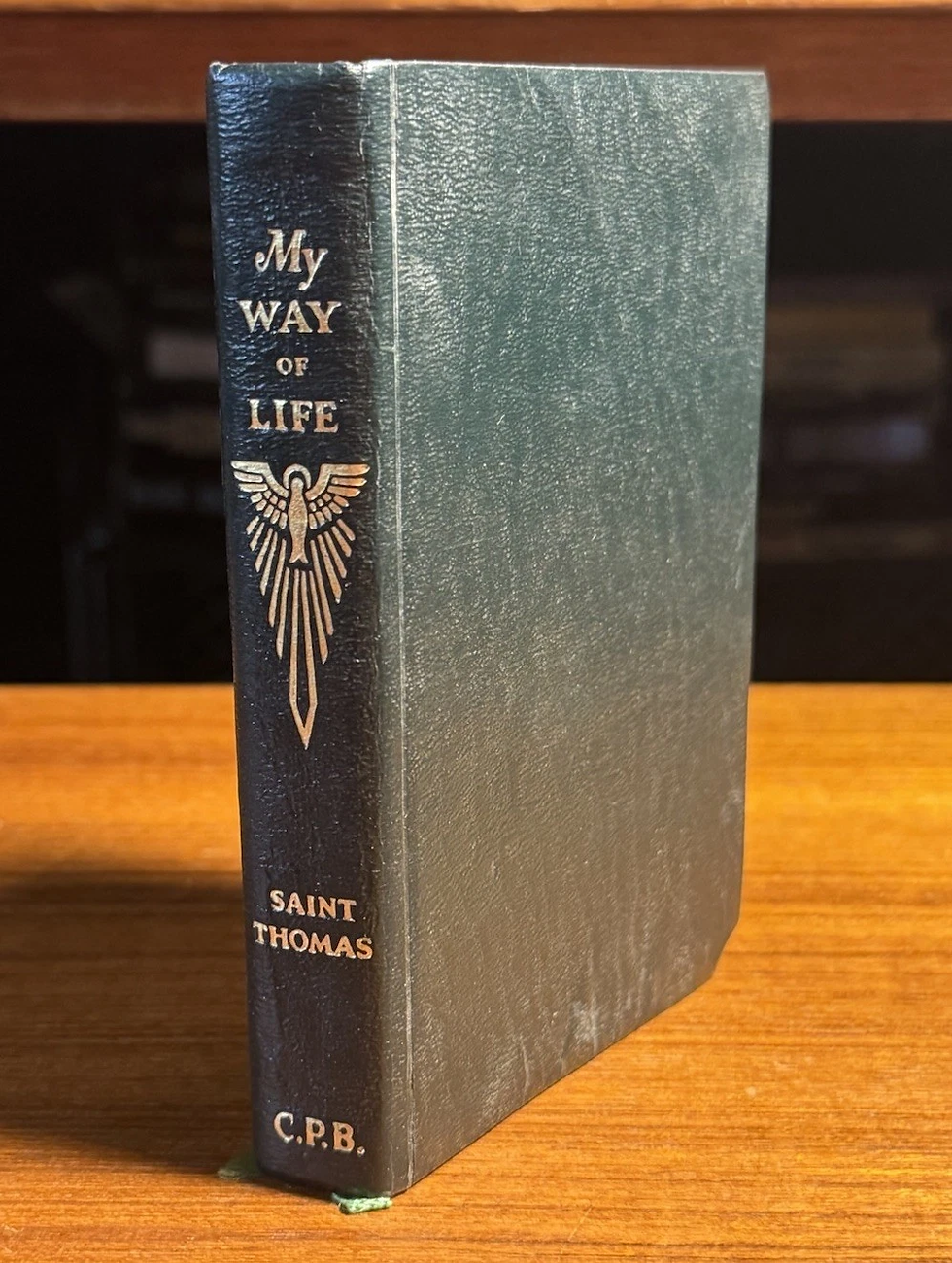
It is not hard to see why Lafferty admired Farrell’s work. Both disdained pretentiousness. Farrell’s concern connects to My Way of Life, which shapes nearly every page of Aurelia. The book is often associated solely with Farrell, though it was completed with Fr. Martin J. Healy. In the TAN Books edition, there is a note that Farrell died soon after completing Part I, and that Healy wrote Parts II and III.
The book presents the theology of St. Thomas in a compact and practical form, covering God, angels, human happiness, the divine life, the Incarnation, the sacraments, and the last things. Its purpose was to make the wisdom of the Summa usable for ordinary Catholics, not only as abstract doctrine but as a guide for living.
Farrell was also closely connected with the Thomistic revival in American Catholic life. He founded The Thomist in 1939, a scholarly quarterly devoted to Thomistic philosophy and theology. At the same time, his work was not confined to professional theologians. A history of the Dominican Order in the United States credits Walter Farrell especially with helping promote the study of theology among laypeople through Thomist Associations, regional study groups, books, periodicals, and theology courses. This is one of the most important facts about him: Farrell believed theology belonged not only to specialists, but to the whole Church.
During World War II, Farrell’s priesthood took another form. From 1942 to 1945, he served as a chaplain in the United States Navy. That included active duty aboard the aircraft carrier U.S.S. Yorktown. His health had been poor for much of his life, and he initially could not meet the physical requirements for the chaplain corps. According to his obituary, President Franklin D. Roosevelt personally intervened in his favor.
Poor health was a major part of Farrell’s story, yet he remained incredibly productive. He wrote books, contributed to theological journals and Catholic magazines, preached retreats, lectured widely, and helped shape American Catholic intellectual life. Among his works were The Essence of the Natural Law, A Companion to the Summa, and The Looking Glass. He contributed to publications such as The Thomist, Cross and Crown, Homiletic and Pastoral Review, New Scholasticism, and The Sign. In 1942, he received the annual Catholic Literary Award of the Gallery of Living Catholic Authors.
Farrell died in Chicago on November 23, 1951, in his sleep. He was forty-nine years old. His funeral was held at St. Pius Church in Chicago, and he was buried in the Dominican Fathers’ plot at All Saints Cemetery. At the time of his death, he was still working on several projects. One of these was a life of Christ. The suddenness of his death shocked those who knew him; fragile as his health had been, he had stayed extraordinarily active as a priest, scholar, and writer.
Understanding Thomism as texture in Aurelia should begin with My Way of Life. It is far wiser than cracking open the Summa itself, which is better suited to deeper inquiry. Yet I would emphasize that Aurelia is not demandingly Thomistic in the sense that one needs to know much about the Thomistic tradition or Aquinas’s own words to enter into it. As Lafferty was drafting the book, it was Farrell, not St. Thomas Aquinas, that he had at his elbow.
Find one of the old pocket edition copies if you can, especially if you want to delight in Aurelia. I will add that My Way of Life is not just well done as a popularization; it is lovingly made as a physical object, it feels like Lafferty’s Catholicism in the hand, and copies are still inexpensive. Buy it and you will also understand Lafferty’s joke in the headnote.
Next time, I’ll look at one of the unusual symbol economies in the novel. There are about ten of these that help me, so I’d like to address the main ones.