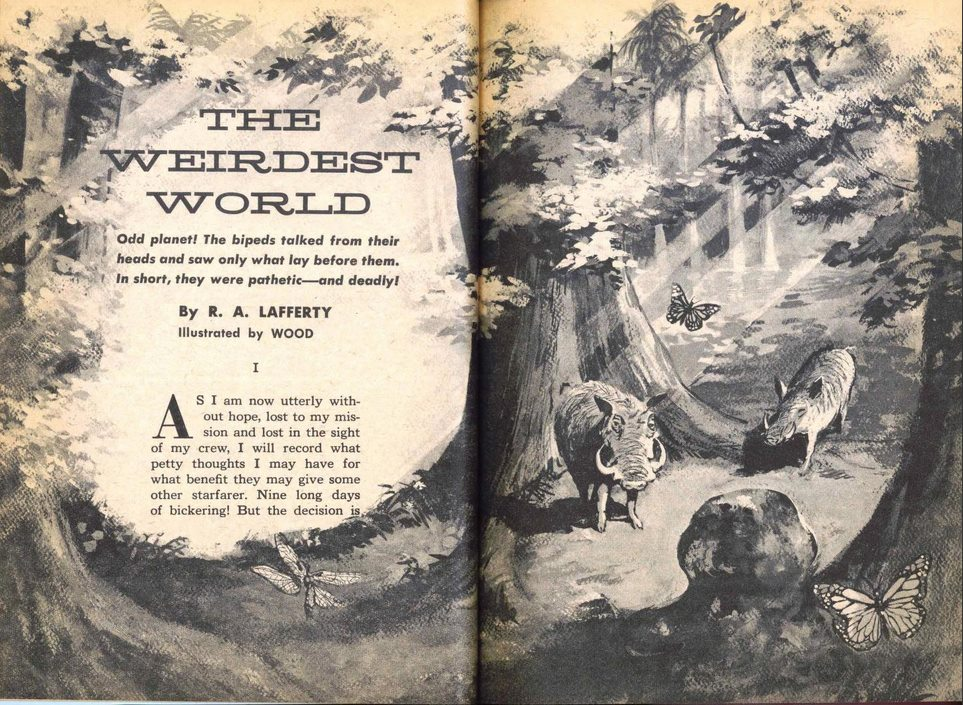
"The Weirdest World" (1958/1961)

Updated: 6 hours ago

“Well, I had been wondering about a thing in me, but I hadn’t thought of him as a bookworm. I hadn’t connected him at all with my new love of reading. ‘Are you a bookworm?’ I asked him. ‘Do I look like a bookworm?’ he asked. ‘Brainless oaf!’ As with the workman Pyoter, I had no précis type for this thing either. He was the other, the stranger. He was the outsider inside me. ‘What are you then?’ I asked him. (If someone is inside me I have theright to know who he is.) ‘I’m a snake,’ he said. ‘I may later make the claim to be the snake.’ ‘You’re too little to be a snake,’ I told him. I intuit snakes, and they are all much larger than this thing, and much less grubby. I suspect, in fact, that he is a species of grub. I intuit grubs also. ‘I will grow,’ he spat at me. ‘Oh, my clatter-brained brother, how I will grow! I am the other side of you. I am the other side of the bite. You generated me and I am your antithesis.’ ‘Well, have I cherished a viper in my bosom?’ I quipped. (Hey, that’s pretty good.) But how could I generate anyone? I am not yet one day old. How could I generate a snake?” [emphasis added] — Arrive at Easterwine (1971)
And Pete the python was curt. "Well, big shot, I guess you aren't so big after all. And you were sure no friend of mine. When you had that doctor cure me of my indigestion, you left me with nothing but my bad conscience. I wish I could get my indigestion back." "A curse on this world," I said. "World, world, water, water, glug, glug," said the turtles in their tanks, my only friends.”
Today I am going to kick a puppy. Lafferty wrote “The Weirdest World” in 1958. It is a pre-nucleation piece, one in which the genre constraints of science fiction overwhelm elements that will later find their proper place in the ghost story. To say this risks taking the story too seriously, since it is very light. Read on its own terms as a disposable early piece, it is well-positioned to be enjoyed thoroughly.
Lightness is what makes the story work, but it is also what keeps it in the science-fiction ghetto. That is the tension I want to write about, fully aware that doing so means reading the story forward into the Lafferty canon, knowing what comes next and knowing that, from this vantage, what the story gives us is famished in significant ways, though perfectly enjoyable on its own terms.
The idea is to take it seriously because we take Lafferty seriously, and want the hard Lafferty to be more legible. If you want your Lafferty to look like an alternative version of Fredric Brown, don’t bother.
Some stories in Lafferty open onto other, richer stories, and one can tunnel through them like a mole, moving into ever richer veins and deeper earth. For the past year or so, I have been creating a motif index for Lafferty to help me understand how it works, how we can move through Fortean stories, for instance, and through the pre-nucleated Institute stories to the full ones.
“The Weirdest World” does not open out; it does not set up richer stories to come. It just shares DNA. What you see is what you get. In short, it is an amuse-bouche: a cozy Twilight Zone episode, complete with an inoffensive moralism that reassures the audience that we are good people already, and therefore need not question ourselves.
People like us are not the targets of satire, its softness implies. We should be, because you and I are the real residents of "The Weirdest World," so, as ghost-story material, it's unpromising.
One measure of what Lafferty is doing here lies in how he treats marriage. The joke he makes about Margaret and her being married multiple times is the real needle poking through; how he handles it should be compared with Dotty and his other, more mature satires on couples. Lafferty gets better by not doing what he does in "The Weirdest World": deflating his own satiric norm:
“I go for you too, blob. You're my buddy. Isn't it funny that the only buddy I have in the world is a blob. But if you'd seen some of the guys I've been married to — boy! I wouldn't insult you by calling them blobs. Have to go now. See you tomorrow night if they keep us both on.”
Dotty is written in a different mode for very different purposes, but the satiric norm in "The Weirdest World" is built on the same belief set to be found in Dotty:
“There will be a lot of people and things you will not be able to face.” “I will have no more of such talk from you. Many of the churches permit remarriage under these conditions. The Episcopals, for instance, in some of their branches, and a great many — ” "Yes, they teach satanism. It is no new thing with them.”
We are left with comedy that looks like satire but is not wounding. It doesn't really hurt Margaret, and it doesn't hurt us. Real satire opens you from throat to navel before you know what has happened. Lafferty will get very good at it.
The only reason to care is that the engine is satire, not comedy. Just behind all the comic cleverness, carried by dialogue, one can see the Swiftian/Augustinian moralist at work—the moralist, finally, not quite getting the job done, even in brilliance. The story does not keep up with the implications of its own satire, and so we get a would-be black comedy that is not nearly black enough. It feels narrowly genre-bound. Here is Lafferty, the artistic outsider, doing his best to look like an insider.
An alien starship captain, our protagonist, the Blob, is marooned on an unknown planet. He documents his efforts at survival in a communication sphere, encountering local wildlife that includes “giant grubs” walking on “flesh stilts” and wearing artificial cocoons. These creatures are, of course, humans. They capture him and sell him to a roadside attraction called the Reptile Ranch.
He wins his girl, Margaret, a multiple divorcée, but his success is short-lived. The court rules that a “blob” is an animal and therefore legally incapable of owning property. Destitute, the Blob retreats into the woods of Planet Florida. He launches his communication sphere into the galaxy to warn other space travelers: "I will fire off my communication sphere . . . be you warned of this one!"
If one reads the story and goes with it as SF ephemera, it works. If one pauses to think about what “The Weirdest World” is really saying, it works less well. It wants to make a satirical point about humans being rotten. Its lightness hides how Augustinian and unsparing it is; it passes as sour a judgment on man as one can find in early Lafferty.
The problem is that this doesn’t sting. It is spoiled by how much the jokiness wants to please the reader. Dealing with this miscalibration requires some care.
As an old-fashioned Catholic moralist, Lafferty invariably writes from Catholic satirical norms. I pointed this out regarding Margaret. The deepest condemnation of Margaret cannot be that she is a gold digger. It must be that she is morally obtuse about the sacrament of marriage. Compare it to real marriage satire in Lafferty found in stories such as "Thou Whited Wall." This story, however, won't push the thumb stud and slash with the knife; instead, it leaves the impression that her chief faults are mercenary calculation and shallowness. It files down the edge of what is, in fact, a far harsher judgment. It whistles its absolute judgment at 23,000 Hz.
Another miscalibration is the Amos'n' Andy-level joke. The Eustace character is black: “The eyes of Eustace were large and white.” I take Eustace’s white eyes and the name joke to be symptoms of the ingratiating, satire-neutering strategy that mars the story. A truly Swiftian attack has no time for this kind of thing.
At the same time, a better Lafferty is here at work and simmering. Albert is a being who lacks crucial information, like someone about to get rolled, someone who is, as it were, unaware that Adam had three brothers. He does not understand that his own fall—the result of his crew’s recognition that he is a loser in terms of executive fiction—has a counterpart. What undoes him is that he never learns the real secret of Earth: Earth is a planet that has passed through the Fall.
Lafferty just does not push this hard enough. Later, he will understand its significance for his project and make it his strength:
But the theme of the Fall in the deep past is implicit in most of the central works of science fiction and in virtually all of the fringe works. It is the breath of life of High Fantasy. It is the ‘memory of Magic’ behind all sword-and-sorcery. The idea of a humanity both taller and deeper and more inclusive than now, of the time when animals were somehow contained in mankind, is echoed in the Tarzan stories, in the Planet-of-the-Apes pieces, in the Island-of-Doctor-Moreau pastiches. The idea of humanity still containing a spirit world, a supernatural world as well as a preternatural world, a ghostly as well as a poltergeistly world, is the theme of all the Tales-of-the-Uncanny-and-Supernatural, or all Tales-of-the-Mysterious-and-Macabre, of all Great-Tales-of-Terror-and-the-Unearthly, of all Weird Tales, of all Great-Ghost-Stories-of-the-Gas-Light-Era.
Despite being built on the idea of the Fall, there is no depth. Everyone Albert meets is a total amnesiac and a user, with one exception—Pete the Python, who has a dim awareness of what has happened and a principled malice.
“Snakes always have bad consciences. We have forgotten the crime, but we remember the guilt.”
It is a story that makes me want to say "poor Pete the python," not "poor Albert," because Pete never gets the respect he deserves. Pete is wholly external to Albert, and Albert has no idea what Pete is. Albert is put into the cage with Pete, which, of course, is the iconographic inset of the story: Albert is trapped in a world where spiritual consequences are being worked out, snake and man, both outside the Garden. Instead, Albert places a curse on “The Weirdest World” itself, space ineptitude to the end, not knowing that Genesis 3 was the problem all along.
To anyone who wants a more interesting Lafferty, I would say: Remember Pete. We will meet him again in fuller form in Arrive at Easterwine (1971), where he appears as Snake inside Epiktistes. Then it becomes clear that Pete's presence in “The Weirdest World” is not just a throwaway joke but a theme that matters and the most important and generative aspect of the story. It survives the genre constraints.
I'll wrap up by saying that “The Weirdest World” clearly wants to be Swiftian in its judgment of humanity, and it also wants to be cute. Lafferty wants it both ways, and so the ending falls short. What should be a punch on the jaw is a pat on the face.
Then again, being too critical of this story, as I said, is kicking the puppy. For all that it is a minor Lafferty classic, it reminds me that the Lafferty most people know and most love is not quite my Lafferty. This is the Lafferty equivalent of Friz Freleng when one wants Chuck Jones.
I prefer Lafferty when he has a freer relation to market discipline, when he learns to balance his Catholic fury with his sense of humor, and when his stories are intellectually strange, morally intense, spiritually violent, formally inventive, and just as funny. This is Lafferty imagining what SF could look like with his voice, but not quite speaking fully in it.