"Teresa" (1961) and "The Ultimate Creature" (1966/1967)

Updated: 1 day ago

“I'd like to have a people-kid sometime,” Teresa said. “After all, mama had me. A people kid have fun playing with the fish kids, and they like him, too. And he could climb int he rocks with the Groll's Trolls. He would sort of knit our family together. You think about it, Peter, and I think about it too, and we see what we come up with at the next milting time.”
Lafferty’s "The Ultimate Creature" is a yarn, a cosmic fable about Peter Feeney, “the meanest man of all the worlds—a low-down sniveler, a weak man,” who has something unusual in his fate. According to the universal law of Floating Justice, which is rigidly isostatic, the lowly Peter will receive the ultimate treasure. The story defines this law as the principle that “every unbalance will be brought into new balance” and contains a final tenet: “that some day, somewhere, the meanest man of all the worlds will possess the ultimate treasure of the worlds.”
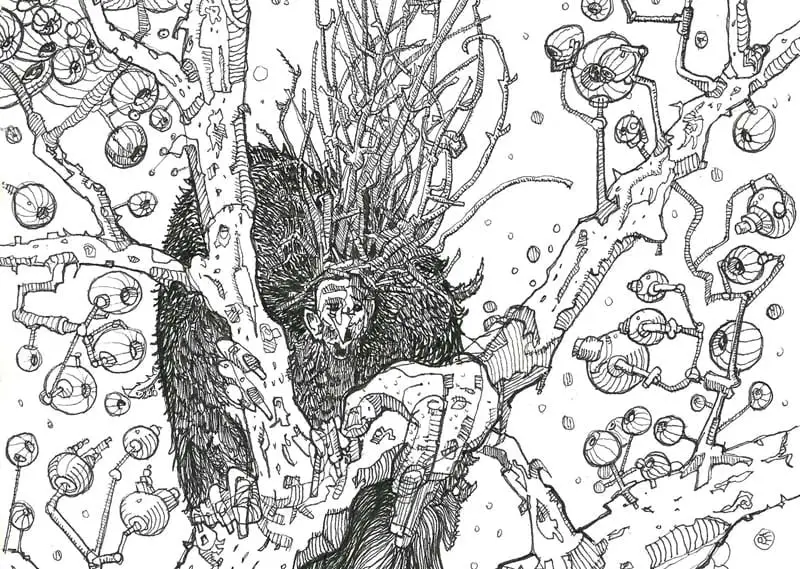
On a remote planet, Peter meets and marries Teresa. She is part human, but she says that her mother was “a queer fish, mama.” Their marriage brings them perfect happiness. It restores the balance of Floating Justice, as “the meanest and weakest man in the universe now possessed the Ultimate Treasure of the universe.” But there is a wrinkle, and Lafferty lays it on thick with a weird mix of the bittersweet and the grotesque. The children of Peter and Teresa are not human but thousands of Fish Kids and Groll’s Trolls. In their perfect domestic life, it is a normal, loving thing to catch and fry their own offspring for dinner. Lafferty gives the reader this tender exchange: “'Oh, four such pretty kids of ours!’ Teresa said. 'Fry them, Peter.'"
After the science fiction market opened to him, Lafferty would sometimes turn the draft of a story written for a different market into one written for the science fiction crowd. This happened with “The Ultimate Creature,” which originated from the unpublished short story "Teresa." The MS version of "Teresa" that I have is incomplete, with its last page or a few pages missing.
The original is off-kilter. “I’m not good,” Lafferty once told Harry Harrison, “at writing things to a pattern.” You know it won’t be a typical romance. Still, it is conventionally patterned (minus the fork business which made it into “The Ultimate Creature”) and grounded. It’s a funny, poignant romance about Peter Feeney, an unassuming and unsuccessful salesman who possesses a secret, extraordinary talent. As Lafferty writes, Peter is “a man of deprivation and penury . . . a museum prowler unable to own, a viewer, always a viewer- never an owner.” This becomes a defining aspect of the other, later Peter Feeney of “The Ultimate Creature,” who has “the finest eye for beauty in a woman of any man anywhere.”
"Teresa"'s Peter travels to Portuguese Ambeno, a remote outpost, the place you get to when “you go to the end of the world, and turn left,” where he meets Teresa, she of supreme beauty.
Lafferty delights in imagining the perfect woman, and it's fascinating how he reshaped the original in the rewrite—my favorite change being the impatient Irishwoman with her brood of children from “Teresa”—“a mother of six in Cork: not really young, of no repose or station or ease; hurried- hurried always, impatient”—transformed into a woman on an alien world: “the mother of six on Camiroi… hurried impatient, and quite likely the most beautiful woman who ever lived.” I'll probably always suspect the Camiroi as being a little Irish.

As you’d expect, in both versions Teresa instantly becomes for Peter the standard against which all other women are measured. From the rewrite: “Then Peter saw Teresa. And she made the seventh? No. She made the first. The six faded. There was only one.”
In the original, a string of encounters builds a quirky bond with a native. It reminded me of Lafferty being more at home among Catholic Tagalog speakers and Mexicans than among the WASPs he served with in the army; he said they seemed alien. It also recalls the nostalgic encounter with the native girls in his novel Archipelago. In the rewrite, the same beats appear but with altered shading: a shared meal, a cigar clumsily dropped and deftly reassembled by Teresa, and a moment of public humiliation—now rendered with a science-fiction gloss.
What was lightly erotic in the original—Teresa “folded and rolled them by ancient formula into a green cylinder that was sheer art. She licked it with the most beautiful tongue in the world”—becomes comically fantastical in the rewrite: "Teresa rescued it, reassembled it, and licked it. Her tongue had a tripart curve in it, more extensible, more flexible, more beautiful than other tongues."
The MS version of "Teresa" breaks off with marriage and departure by boat, as Peter and Teresa leave for “a happier place, a larger island in a more amenable location, where Teresa might regain her lost beauty.” I wish I knew the twist ending of the original. There probably was one.

---