"Snake Cabin" (1959)

Updated: 1 day ago

“Well, I started writing everything. I wrote a Saturday Evening Post story and an American Magazine story and a Collier’s story, and some sort of a western story, and science fiction and mystery stories. I sent them around. The science fiction story sold and the others didn’t, so after several repetitions then, I just wrote science fiction. It took me about a year before I was selling.” —1983 interview with Schweitzer
Andrew Ferguson has already noted the most important fact about “Snake Cabin,” namely that it was written for the men’s market in 1959. Lafferty submitted the story to Climax, Argosy, Manhunt, For Men Only, Playboy, Double Action Detective, Guilty, Adventure, Mike Shane, The Saint, Saga, Fear, Shock, and Adam. No one wanted it, and it remains unpublished.
What stands out to me is how much Lafferty leaves in that he would usually leave out. Because the story is about survival, he decompresses the kinds of detail he normally elides. And it is odd to see so many Lafferty motifs arrayed in a fairly standard adventure story: Native Americans, reality distortion, an attractive woman slinging a body over her shoulder, a trickster figure, chock beer, and snakes, more specifically, that recurrent image of a snake on the chest:
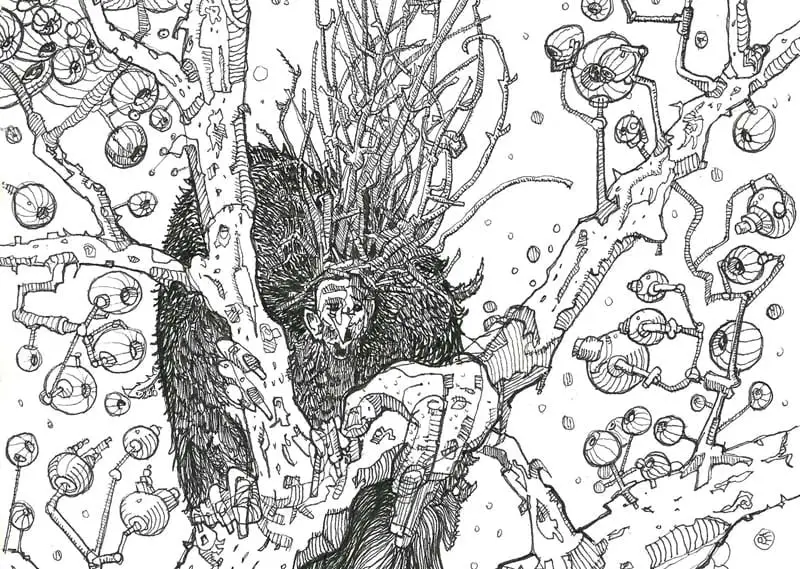
A snake dropped weightlessly from the rafter onto his chest, but this did not startle him overly. He passed his hands through it and could not touch it. He knew then that it was a delirium snake. But how could he be able to tell which of the snakes were real?
At the center of the story is a lawman named Johnny McAlester, who is hunting down a fugitive named Blocker. The pursuit takes him into the remote hills to the isolated town of Hochaton, known locally as Hoochy Town. McAlester discovers the town's true name and location on a map with the help of a trustee named Little Willy Wotby. Upon arriving, McAlester gathers information from a local man named Joe Lorimer over quarts of chock beer, playing along with Lorimer's assumption that he is a tax-sale land buyer in order to hide his identity as the law:
"You just waste your money. Isn't anyone in this country going to let an owner on a place. Mister, this is hog-law, open-range, fence-cutting, barn-burning country. Always has been. People who tax-buy farms for a hundred or so dollars and try to take claim of them get hurt."
The next day, McAlester bribes a young local woman, Little Jean Checotah, with more chock beer to learn Blocker's whereabouts. She directs him to Snake Cabin. It’s a decrepit place high up on the knuckles of Winding Stair Mountain. Jean says Blocker stays there a couple of nights a week. Leaving his car with a cattleman, McAlester hikes up the mountain and slips into the windowless, hillside cabin at dusk. He fortifies the door and sets up a warning system of dangling bells to alert him of any intruders. Gun nearby, he is settled in, using himself as bait.
The story then flips, with McAlester becoming the hunted—hunted by snakes. You see, when McAlester built a small fire and started waiting, the heat drew the rattlesnakes' attention. Before we know it, he is bitten on the hand by a rattlesnake. In manly fashion, he slashes the bite with a jackknife, makes a tourniquet, and sears the wound in his lantern flame. Then he realizes what he has done, that the heat has drawn a huge number of rattlesnakes out of hibernation from deep within the mountain's crevices.
McAlester now has to face the snake infestation, and things become more complicated. Blocker arrives on the roof to kill McAlester, drops a heavy cross-bar to lock the cabin door from the outside, and shouts a taunt. Trapped inside with a swelling arm and a rising fever, experiencing delusions, McAlester wraps his legs in strips of his jacket and blanket. He uses his rifle and a length of chain to fend off and kill the snakes that strike at him throughout what is a very long night.
Very near dawn, he gets lucky. A wild boar tears through the cabin's floorboards from the outside to hunt and eat the snakes. McAlester uses a chain and a broken chair to pry up the loose boards to let the animal inside. That causes surviving snakes to flee back into the mountain's crawl passages. Then the boar turns its aggression toward McAlester. He smashes his lit lantern over the animal, and that sets both the boar and the cabin on fire. It also allows McAlester to escape from the burning snake cabin.
Outside, he tackles a form hiding in the grass, which he thinks is Blocker, but it turns out to be Little Jean Checotah; she says she lied about Blocker using the cabin to draw McAlester into the snake den. She now agrees to take McAlester to Blocker, and it turns out he is dead. A rattlesnake bit him.
The whole thing ends with the small Indian girl shouldering Blocker's corpse for the three-mile trek down the mountain. She does it for a beer. Sick and stumbling, McAlester holds on to her hair, following from behind.
This is an unusual story in that it was a dead end. Lafferty writes against type here, in his version of the market-standard tough-guy style, and gives the reader about as straight a line through the action as one will find in him. A man goes hunting and discovers that he is not the predator. McAlester is clearly good at what he does, and Lafferty is careful to establish his competence. What makes it a Lafferty story is that the genre is being subverted. We hear of McAlester’s experience with every kind of game:
McAlester had been a small town deputy before he had been a city officer; and he had hunted many sorts of game: feathered, finned, bush-tailed, ring-tailed, clawed, horned, hoofed, fourlegged, two-legged. He could tell now that he was on the scent of the prey, and that the prey knew it.
Yet none of it matters once the snakes and then the wild boar appear. His bells, his rifle, his fieldcraft, his light sleeping, all of it is directed toward the wrong threat. He is ready for Blocker, but the mountain sends him snakes.
Blocker, who is also competent, gets the same surprise. He goes up on the roof to trap McAlester, then steps on a rattler warmed by McAlester’s fire and dies a few feet away. Neither man gets the confrontation he wants, and although there is little humor, the shape is that of a comedy of errors. Here are two men who are that one thing we find so often in Lafferty: a schizo-gash. There is little reason to think McAlester is superior to Blocker. He is just luckier, and perhaps slightly more willing to accept help from things he cannot control: the boar hog, Little Jean, daylight.
If there is a Lafferty twist here, it is that the story deconstructs the competent-man genre. What McAlester does either fails or becomes irrelevant. What saves him is deflating. The closing image of him is a deconstruction of the frontier hero in the mid-twentieth century:
The Indian girl shouldered the dead man, and they started down the knuckles of Winding Stair Mountain. [...] He was still sick, and he wobbled when he walked. Sometimes he held onto a handful of Little Jean's hair to steady himself. Sometimes he hung onto a heel of the dead Blocker. He followed them down to his car at the cattleman's.