Rechabitism in Past Master (1968)

Updated: Apr 3

“Are we still dangling on the thread, or has the thread been broken even before the official act (soon to be proposed) to break it? The Ancient Instruction was to go to All Nations. But we are not the Nations. We are something different. The Promise was that the Transcendent Thing would endure till the End of the World. But we are not the World. We are quite a different world, and no promise was ever given to us.”
“Nine snakes in my head! I won’t!" Thomas shouted. "It is not just four madmen in Cathead you’d be outlawing. I found about it only by accident, but there is a synagogue on Astrobe yet. It has between fifty and sixty members. There’s a mosque on Astrobe with thirteen members. There are several dozen of the old sects remaining, several of them with near a dozen members. There’s the green-robed monks of Saint Klingensmith still working in the feral strips. These are all good people, even if they are believers in outmoded things, and I see no reason to sentence them to death." "They are hundreds only, or less, out of billions. We break it,’ said Northprophet.
Today I was flipping through Past Master and remembered that the question of Rechabites confuses some readers, namely, why Northprophet and his cohort of devils are even called Rechabites. Most of the answer has been worked out by others. It has to do with the theme of possession (the Rechabites lived in tents) and with the history of anti-Catholic sentiment before and during Prohibition. But there is a larger picture. That is where this will go, but first, the two background pieces.
The Rechabites. They were a nomadic clan said to be descended from Jonadab, son of Rechab, who took a lifelong vow to abstain from wine, live in tents, and reject settled agricultural life. All three forms of self-denial were signs of obedience and moral discipline. In the Book of Jeremiah, God praises the Rechabites for faithfully keeping this vow across generations. It contrasts with Israel’s disobedience. Because of this Biblical story, later self-righteous prigs in temperance movements drew on the Rechabites as a sacred precedent for total abstinence from alcohol. There were Rechabite clubs, Rechabite politics, Rechabite ceremonies, and satire of the modern Rechabites. Though it started in England, it all got wrapped into the strangeness of American nineteenth-century lodge culture. At one point, probably half of American men belonged to lodges. This is an element of cultural amnesia. Had the most extreme forms of American Rechabitism been successful, there would have been no carve-outs for the sacramental use of wine in the Catholic Mass—and that takes us to Oklahoma:
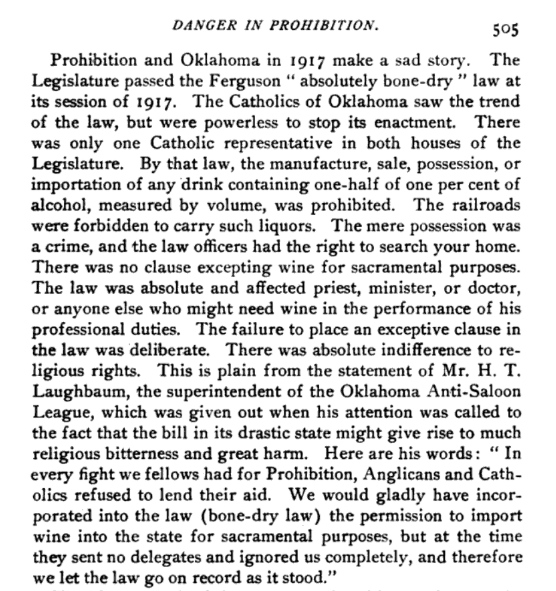
Prohibition in Oklahoma was baked in from the start. The 1907 constitution banned booze outright, and enforcement hardened with the 1917 Bone-Dry Law, which outlawed the manufacture, sale, and possession of alcohol. As you can see above, the 1917 law was a chin-flick to Catholics and high-church liturgies, a poke in the eye. These dry provisions were later reinforced by the federal Volstead regime during national Prohibition (1920–1933).
For Catholics, the ramifications are obvious. Although sacramental wine was eventually technically permitted, priests were required to obtain federal permits and to keep detailed records, placing parishes under surveillance and under suspicion. Appeals to the courts were necessary. In short, these laws reflected Protestant-led temperance politics and intensified religious tensions by treating Catholic worship as a narrow exception within the state’s moral order. One can draw a line from this history to the Ban the Beyond Act in Past Master.
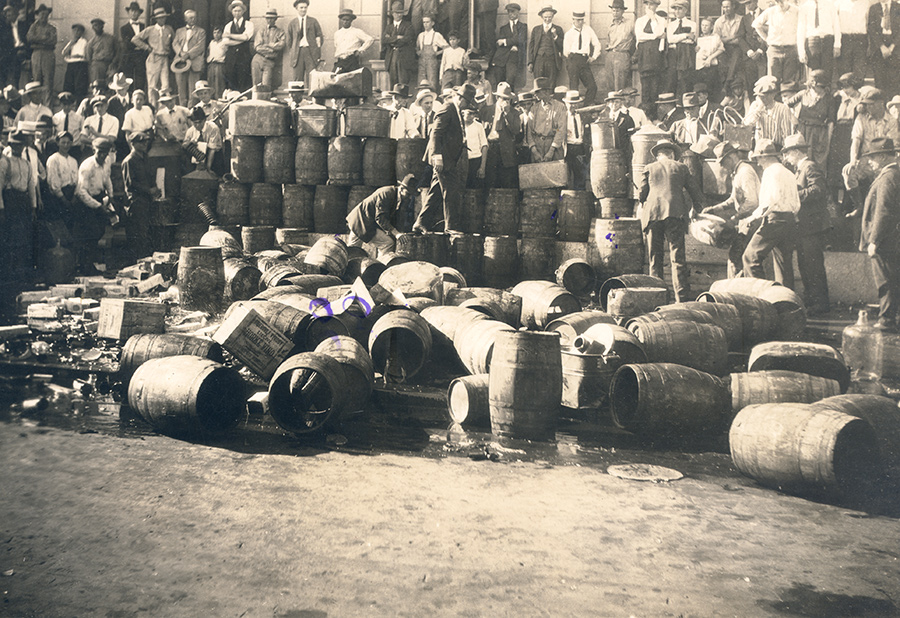
Doing so brings Northprophet’s role into focus. He heads one of the three sets of devils, and he wants to destroy the sacramental economy. While Past Master is an eschatological novel, the Ouden conspiracy attempts to evade the eschatological by extinguishing it. In place of the Alpha and Omega, there will be the Ouden Omega. Northprophet is the Programmed Person most closely associated with the Ban the Beyond Act, and he is primarily responsible for stamping out all forms of worship on Astrobe:
"I am Northprophet," said the leader of the second group. "My fellows here are Knobnoster and Beebonnet, and our specialty is rechabitism."
Later, Thomas notes:
"They should call it the Ban the Beyond Act," he said. Its very plausibility went against it. Why bother to enact such a thing? It wasn't needed. There was no reason at all for it. But somebody had gone to the trouble of trying to slip it past him.
"Aye, they'd forbid the thing even to cast a shadow any longer," he said.
In the degraded form of the mechanical Mass on Astrobe, Lafferty makes it a point to say that the wine has been switched out for grape juice, which is part of Programmed Persons’ attack on the liturgy:
At the Consecration, a sign lit up: "Brought to you Courtesy of Grailo Grape-Ape, the Finest of the Bogus Wines.“
Grape juice is, of course, unfermented. It is Dr. Welch’s Unfermented Wine. Past Master makes yeast its central symbol for change on Astrobe: a Christological image of enlivening leaven (“The kingdom of heaven is like unto leaven, which a woman took, and hid in three measures of meal, till the whole was leavened”). Yeast is obviously sine qua non in winemaking. It converts the natural sugars in Grailo Grape-Ape into alcohol and carbon dioxide, making juice into wine. In the novel, yeast is the principle of life and eschatological hope, and Ouden, along with the Programmed Person annihilation cult, is its enemy.
Rechabitism is therefore not incidental. It is not a curiosity. It is a central part of the novel’s conspiracy and its poetics, as one can see from various throughlines. We read of Thomas More’s group of eagles at Electric Mountain: “they drank in the view as though it were new apple-wine.” The Metropolitan of Astrobe defies Rechabitism. When Thomas meets him, he offers Thomas wine. Thomas pours the wine. As Thomas draws near his execution, he tells Fabian Foreman that Foreman is full of morning wine. And he is right.
The significance of “full of wine” should be clear if you have read the end of the novel. Foreman’s aim—though he receives the Lafferty spermagos treatment for the way he pursues it—has always been to bring forth the transcendental yeast. Foreman enables Paul’s plight to retrieve Thomas More. When Paul and Thomas meet, we read that “They burned oak and pitch-pine and yew in the open fire, and drank a little of the native. In that century, England still had a wine of its own.” That is what Astrobe lacks under Rechabitism. Of course, what followed the historical More's death was a Protestant story: further stripping of the altars. That historical trajectory culminated, in one of its developments, in low-church social gospels that had abandoned belief in the Real Presence through transubstantiation. The Independent Order of Rechabites was founded by Methodists in England in 1835. (Thomas Bramwell Welch was himself a Methodist.) Low-church movements like it saw no difficulty in Catholics substituting Grailo Grape-Ape or Dr. Welch’s products for wine in places like Tulsa, Oklahoma.
Foreman says:
"I don't know what goes on when a world dies; there must be, I believe, a bit of the transcendent yeast to make it rise again. Something must trigger a reaction. There was building a reaction to the 'Ban the Beyond' push, and the blood of the spotted lamb (yourself) will cinch it . . . Your death and the reaction to it will be the trigger, the mustard seed, We plant it now."
"I know it!" Evita sang. "I'm a bunch of that transcendent yeast. I'm the heart of that furious reaction! I revel in it. And we've had a dog for puppeteer all this late time. No wonder it's been a time of trouble."
The Rechabites’ role among the devils lies between extrapolation and projection and constitutes one of the novel’s central conspiratorial plots. How does one cut a civilization off from its sources? How does one destroy communion with the sacred by emptying its mediating forms? Like Ouden, Rechabitism is a structuring element of the book. It is one of Lafferty’s statements about the spirit of Antichrist: the distortion of the past (extrapolation), the manufacture of a false future (projection), and the severing of people from the sources of spirit. To treat it as incidental, or mainly as a symptom of Lafferty’s fondness for a drink or two, as I have seen said, would be a serious misreading.