Past Master: Chapters 6 & 7

Updated: Nov 7
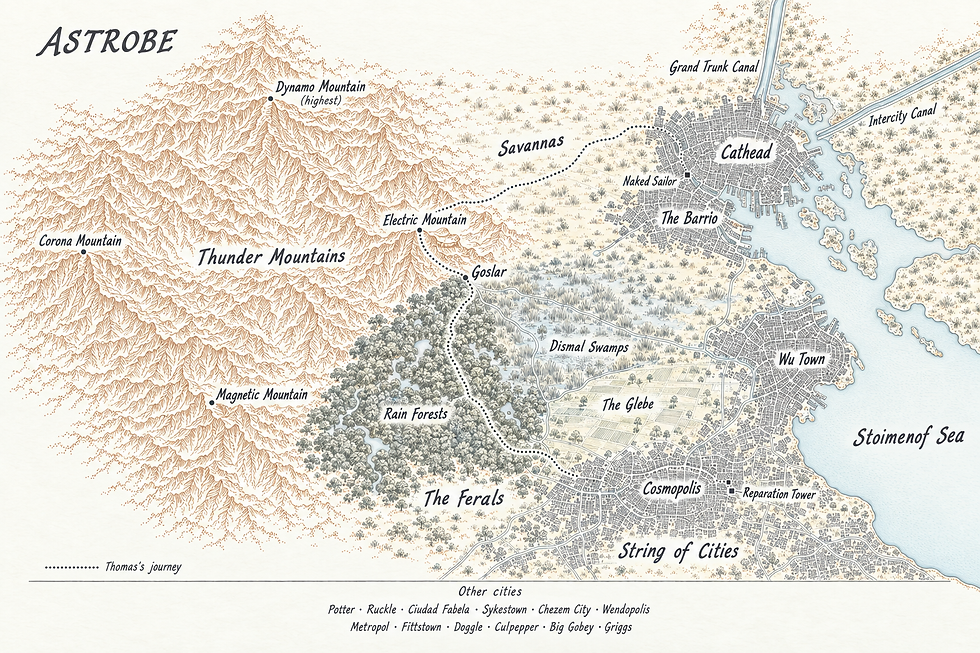
In the rough diamond between them was a country so harsh as to make even the feral strips look tame. This was deeply muscled country that had sinuous depths and involved hills and ramparts. It was prototype nightmare country where everything was bigger and woolier. It was heap upon heap, and spires rising in clusters to the cross-buttressed heights of the mountains. And now, as the darkness began more to deepen, all the high places were outlined with an electric blue glow.— Chapter 7
Lightning, a billion times as bright as that on Electric Mountain, a billion times as short in duration, does it lace the things together with its instantaneous fire, or sunder them forever? Thunder that flattens worlds with the shock of it, and a tidal wave, a world wave carrying away the golden fungus from the orb! In much less than an instant, in much more than forever, it is over with. — Chapter 13
I've been thinking more today about Petersen’s exposition of Chapters 6 and 7 of Past Master (LINK). I think these chapters anticipate the novel’s final moments. The image and table below extend my earlier discussion of spiritual and temporal authority in the novel.
Another relation worth considering is that between the Book of Nature and the Book of Revelation: creation as a means of knowing God, and truths received through revelation. Romans 1:20 supplies a scriptural basis for the first of these.
The two books are a way of distinguishing natural knowledge from revealed truth. Here, Book of Revelation names the latter category; it does not mean only the biblical Apocalypse. I want to connect this distinction with spiritual and temporal authority in the novel.
I propose reading Charles and Oddopter through the relation of emperor and church, and the feral lands and their disclosures through nature and revelation. Adam and Evita complicate this arrangement. The four mountains suggest a corresponding structure, though I do not take the table as a complete key to the characters.
Thomas More stands within these relations, sometimes misunderstanding them and sometimes resisting what they demand. His position needs a fuller account than this table can provide.
I read the rough diamond between the mountains as an anticipation of the final chapter. Chapter 7 lets the travelers see its structure from outside. The final catastrophe brings the corresponding forces upon the whole world. The relation between those scenes matters to any account of Astrobe’s possible rebirth.
Evita, as the female mountain, is a major part of the transcendent yeast—transcendent in the sense of being a necessary condition of possibility, one of four lightning rods for its primal discharge. I can see how the interior of the rough diamond-shaped space is an image of primordial nature. I would argue that its defining points are just as significant, ensuring that we have both ground and figure.

This is an interpretive comparison. The distinction between spiritual and temporal guidance follows Dante, Monarchia III.16; the events are drawn from Past Master, chapters 6–7.


