More "Narrow Valley"

“Your analogy is a little strained,” Mary Mabel said. “Those Indians we saw in Florida and the ones at Atlantic City had war bonnets, and they couldn't very well have been the kind of Sioux you said. And just last night on the TV in the motel, those Massachusetts Indians put a war bonnet on the President and called him the Great White Father. You mean to tell me that they were all phonies? Hey, who's laughing at who here?”
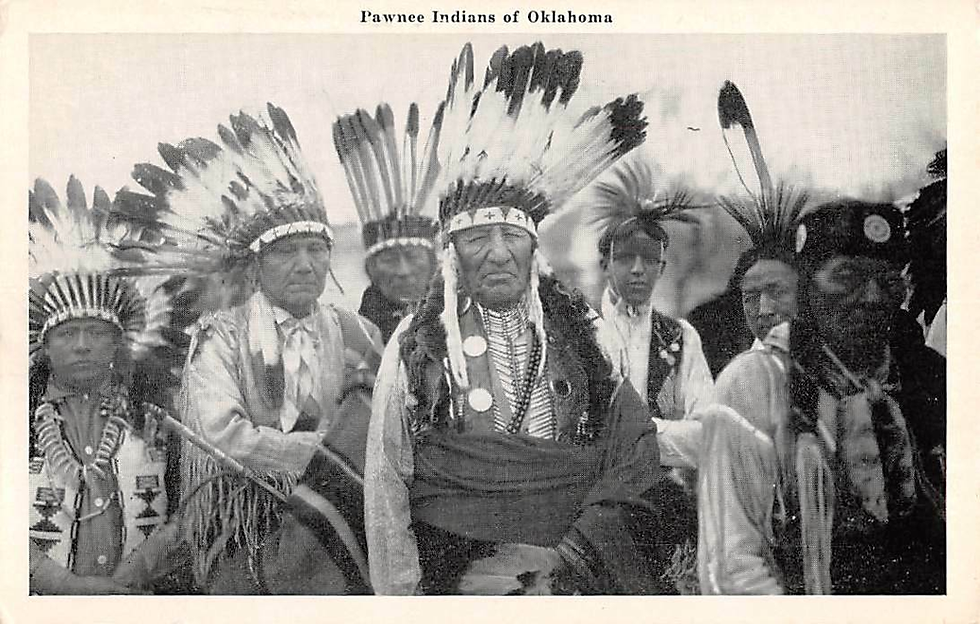
You can tell a lot about a writer by what he chooses to celebrate. There is a grim backstory underlying this tale and Lafferty, who knew Oklahoma history inside and out, was well aware of it. In the early seventeenth century, there were sixty thousand Pawnee in possession of a great deal of land and by 1875 . . . well, you can read that for yourself in the opening sentence. — Michael Swanwick, The Best of R. A. Lafferty
Working on an idea for a cut-out animated version of “Narrow Valley” led me back to the story’s historical background. Here are a few notes on that history.
The allotment behind the story’s premise grew out of the Dawes Act of 1887, which authorized the division of collectively held tribal lands into individual holdings. The Pawnee agreement was signed on November 23, 1892, and ratified by Congress on March 3, 1893. It confirmed individual allotments and ceded the remaining reservation land to the United States for payment, opening land classified as surplus to white settlement. Such is the original sin behind the story. And if that wasn’t bad enough, the Pawnee had already lost their Nebraska homeland and moved to Indian Territory in the 1870s. Clarence Big-Saddle’s choice of a valley thus takes place during a second dispossession. Federal records count 821 Pawnee allotment recipients, the number Lafferty uses.

The Pawnee ratified their constitution on January 6, 1938, when Lafferty was twenty-three. It came out of the federal government’s retreat from allotment and compulsory assimilation during the New Deal. Four years earlier, the Indian Reorganization Act had encouraged tribal self-government; the Oklahoma Indian Welfare Act of June 26, 1936, set out a corresponding framework for Oklahoma tribes. Under that law, the Pawnee adopted their constitution by 197 votes to 60, following federal approval on November 26, 1937.
The constitution opened a new phase of Pawnee life. First, it created an eight-member Business Council; second, it kept the Nasharo Council in place, with two representatives from each of the four Pawnee bands and authority to review decisions about membership and treaty-related claims and rights. After decades of removal, allotment, and federal interference, it gave Pawnee government a new legal form while retaining the bands’ place within it. Federal supervision stayed in place, but this was a small measure of restorative justice. The constitution also contains two band names that appear in Lafferty’s story, “Kitkehahke” and “Petahauerat.”