"McGruder's Marvels" (1968/1968)

Updated: 2 days ago

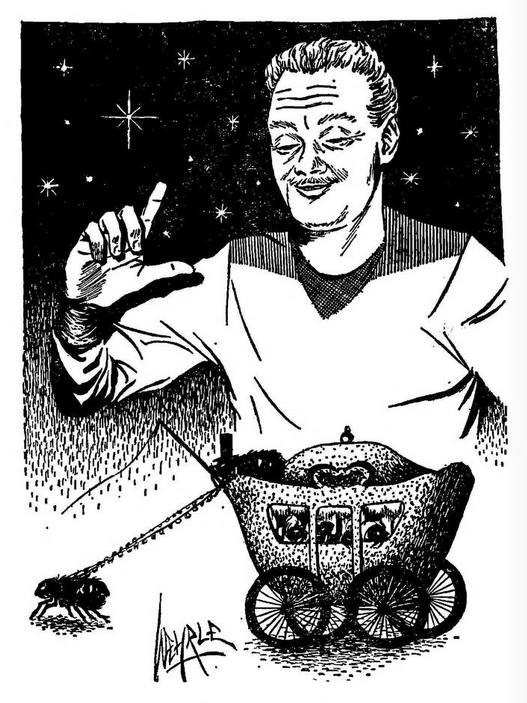
"The Covenant,” it said. “Large, hard-roasted, de-oiled, white peanuts under the Goober John trade name. Three a day, and they must be Goober John Number Ones. Failure to provide them will void the Covenant.” “There will be no failure,” said Malcomb ‘the Marvelous’McGruder. “It shall be done.” “We like-stuff pledge fulfill the Covenant,” it said.
In his review of The Best of R. A. Lafferty for the Los Angeles Review of Books, Matt Keely writes:
“Lafferty was an electrical engineer by trade, and I know of no irregularities in his work life: as far as I know, every circuit he laid was closed, every wire he ran was properly insulated. But though Lafferty adhered to safety regulations in his job, in his vocation of literature — and Catholics (Lafferty was devoted to his faith) carefully distinguish between “job” and “vocation” — he aimed to electrify.”
Poor Lafferty. He sold parts for Clark Electrical Supply Co. He took an ICS correspondence course before the war. Somewhere between fact and retelling, it turns into a game of telephone, then a clean forward takeoff, and then a full triple axel of bullshit.

I was reminded of Keely today because of how much that kind of tail wagging irritates me, and because “McGruder’s Marvels” is one of the stories in which Lafferty's work converges with his fiction. In the years when Lafferty was selling parts at Clark’s, the world of electronics went through rapid miniaturization.
The big landmark was Bell Labs’ transistor in 1947–48 and the more practical junction transistor of 1948–51. Then there was the move to silicon transistors and the Regency TR-1 transistor radio in 1954, the integrated-circuit breakthrough with Jack Kilby’s 1958 solid circuit, plus Jean Hoerni’s planar process and Robert Noyce’s 1959 monolithic IC. The first commercial and planar integrated circuits came out in 1960. Standardized logic families, such as TTL, were introduced in 1963. Then, in 1965, one of the big moments: Gordon Moore’s 1965 prediction of rapidly rising chip density, the famous Moore’s Law.
And now we are in a world where the future of humanity probably depends on Nvidia chips and the black boxes that are behind much of post-transformer AI. As Dario Amodei of Anthropic said not so long ago, we “do not understand how our own AI creations work.” That, too, is relevant to “McGruder’s Marvels,” a story all about technological miniaturization and hubris.
This time, Lafferty gives us a story set in what appears to be the near future. The United States is behind the eight-ball and losing a technological arms race. Now facing imminent destruction and needing a micro-miniaturized control station within two weeks to save the nation, Colonels Ludenschlager, Dinneen, and Schachmeister have to find a solution. So they review four defense bids. The first three are major corporate contractors—Micro Machinists Amalgamated, Intensive Instrumentation, and Dow-Mec-Tech. They are all asking for millions of dollars and approximately two years to build the bullet brain (eraser-sized) devices.
But there is a fourth bid, and it is different. M. “M.” McGruder says that he will provide the device for $24.00 within 24 hours. Colonel Schachmeister recognizes McGruder as being perhaps the former operator of a miniature flea circus in Manhattan, and he visits McGruder’s rundown Washington, D.C., address to investigate.
At the shop, McGruder won’t explain the exact manufacturing process. He just says that he subcontracts the work to unseen, microscopic associates of smaller and smaller orders. Schachmeister purchases it for $24.00 and tests it in a secret military laboratory. It functions perfectly, handling thirteen simultaneous data flows. The military will deploy thirty of these stations very soon, paralyzing the enemy's programs. There is a catch, though. McGruder’s Marvels only work under a strict agreement called "The Covenant," which requires a daily provision of exactly three Goober John Number One brand peanuts to keep working.
The colonels are now on the brink of using the marvels to rule the world, a delusion Lafferty explicitly diagnoses:
“We be the lords of the world now,” cried Colonel Schachmeister... “We will shape the whole world like clay in our hands. We will run the world now, and all must come down to our spring to drink.” The Greeks named it hybris. And in the Ozarks they call it Peacock Fever. It was Pride. It was the Grand Arrogance, the Warrantless Assumption, the bursting summertime of Giant Pride. And it would have its fall.
But peanuts are running low, so McGruder goes to purchase more and finds the Goober John Number One out of stock. He swaps them with Arizona Spanish Peanuts. It is a huge mistake, prompting a pseudo-biblical judgment from the devices:
“The Covenant!” it thundered like acorns rattling on the roof... “These aren't Goober John Number Ones!” . . . “The Covenant is voided!” it said sadly. “The involvement with humanity is ended.”
All the control stations shut down. Enemy attacks begin to obliterate the city. Schachmeister rushes back to McGruder, who says that the devices never contained any actual mechanical works. They were worked by seven orders of ever-smaller associates, someone one of his fleas introduced him to in the flea-circus days.

A real digression. I did not know much about flea circuses, but since they turn up in Lafferty from time to time, I went down a rabbit hole. The real flea circuses died out at the beginning of the twentieth century. They began in the sixteenth century as a technical showpiece. Artisans who made tiny metal marvels (think of the clockwork mechanics and automata of the period) harnessed human fleas to pull them. With wire harnesses. The point was to prove how light and finely crafted their metal creations were and to showcase the artistry. At bottom, they were a gimmick. Put a wire on a flea.
In the nineteenth century, the idea took on a life of its own. There was a whole period of flea-circus legends, among them Louis Bertolotto, who helped turn flea acts into popular entertainment. A piece by the Royal Entomological Society argues that the flea circus died out after World War II, as improved household hygiene and widespread vacuum use reduced flea populations. The flea circus phenomenon depended on the strength and jumping ability of the human fleas (Pulex irritans). Those fleas produce a protein that makes them especially strong jumpers, and dog and cat fleas just can't sustain the circus acts. I'll add that I suspect mass media also contributed to the flea circus's demise.

I suspect that “McGruder’s Marvels” is a fun story for most readers who will see it as a piece of whimsy. The only review of it I could find online says, “If I hadn't known this story was written by Lafferty, I'd still have guessed it was written by Lafferty. After all, he and whimsy are old companions. It's more of an F&SF fantasy than SF, but it at least has the virtue of being memorable. Three stars.”
Lafferty invites this because he is damn smart and cagey, but, as usual, there is method behind the madness. The goobers’ name, John Number One, is a fairly obvious allusion to John 1 and the hymn to the Word, and the breaking of the Covenant speaks for itself.

Serious Lafferty is here.
Very few people are going to drill down on esoteric Lafferty in a story like this, but what can I say? Someone ought to. It looks to me like Lafferty is blending the bizarre history of the flea circus with the theological weight of the Gospel of John to mock the modern fetishization of technology, and he is using his firsthand experience as a parts salesman who lived through miniaturization and microminiaturization to do it.
The military assumes it has an advanced black box panacea, but the machine depends on hidden truths. The Covenant is the sacred bond between the unseen world and ours, yet another version of sacramental poesis in Lafferty (three peanuts). When the authentic “John Number One,” the animating Word of the black box, the Incarnation and New Covenant of the Prologue to the Gospel of St. John (where Lafferty gets Ouden's name, btw), is replaced by a substitute, the Covenant is broken on man's side.
It is a light story, yet it ends in a fiery, violent apocalypse, with streets melting and people on fire. Exoteric genre readers think they have seen a modern version of something like a flea circus, and then they stop thinking. And none of it is really that hidden. “John Number One” is something a remedial Baptist sword driller from Slapout, Alabama, would spot in half a second. Seasoned Lafferty readers miss it. Not knowing the wiring is how you get electrocuted.