"Maybe Jones and the City" (1964/1968)

Updated: 1 day ago

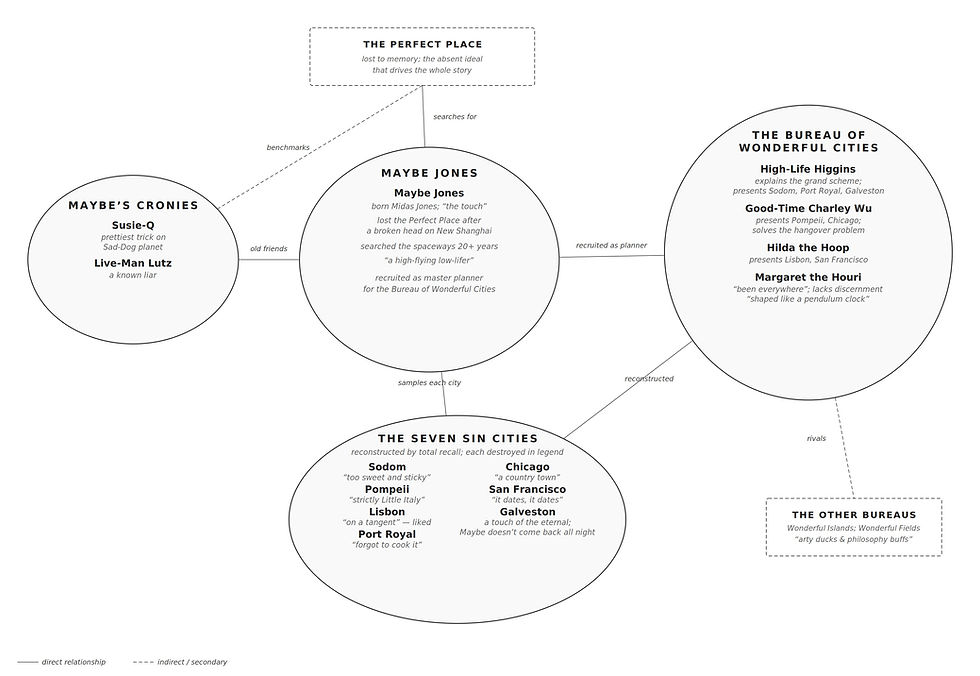
And there was a small bureau set up for that smallgroup of folks who may perhaps have slight flaws in theircharacters — the golden flaw, as Maybe Jones once called it.This small bureau was to plan the future for the good-timecrowd who could not be reformed into the sanctioned mold.
My favorite work by Jonathan Swift is his 1704 A Tale of a Tub, a work about which readers disagree in fundamental ways and about which there will never be agreement. That readers arrive at different interpretations of texts is a platitude. “Maybe Jones and the City,” and Lafferty’s ironies more broadly, have me thinking about this. As Lafferty readers know, he is about as ironic a writer as one will find, far more ironic than genre fiction usually tolerates.
The SFE entry on him has a line that neatly indexes those ironies. Clute writes that Lafferty “has been understood by some as essentially light-hearted and by others as a solitary, stringent moralist.” The irony is that Lafferty is both, and because his ironies are so demanding, most readers find it hard to keep both aspects in view at once.
If you read this blog, you know that I think Lafferty developed strategies that allow readers to engage those ironies, and one of the most important is counterfiguration. “Maybe Jones and the City” is a more traditionally satirical story than most of what Lafferty writes, and it is puzzling that it has not been recognized as such. I will summarize it and then go through some of how I think it works, though it may be that, as with Swift’s A Tale of a Tub, what looks to me like a plainly satirical strategy and a series of ironic moves may look to you like something else, perhaps something more ambivalent.
“Maybe Jones” was written in 1964 but published in 1968, the same year as Space Chantey, and no half-knowledgeable Lafferty reader is going to miss the association. But I would suggest reading the story as if it belonged to one of Lafferty’s parallel tracks of fictional reality rather than to the Space Chantey universe, because much of it does not match up.
In “Maybe Jones,” humanity has cured mortality and achieved physical immortality, so society begins organizing itself into bureaucratic committees to design and construct customized versions of the afterlife. After all, the afterlife is now here among us. Lafferty had played earlier with solving the death problem in a science-fiction setting, though not quite successfully, as in “Panic Flight.” Here, however, most of the population plans peaceful, pastoral eternities through agencies such as the Bureau of Wonderful Islands and the Bureau of Wonderful Fields. There is, however, a wrinkle. A smaller faction of hedonistic nonconformists forms the Bureau of Wonderful Cities. Lafferty writes,
"And there was a small bureau set up for that small group of folks who may perhaps have slight flaws in their characters — the golden flaw, as Maybe Jones once called it. This small bureau was to plan the future for the good-time crowd who could not be reformed into the sanctioned mold."
Among this group is Maybe Jones, the man who once discovered the Perfect Place. The Perfect Place is like Cockaigne: a consequence-free place of endless revelry. Unfortunately, Maybe Jones doesn’t know how to get back. After seeing the place, he went to New Shanghai, was hit on the head, and lost the coordinates. Now he has spent two decades following false directions across the galaxy to find it again.
Meet the planners at the Bureau of Wonderful Cities. To help Jones recover his lost memories so they can build a new version of his paradise, they use "total recall" technology to digitally resurrect the Seven Sin Cities of Earth's history. Jones visits simulations of Sodom, Pompeii, Lisbon, Port Royal, Chicago, San Francisco, and Galveston. He samples each location just before it was historically destroyed by a catastrophe. As he tours these pleasure centers, Jones judges their offerings and largely finds them lacking, dismissing them as too crude, adolescent, antiquated, and so forth, to serve as a sustainable environment for immortal revelers.
The final simulation is of pre-hurricane Galveston. It is closer. Maybe Jones can get back to the Perfect Place through a substitute. Returning from the simulation, Jones reveals exactly what kind of morbid inspiration makes this town the perfect foundation for his eternal paradise:
“It's put me in the mood,” he cried. “I'm ready to go to work. Hey, that place has a touch of the eternal! I found a way to tune it and visited Galveston in earlier and later years. I picked up an interesting piece of history too. You know, they never did bury any of the dead people after the hurricanes and tidal waves. They just ground them up and sold them for crab-meat sandwiches. Well, let's go to work.”
Armed with this recovered, grotesque knowledge, he enthusiastically begins drafting the blueprints for a new, engineered pleasure-city titled "The Empyrean According to Maybe Jones.” There won’t be hangovers. There will be mile-long bars and girls built like clepsydras. The story ends with a call to action for the reader.
The first thing I’d note about this story is the characters breaking the fourth wall. Usually, it’s Lafferty’s narrator, using his pragmatic marker trick. This time, though, it’s a collective. Lafferty writes:
Listen, you high-old-time people, make your wants known now. They're building the place, and they'll put in anything you suggest. Funds are available. Lots of those peace-and-benevolence folks have made perpetual donations for those persons less fortunate than themselves in their aspirations. Less fortunate than—from where we stand, that's a joke, isn't it? There is time, but barely. Tell them what you want them to put in. Act now!
If one wants to understand this story, I think one has to put some pressure on the “Less fortunate than—from where we stand, that’s a joke, isn’t it?” This is what readers of the story seem to miss. In my reading, this is a joke because the voice comes from some very unfortunate place. Lafferty is going to keep it ambiguous, but this voice that is talking to itself, that in fact breaks its pitch and accidentally lets us overhear it, is one of Lafferty’s sets of devils.
There are many reasons to suspect this, not least of which is how judgment has been conspicuously removed from the four final things in the story, which become the three final things of immortality, heaven, and hell, with hell just being the other people’s versions of heaven. High-Life Higgins explicitly outlines this blasphemous theological restructuring:
“The pitch is this,” said High-Life Higgins, after they had eaten and drunk and made cheer to excess. “We have now arrived at the three ultimates: Immortality, Heaven, Hell. We have just achieved the first of them. We are now setting up projects to construct the other two, on the premise that one man's Heaven is another man's Hell. We must build final enclaves for people of every choice. We cannot sit idly by and ask what we would do with the after-life. This is the after-life.”
Let’s consider two of these clues: the nature of the cities and the story’s most important use of counterfiguration.
The seven cities in the story are versions of the notorious cities of the plain. What were they? Most people can rattle off two of them, but there were five cities named in Genesis 14:2: Sodom, Gomorrah, Admah, Zeboiim, and Bela (that is, Zoar). They were in the Jordan Plain/Valley, as described in Genesis 13:10–12. In the story, Lot chooses the well-watered Jordan region and lives among those cities.
Their destruction is narrated in Genesis 19:24–25, where the Lord destroys Sodom and Gomorrah and overturns the cities of the valley/plain. Zoar is the exception: Lot asks to flee there, so it was spared for him in Genesis 19:20–23 (see also Genesis 19:30). The four-city pattern of judgment—Sodom, Gomorrah, Admah, and Zeboiim—is repeated later in Deuteronomy 29:23.

Jones has what we might call a Lot problem. He can’t help but look back. In the story, he visits each of the seven cities just before they are destroyed. One of Lafferty’s tricks is to just brush past the nature of the destruction as natural events rather than acts of divine judgment. Good-Time Charley Wu explains their methodology this way:
“By our total recall methods we are able to reconstruct the Seven Sin Cities of History, Jones. They are the folk dreams that have also been raucous facts . . . But they were such a hopping bunch of towns that (under the old recension) they had to be destroyed: by blast-from-Heaven, lava-flow, earthquake, sinking-in-the-sea, cow-fire, earthquake again and fire, hurricane and tidal wave. They were too hot to last.”
He fills our attention with the high life of prostitutes and high times. Just to be clear, I am not saying that places such as Galveston, Texas, experienced divine judgment. What I am saying is that Lafferty knows he is using the tropology of the cities of the plain in this story, and writing it as if there could be no consequences, that judgment is not a problem. But, of course, it is. All of the cities that Jones visited were destroyed. Why will the city that Jones builds not also be destroyed? The answer Lafferty invites is that it will absolutely be destroyed. The invitation to rebuild Sodom is about as smart as investing in the Tower of Babel Construction Company.
I think all this is enough to make one recognize the story’s satirical norm and to grow suspicious of the voice urging one to Act Now, but what seals it for me is the counterfiguration of fire. This is not a story about heaven or the earthly paradise.
The Empyrean, the highest heaven in Dante’s Paradiso, the sphere of pure divine fire where the soul rests in God, is identified by the Bureau of Wonderful Cities with places like Sodom. There is no way Lafferty is not being highly ironic. High-Life Higgins says they hold “the Empyrean, the eternal fire-stuff,” and Maybe Jones, as I said, calls his blueprint “The Empyrean According to Maybe Jones.” The counterfiguration turns on fire’s double valence in Christian theology: the same fire is divine love or hellish torment, depending on one’s ordered relation to God.
Every one of the Seven Sin Cities was destroyed by fire or one of its cognates: blast from Heaven, lava, earthquake, sinking, cow fire, hurricane. What is razed by the divine fire of God’s love as angry is celebrated. Sodom becomes a pleasure destination, not a toponym for what God hates.
As if all this were not clear enough, there is the golden flaw. All idolatry, of course, is a worship of the created rather than the Creator, and the great instance of this in the tradition is the Golden Calf of Exodus. And for whom is the bureau established? For people with the golden flaw, “the good-time crowd who could not be reformed into the sanctioned mold.” There, Lafferty is plainly punning on sanctioned and sanctified. This golden flaw is also why Maybe's real name is Midas.