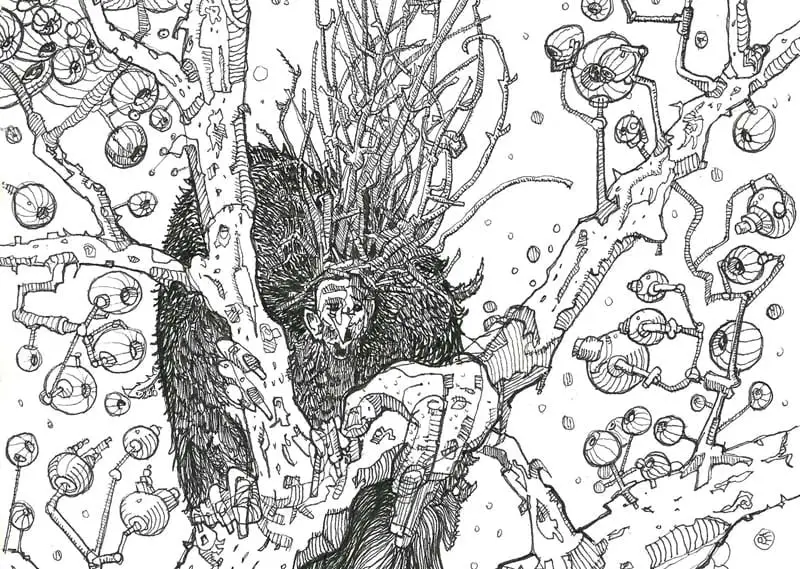
"Lord Torpedo, Lord Gyroscope" (1976/1980)

Updated: 14 hours ago

In such a context . . . the values of being are replaced by those of having. The only goal which counts is the pursuit of one's own material well-being. The so-called "quality of life" is interpreted primarily or exclusively as economic efficiency, inordinate consumerism, physical beauty and pleasure, to the neglect of the more profound dimensions . . . of existence. . . . Within this same cultural climate . . . interpersonal relations are seriously impoverished. The first to be harmed are women, children, the sick or suffering, and the elderly. The criterion of personal dignity—which demands respect, generosity and service—is replaced by the criterion of efficiency, functionality and usefulness: others are considered not for what they "are," but for what they "have, do and produce." This is the supremacy of the strong over the weak. — Evangelium Vitae, Paragraph 23
He was like a roaring river in his relentless activity and in his constant consuming.
Whatever else it is, “Lord Torpedo, Lord Gyroscope” is an assault on Flatland and late modernity. Karl Riproar is one of Lafferty’s great images of a historical process depicted as a fictional character, which makes it one of Lafferty’s allegories. I situate it within the whole Lafferty inside Lafferty’s sequence of stories about the law of intellectual constancy; this is a horror-story version of the Law, with the Law being used to erode spiritual and cultural goods with no sign of occult compensation. It’s dark.
The story also hooks in with Lafferty's broader use of angular momentum and angular velocity. The ideas seem to fascinate 1970s Lafferty as a symbol for late modernity. Whenever he talks about this, I picture the hanging, spinning wheel from a physics class and the strong impression the experiment made on me as a student. In the unpublished novel Iron Tongue of Midnight, angular velocity drives the world mad. Lafferty writes, “A vessel with the contingent name of ‘The Angular Velocity of Psychic Accumulation’ reached its breaking point and broke, and the world itself was altered in its dispositions.”
The story has many satiric targets: the "great man" as parasite, which is a major theme in Not to Mention Camels; the fallacy of niceness as goodness, a major Lafferty theme (Lafferty was a nice man who did not write nice stories); the nightmare of coordination as monstrous efficiency; the self-validating, self-sealing nature of diabolical power; and the narcissism of modern progress as a death drive.
At the center of it all is Karl Riproar. Karl is born to Epstein Riproar and Nastasia Hectic-Smith, two genetic mutants who manufacture human torpedoes—high-speed assassins. At one day old, Karl undergoes surgical enhancement to double his activity and intelligence; however, a chemist’s error occurs. He is given a “nice-guy drug” called Melerex-X instead of an aggressive stimulant that would make him an icy murderer.
Both of his parents die in a shootout when he is an infant, and Karl is raised in a progressive school where he displays the ability to perform up to twelve tasks simultaneously. He can read three books, watch three television sets, and eat at a startling rate. He is a wunderkind in every academic and athletic pursuit. Lafferty illustrates this hyperactivity in a scene from Karl's childhood:
A recollection of him when he was about six years old has him sitting at table and shoveling it in at a startling rate, but he was doing many other things at the same time. He had an earplug in each ear, and they were receiving two different instructional programs. There were three TV sets before him, two of the programs being educational and the other one being that whanging presentation of violence and adventure and relentless activity ‘The Restless Ones’. Karl had a dictaphone turned onto himself, and he was talking and singing around his food, putting out an amazing spate of entertainment from his ‘consciousness three’ level. He was also reading one book and one newspaper by eye, and reading another book by Braille.
And as a child still, he meets his match, Emily Vortex. She has a similar hyperactive ability, and she defeats him in a metric mile by cheating—but cheating in style. There is a bolo involved.
During his youth, Karl is called “Lord Torpedo” for his speed and “Lord Gyroscope” for his high-speed mental rotation to predict stock market trends. Near his fifteenth birthday, he marries Emily Vortex. He calls himself the Ultra-Departmental Director of the city. He founds several enterprises, including the Imperial Compressed Music Company and the Pleasant Meadows Home Development Project. Karl and Emily live in a manor on Torpedo Mountain, where they experience life at a compressed rate. Each of them performs thousands of minutes of activity per hour. Secretly, they siphon psychic energy from the “genius sheep” who live in their housing development.
This brings forth an investigation by the Chairman of the Environmental Quality Board. He visits the Riproar manor to confront the couple. The Chairman realizes they are psychic vampires and tries to summon backup by blowing a specialized alarm whistle. Karl thwarts this by using ventriloquism to manipulate the sound into a pleasant tune that signals an “all clear” to the Chairman’s associates.
Emily rejects the Chairman’s judgment. She says that she and Karl are special cases. All the while, Karl is performing multiple artistic and academic tasks. The Chairman begins to feel giddy and weakened. Karl uses a nasal plug to inhale the man’s remaining “energy and pleasure potential.” The Chairman weakens and dies, and the couple waits for a doctor’s lorry to collect his body.
Again, this is another Lafferty story that draws on one of his richest sources of story-ideas: the Law of Intellectual Constancy. He came across the idea in Havelock Ellis, who adapted it from Rémy de Gourmont. The idea holds that the human species has a fixed intellectual budget. In “Lord Torpedo, Lord Gyroscope,” Lafferty takes this Law and uses it to criticize the frenetic pace and logic of modernity. Modernity praises velocity, efficiency, and quantity relative to each other, but not relative to other social goods in the human community, all oriented to something higher.
His image for it is the conservation of angular momentum. Wrangler Hoxie says, “All that angular momentum that is consumed has to come from somewhere.” This is just the Law imagined in mechanical terms. If Karl Riproar spins at superhuman velocity—experiencing 216,000 minutes per hour and doing twelve things simultaneously—then that energy gets siphoned from the intellectual budget of humanity. “It comes from the sheep—the pleasant genius sheep of Pleasant Meadows.” Specifically, it comes from the 3,000 genius families who populate Karl’s intellectual paradise. They are livestock, drained of their ichor so that Karl and Emily can flourish. Karl explains the source of his vitality to the Chairman:
“Where does all that personal and psychic energy, all that angular momentum come from?” the board chairman asked. “You consume colossal amounts of it.” “Oh, it comes from the sheep,” Karl said, “from the pleasant genius sheep of Pleasant Meadows. We shear them but we do not butcher them. Why were you not afraid to come here alone?” [...] “You are vampires,” the board chairman said. “The energy consumed by your dazzling simultaneities comes from the blood of others.” “Not from blood, from ichor,” Karl Riproar said.
This is itself ironic, because Lafferty is also criticizing the elitism of those 3,000 families. They are moderns, destroyed by their own values. They allow themselves to be herded and shorn. It just so happens that Karl and Emily are incredibly advanced mutant forms of the modern value set. It is not so much that Karl and Emily are exceptional in themselves, though they are. They are also the best thieves and despoilers, the values as a dynamo. The story flips Lafferty’s statement in the Argo Legend that “the human race is made up entirely of glowing geniuses” into horror: what happens if that glow can be dimmed like slowly sliding down a light switch until the room darkens?
The Chairman of the Environmental Quality Board could be called the Chairman of Flatland. Environmental quality has been altered by the new gods of torpedo and gyroscope. Karl and Emily are modernity’s ideals made monstrous. They are hyperproductive, efficient, and optimized. They consume experience at maximum bandwidth. They do twelve things at once. They compress three-hour symphonies into microseconds. They achieve 216,000 minutes per hour. They break their lovemaking down to efficient units of twenty seconds. They even regiment their nightly dreams. The couple's philosophy is rooted in the belief that the value of life is found in its sheer volume:
"The quality [of life] is always predicated on the quantity. The more life there is the better it is. The abundance of it is the whole thing. It cannot be rich and detailed if it isn't abundant. [...] Three-hour-long works of limpid melody can be turned to ultra-high speed and then compressed and solidified into mere micro-seconds, into depth-moments of total enjoyment and no duration at all. These compressions can be enjoyed, one or ten or ten thousand of them, exquisite morsels for the sensually-educated elite."
If there were any doubt that the story is criticizing modernity and the modern person—the best of whom could only be cheapjack versions of Karl and Emily—Lafferty tips his hand early with the progressive institution that educates the two as children. Its wranglers and rhetors and monitors (not teachers) are a Flatland factory. They measure “attainment levels” and manufacture human capital. Pleasant Meadows is its adult form: a meadow-flat community of modern geniuses who exist to be drained. The vampirism of the story is deracination and anomie-induction.
Lafferty is making a point about spiritual goods. There is an ironic similarity to one of the great passages in Karl Marx: “Capital is dead labour, which, vampire-like, lives only by sucking living labour, and lives the more, the more labour it sucks.” But there is a difference.
Lafferty tries to make it clear that the goods are, in fact, not materialist but spiritual by doing something a little obscure. It boils down to one curious word. Marx’s metaphor was blood as the symbol of labor. It was a materialist social ontology about how abstract labor value is created in the production system, not inside the sphere of exchange.
Lafferty is unambiguous that what Karl and Emily feed on is ichor. Ichor is, of course, not blood. It is the ethereal, golden fluid that flows in the veins of the Greek gods, the divine counterpart to mortal blood. In “Lord Torpedo, Lord Gyroscope,” it seems to pick out the old animating essence and lebenswelten that came before Flatland: the language, art, morality, memory, ritual, and other sacred things that are siphoned away by torpedo and gyroscope, because everything is now product, and everything exists to be consumed.
Karl and Emily are whirligigs of competition and vampirism, but their victims experience both as a slow bleed-out. Lafferty’s message is: it’s happening to you, right now.