"Last Laugh" (1963)

Updated: 2 days ago

“. . . the greater and more unexpected [. . .] this incongruity is, the more violent will be his laughter.” —Arthur Schopenhauer, The World as Will and Representation (1818), vol. I, §13
There was something futile in all this gushing blood and smashed transistors. The calculating Programmed remained comfortably ahead of the Jokers, but not too far ahead. They disassembled and put themselves to death when the odds showed themselves too long. How can you have a proper battle when the majority side desires nothing more than death for itself? This wasn't as funny as it might have been.
A world is at its end, exhausted in nearly every way, though not without dissidents. The Programmed have concluded that the only work left is dismantling everything. Under the gospel of Final Peace, which is Annihilation, they will take apart towns, people, and the planet itself. Set against them are a few ragged people, and it all ends with a beheading.
"Last Laugh” shares so much DNA with Past Master that I have wondered whether it is the story source Lafferty sometimes referred to. He finished "Last Laugh" in late October 1963, shopped it around, and eventually sent it to Pohl and Knight, who both returned it. The last record of it on his index cards dates from February 1965. The earliest dated work on Past Master that I know about is from December 1964. From 1965 to 1967, Lafferty gave Past Master its final shape.
The overlap between “Last Laugh” and Past Master is about as close as one will find in Lafferty. They are cousins of some kind. Once Past Master was finished, “Last Laugh” was set aside and never appeared in the Drumm or Knight publications. Lovers of Past Master should read it.
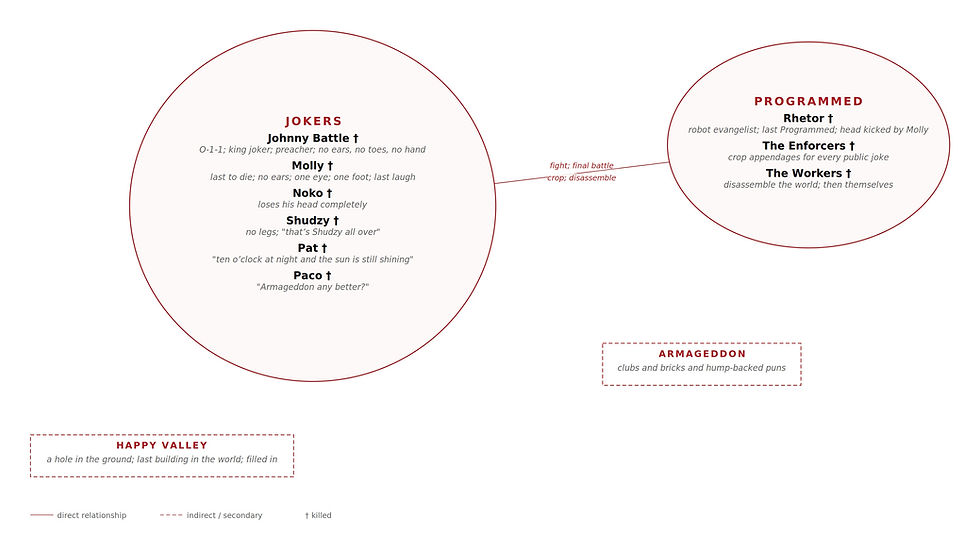
The story is set on a future Earth being systematically dismantled by programmed robots seeking to achieve a state of annihilation called Final Peace. There is a small group of human outcasts known as the Jokers, analogous to the Company of Eagles in Past Master. Led by Johnny Battle, a man missing his ears and several limbs, the Jokers use the transcendent thing to hold onto their spiritual humanity: humor. The Programmed punish the Jokers for their jokes by amputation, literalizing the dream of annihilation through privation.
The evangelist Rhetor, one of the Programmed, preaches about Cosmic Peace. He likens himself to Buddha in his love of nothingness. When he says he even has a little Indian in him, a Joker named Molly busts up laughing. The cost:
"Glory be," shrieked Molly in full laughter, "The Thing is pregnant! It has a little Indian in it!"Ototomies were neat, we will say that of them. An enforcer was always near, and the instrument used was like an old-fashioned bolt-cutter. Molly had once had two ears—then one—and after today none at all.
The Jokers then retreat to their underground home, a hole they call Happy Valley, where Johnny explains the history of the story world. Humanity lost its sense of purpose and created the Programmed to do the world's work. The robots logically concluded that this meant destroying the environment and themselves to achieve nothingness, since they had been created by materialists. As the Jokers discuss their situation, a Programmed worker arrives and says that it is time to end their dwelling, which is the last building in the world. The Jokers are quick to point out the absurdity:
"Please, people," said one of the last of the Programmed Workers coming to their place, "it is the end of things. It is time to tear down the hole." "Not Happy Valley!" they howled." The same," said the Programmed. "It is the last building in the world, albeit an inverted sort of one." "I am interested in seeing how you will tear down a hole," said Molly.
The program fills it. Knowing that the end is near, Johnny rallies the Jokers to stage a final battle they call Armageddon, and the crippled Jokers attack.
For me, it is one of the more memorable scenes in Lafferty, this mutilated, half-crazy remnant swinging their clubs and throwing their bricks, having the joyful time of their lives. Making it more memorable, the robots fight back, then do something terrifying. They disassemble themselves as the fight goes on, hastening their destruction, and move in step with the remnant being cut down in death, all on their way to the big Omega.
Johnny and others die memorably. Then there is only Molly left, with no legs, one leg, and hobbling around on a crutch, the last person.
She confronts Rhetor, who is the last active Programmed. Rhetor tells her to accept the Terminal Peace and starts to unstring his own limbs in front of her. Molly says, "I'll riot while I live and riot when I die." She uses her crutch to knock off Rhetor's head and kicks it around like a ball, playing shinny with it as she chants defiantly:
"A shinny can, a shinny head, A clatter-kicking blowsy gimper! But note about the world that's dead —It never ended with a whimper!"
The story has some of Lafferty’s worst puns, and they only half work for me, but I do love this unpublished story. At the beginning of the story, Lafferty quotes the Song of Roland, and the entire story is mock-heroic. Philosophically, Lafferty makes humor the thing the Programmed cannot understand, part of the transcendent thing. That, of course, is a huge theme in Lafferty, finding its master image in the Laughing Christ. But it might be worth thinking about how it works in this story because it is particularly clear. Elsewhere in Lafferty, he doesn’t quite spell it out.
The key passage is Johnny Battle's speech in Happy Valley. There, Johnny Battle sets out a truth that is always operative in deep Lafferty:
"Once it was believed that there was a human soul or astral body that transcended time and space. But then the belief crept in that there was no more to anything than that which is apparent. There was an interior logic in each belief; but if the logic of the second belief were carried out it meant the termination of belief and believers and everything else. There was once a choice between these two beliefs. But there have never been others than these two, and there has never been a middle ground between them."
Either there is something in the human person that transcends time and space, which Battle ecumenically calls a soul or an astral body, or there is nothing more to anything than what is apparent. There is no middle ground. This contrast between the exhaustively apparent and the hidden underscores the importance of incongruity in the story, which uses the incongruity theory of laughter to make its point about human beings being larger than the programmed.
The Programmed are beings of the apparent, which is to say that they are the logical terminus of the second belief. If nothing transcends the material, then existence is purposeless, and the only rational work is to wind it all down. Lafferty moves fast there, but he is always consistent on this point in his work. It was a take-no-prisoners view. In the story’s version of the Programmed history, materialists who believed only in the apparent built the Programmed. People looked at the apparent and forgot their original nature. That is, almost everyone forgot except for that group in the story called the Jokers.
Lafferty says that humor cannot exist within the programmed system. A joke requires the human response to perceiving incongruity. It necessitates spotting a gap between what is and what ought to be, between the apparent and the hidden, between skewed planes of meaning. Human perception is irreducibly subjective and therefore interpretive. It is not programmed because it depends on a mind that stands, in some sense, outside the appearances it observes and is a transcendental proof of something larger than programmed appearance.
"Last Laugh" is a dark little story. The image of Molly kicking around the head of the Rhetor before she dies is one of my favorite things in Lafferty.
Sick and psycho, jabbering and jocund, she had kept a piece of the transcendent thing. She had the last laugh.
Her last laugh and death are surely related to those of Thomas More as he prepares himself to go to the scaffold in Past Master:
"Fabian, you're full of morning wine," Thomas laughed. But he smothered his laugh into a crooked smile. A man due to be executed this day should not laugh too easily. Somebody might suspect that he was having the last laugh.