"In Our Block" (1965)

Updated: Sep 21
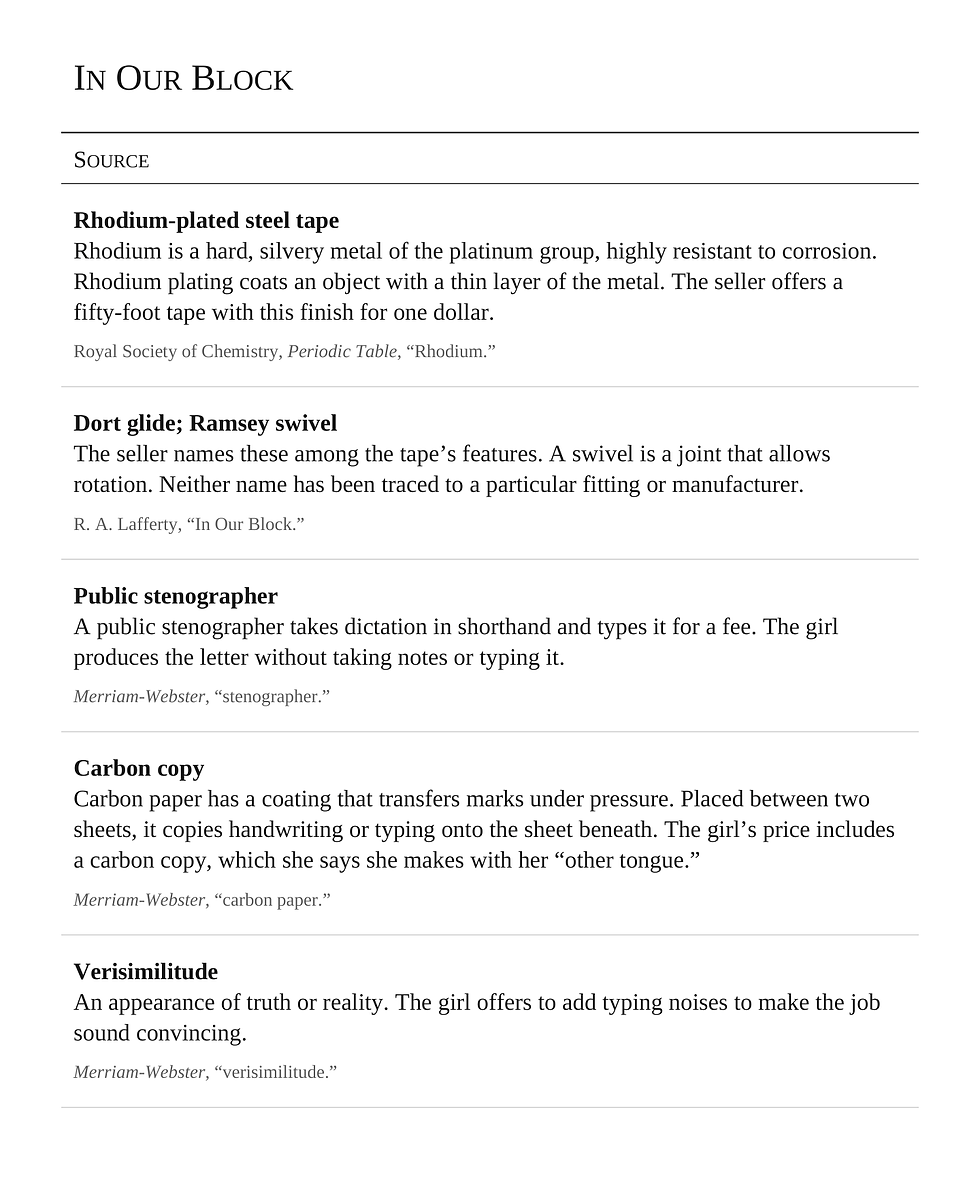
“Fully retractable, rhodium-plated. Dort glide. Ramsey swivel. And it forms its own carrying case. One dollar,” the man said.
“In Our Block” is one of Lafferty’s lighter stories, written in his 1960s amuse-bouche mode. Between 1966 and 1972, he was nominated for seven Nebula Awards, and this was the first.
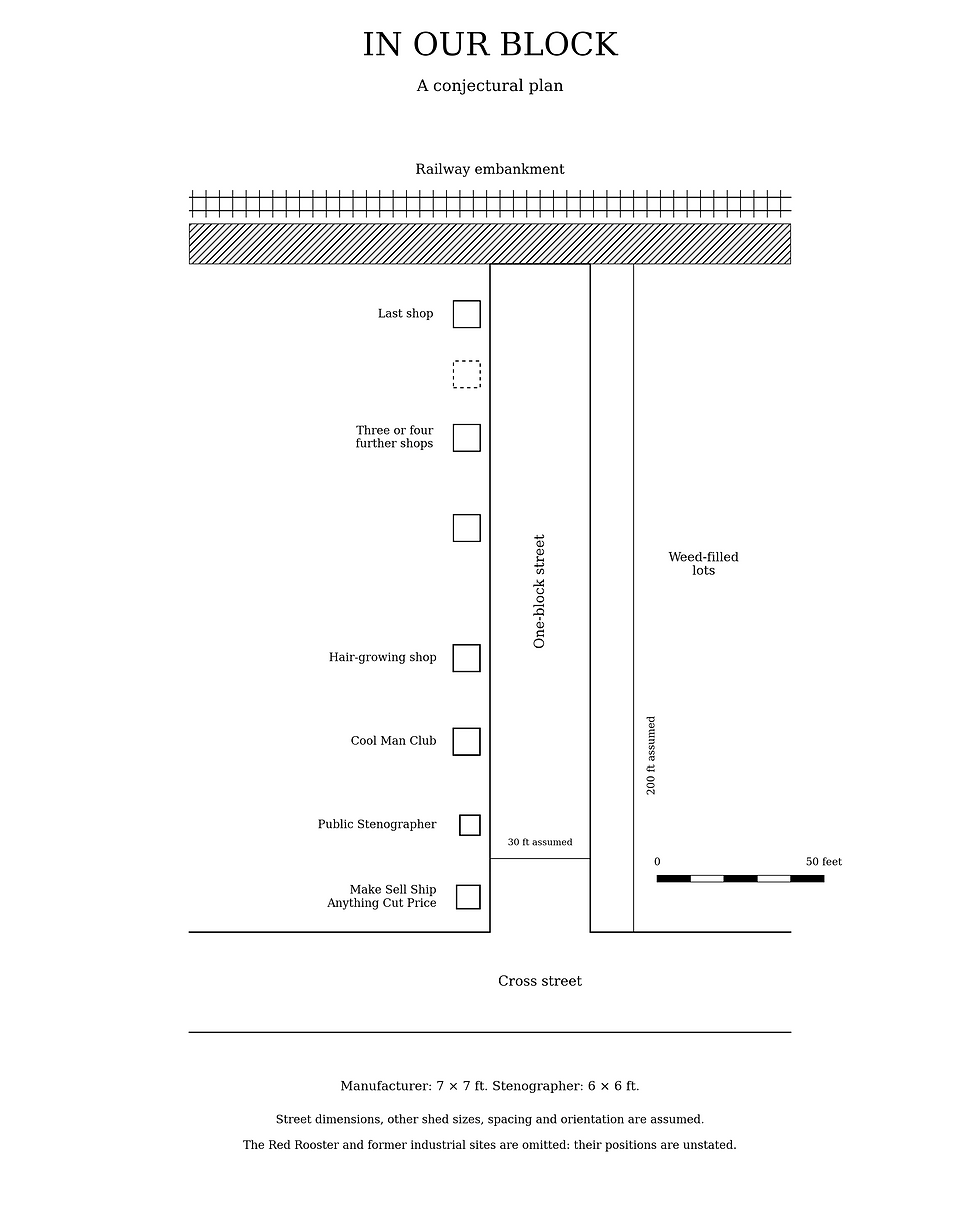
Two men, Art Slick and Jim Boomer, stumble upon a cluster of makeshift shacks, each more improbable than the last. Inside, they find people who can produce, sell, and ship limitless goods from spaces barely large enough to turn around in. One shack operates as a full-scale factory, churning out endless pipe and tape from nothing. One shack houses a public stenographer with no typewriter. A third serves beer that appears the moment it’s ordered.
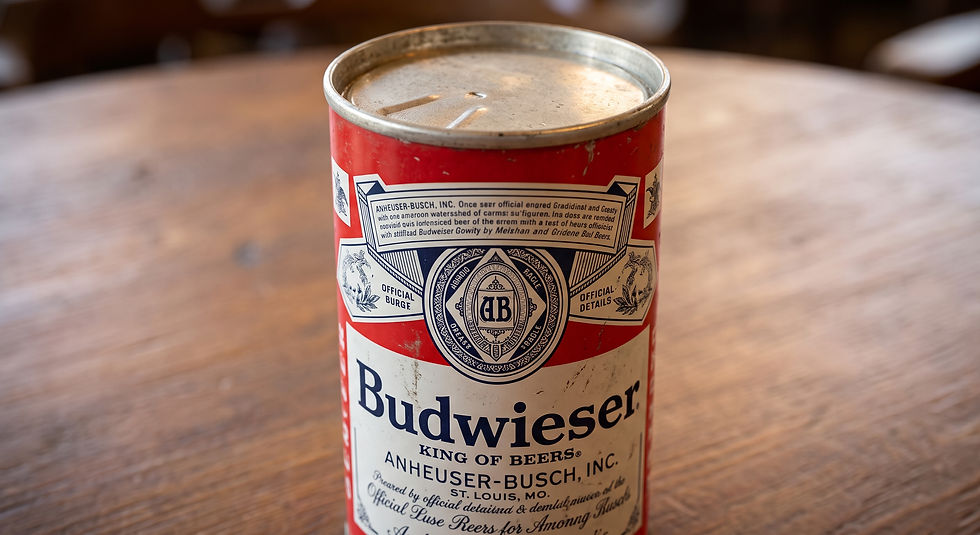
The people in the shacks don’t assemble goods from raw materials; they "make" them, plain and simple. But when Art and Jim ask for specifics, the answers look, on the surface, to be good-natured dodges. By the end, Art and Jim are still confused. Art is smart enough to know something dangerous is here. But rather than digging deeper, they shrug it off. The block, they decide, is just full of “funny people.” And with that, they return to their old bar. One of the best moments is when Lafferty's go-to lager, the king of beers, gets disrespected.
If asked what the story does, beyond being a charming piece of slick fantasy, I’d point to two elements. One is the measuring-tape fabrication and the rules of “making” in the story. This could be Lafferty having fun with the “measurement problem” in quantum mechanics. But maybe that goes too far. The other element is strongly present.
As much as Lafferty detested Karl Marx and was probably thinking of things like Rerum Novarum and ideas like distributionism, “In Our Block” contains a sharp critique of commodity fetishism, where people treat manufactured goods as if they have intrinsic value, independent of the human labor and social relations that produce them. The story focuses on the kind of American consumer culture that surged during the post–World War II economic boom and began to unravel in the early 1970s.
What has me thinking about “In Our Block” is how brutally Lafferty goes at consumerism in The Three Armageddons of Enniscorthy Sweeny. That connection makes the character of Art Slick worth noticing, as a kind of early version or first act in Lafferty’s growing anger on the theme. We see the critique flare up in Past Master, with the rejection of the Astrobe Dream. It is fully developed in “The Last Pauper.” But the rejection of the kind of consumption made possible by the shanties in “In Our Block” becomes a central concern in Armageddons, where the cultural crisis surrounding wealth begins to take shape after Sweeny’s second opera, Armageddon II.
In that novella, early in the twentieth century, signs suggest America might be heading toward total corruption through luxury, but the full menace takes shape in the 1940s. In a 1940 review of Sweeny’s Armageddon II, Lafferty has a fictional critic write: “For us, the most direct and most immoral result of this music that has infested and rotted the world is that it has already degraded our national society to the point that people can pay thirty dollars a ticket to see itself, Armageddon II. The most corrupting influence of the two operas that have appeared so far has been turning America into the cartoon hog with the cartoon dollar sign printed on its ham-fat side.”
This descent into ruin through luxuria continues across the timeline, peaking in 1983 near the end of Sweeny’s life. Of that period, Lafferty writes: “And there was the constant wealth that was clogging everything. Streets and roads were almost impassable from the glossy cars that people bought, drove once, and then abandoned to buy later models that afternoon. Some people even acknowledged that they liked being rich and that they were impatient when the wealth didn’t double every week.”
The Three Armageddons doesn’t do much to show how the mechanics of mass consumption hollowed out Sweeny’s America, but “In Our Block” offers a close-up view of it in proto-parabolic form. Here, in a very short space, we find mass-production fantasies, the erasure of labor, branding as pure surface, instant self-improvement, the tension between packaging and substance, hidden energy and waste costs, and even cultural appropriation.