"Hooligs"

Updated: 14 hours ago

A short post on a curiosity.
Lafferty wrote a sequel to “Quiz Ship Loose” that has never been published. The work survives in an intermediate stage. His handwritten notes and a complete typed version exist, though he never polished it. The story is typed on lined notebook paper, a sure sign of a first-typed draft. Had Lafferty wanted to save the story, he would have next typed it out on carbons. For whatever reason, he abandoned it.
In “Hooligs,” we again meet the crew of Quiz Ship. It includes Manbreaker Crag, best known for his role in “Nine-Hundred Grandmothers.” Quiz Ship Crag is one of Lafferty’s many characters on different levels of fictional reality, making Quiz Ship Crag one of Lafferty’s many character reduplications. This practice makes Lafferty’s work both fascinating and tricky for anyone who wants much continuity in the Ghost Story. Chris Merrick's exhaustive listing of thousands of characters, objects, and places is invaluable for anyone at all interested in surveyorship.
“Hooligs” is pretty obviously short for hooligans, a slur the English used against the Irish. It first appeared in print in late nineteenth-century England, likely deriving from the Irish surname Houlihan.

In “Hooligs,” the reader meets shapeshifting child aliens, perhaps distant cousins of the Dulanty children, for Hooligs have Gaelic names like the Puca in The Reefs of Earth. The story follows six of them, whom Lafferty describes as a mimic-morphic race of hardy workers. They are widely regarded as the best cooks in the universe. Our bunch of Hooligs faces hard times after being “unshipped” at Crossroads Port following a series of disastrous banquet failures.
Lafferty writes,
The Hooligs are a mimic-morphic race who, when they want to, look quite a bit more like humans than they really are. They were not accounted as very intelligent and they didn't test very high . . . But they were good-natured and comic folks. If they really didn't understand a thing, they faked it, and that was about as good as far as results went . . . they were solid scrappers in any free-swinging fight and were absolutely loyal to whatever ship they were articled to; they could cook; they could cook; they could cook.
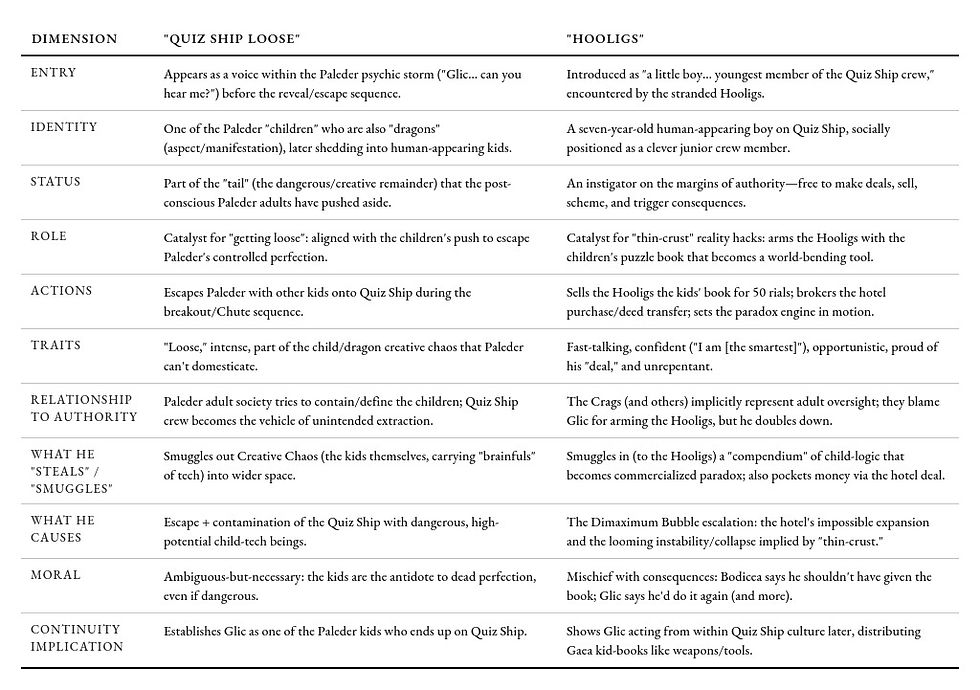
Stranded and in need of a livelihood, the six Hooligs meet the alien child who caused so much mischief in “Quiz Ship Loose.” He is the seven-year-old Glic, who has been traveling with the Quiz Ship and its crew. He sells the Hooligs a Gaea children’s publication titled Captain Smart’s Big Book of Jokes, Puns, and Puzzles for fifty rials, promising the Hooligs it is a compendium of all wisdom. Glic then brokers their purchase of the dilapidated Break-Back Hotel. At the same time, he secretly maneuvers the deal so the previous owner pays him to take the building off his hands.
The Hooligs might not have a pandect, but they certainly have a problem in the form of a legal deadline explained by the hotel’s former owner: the transferred property must show a paid occupancy of at least ten tenants by sundown or the building will be demolished. The rub is that the Break-Back Hotel has only nine very small rooms.
A Hoolig named Mil uses a logic puzzle from Glic's joke book about an "Expandible Hotel." Thus inspired, the Hooligs renumber the nine physical rooms from 2 through 10 and place the first 9 guests in those rooms sequentially. Mil lodges the tenth guest in room number one, saying that it is unused. This satisfies the legal occupancy requirement and baffles the Planetary Hotel Inspector, who counts the occupants and accuses the Hooligs of flimflam.
As the night goes on, the Hooligs use more creative recounting, along with frequent fire drills, to spin up Marx Brothers-style comedy. This, in turn, leads to the discovery of what Lafferty calls a Dimaximum Bubble, a funny allusion to one of my heroes, Buckminster Fuller. The Dimaximum Bubble causes the hotel to physically grow to accommodate more guests.


By the end, the building has expanded to twenty-seven rooms and now lodges crews from several newly docked starships. The members of the Quiz Ship note that such bubbles are always temporary. They are thin-crust effects, the result of the Hooligs’ ability to turn simple puns and puzzles into world-altering devices. Glic is defiant about the ethics of the trade, saying that he will ply the Hooligs with even more children’s literature.
"Yes, Manbreaker," Bodicea said. "The puns especially. With thin-crust effectors like the Hooligs even puns may become veritable world-changers. You shouldn't have given them Captain Smart's Big Book, Glic." "If I had my life to live over again," said seven-year-old Glic, "I'd give them the book all over again. And I'd give them the other Gaea kid's-books too, before you had a chance to impound them."
In Lafferty’s more serious “Quiz Ship Loose,” Glic is one of the morphic dragon-children of Paleder. He intercedes during the Gaea crew’s psychic storms by giving members encouragement in Low Galactic. Without him, the crew would have been in trouble. On the other hand, Glic himself is trouble. He stows away on the Quiz Ship with eight other children. They want to escape the stagnant “post-conscious” society of Paleder. Glic even says he has comprehensive knowledge of Paleder’s advanced technology and is willing to share it with the backward people of Gaea.
There is nothing quite like "Hooligs" in Lafferty, with its plot based on a popular type of puzzle humor. Reading it for the first time, I remembered being a child and seeing the basis of its plot in a rhyme.

Lafferty enjoyed counting tricks like this and uses them in stories from time to time (“In Outraged Stone”).
So that is “Hooligs,” a playful experiment where formal operations (counting, renaming, reindexing, and even pun-based logic) reshape reality. What appears as children’s humor (similar to the Little Willy verses in "What's the Name of that Town?") conceals yet another Lafferty meditation on the constitutive power of reality manipulation. An ideal collection of his short fiction would need to include “Hooligs,” not least because it adds yet another story sequence to the Lafferty canon.