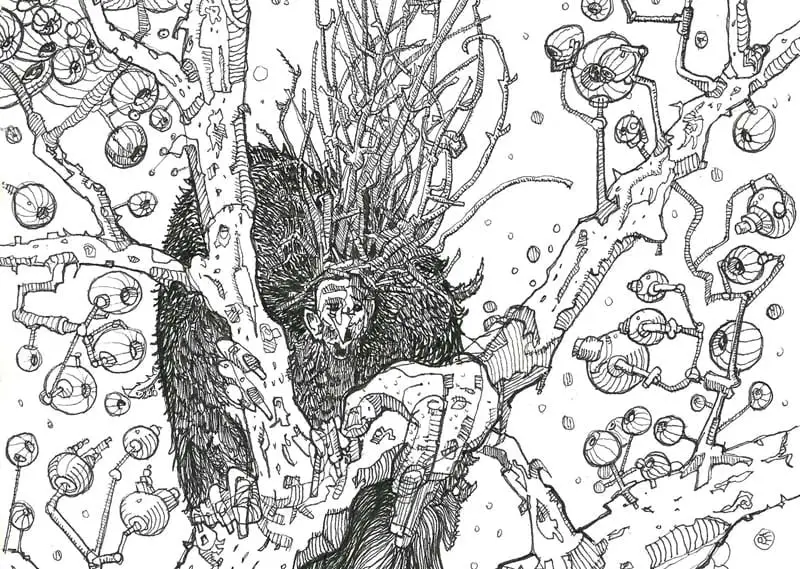
"In Outraged Stone" (1971/1973)

Updated: 19 hours ago

“In Outraged Stone." This is the stubborn refusal to accept that there is no transcendence, that there is no ultimate reality. When they try to tell you that you are only an artifact in a collection, that you are not alive, that you have never been alive, that is the time to get mad ”— "Introduction," Ringing Changes (1984)
And the five young mind-scientists from Earth. Five? Not six? Christopher, George. Philip, Bonta, Helen,Margaret. Do they not come to six? No. There are five of them. Count them again carefully.See, there are five of them.”
A sequel to Lafferty’s great short story “Frog on the Mountain,” “In Outraged Stone” offers a variation on the schizo-gash in the problem of the secondary person. What is a secondary person? The story is slippery on this point, and in his notes on the story for the Ringing Changes collection, Lafferty said it concerns the anger we should feel when denied transcendence. What makes the story particularly tricky is understanding how its various pieces hang together.
In the story, five Earth psychologists visit the planet Paravata to study the Oganta, the native species resembling large frogs that remain in a neotenic, sub-adult state. As we learn in “Frog on the Mountain,” the planet Paravata's high gravity and oxygen-rich atmosphere induce a state of intense energy and physical activity in the visitors. This time, our main characters join the Oganta in a gluttonous feast at a mountain inn. The group—consisting of Christopher Bullock, George Oneiron, Philip Blax, Bonta Chrysalis, Helen Damalis, and Margaret Mondo—adopts the rough mannerisms of the natives. They go native, wrestling and playing the mystic game of leapfrog.
During the shenanigans, we learn about the Marsala Plasma globes. Their nature is central to the story. George captures one, which undergoes a phase change and shatters into heavy, sharp fragments. This leads the psychologists and Oganta to cut themselves and mix their blood in communal bowls to drink. Now there is a real bond between the species.
The psychologists begin using the Marsala Plasma globes, which act as crystal balls that record dreams and personalities. They’re handy devices for researching specific Oganta subjects, for the Oganta are so psychologically open that they exteriorize their dreams. Margaret Mondo manages multiple recording globes with her magic hands, while George projects his own split personality into his subjects' dreams. Bonta Chrysalis focuses on a specific male Oganta, attempting to "disenchant" him and trigger a biological development into a higher form. Then there is Helen Damalis, who attaches herself to a cruel Oganta subject who physically abuses her, breaking her bones and dominating her within the recorded dream sequences.
Bonta’s experiment succeeds in transforming her subject into a Rogha, the ancient and lost adult form of the Oganta species, the sequence we know from “Frog on the Mountain.” However, the creature declares himself king and dismisses Bonta as a small creature. Simultaneously, Helen Damalis, mangled by her subject, attempts to save herself by merging her physical form with an empty Marsala Plasma globe, effectively hiding inside the recording medium. The Oganta nation holds a final, raucous celebration for the departing humans, after which the psychologists collect the solidified globes containing the recorded data to return to Earth.
As the group packs the collection, Margaret Mondo retrieves the globe associated with Helen’s hostile subject. And here is the story twist. The object, now a heavy, misshapen stone (we learn how this process works through Christopher Bullock's notes), shrieks and identifies itself as Helen Damalis, begging to be released so it can "mend up my bones" and return to Earth. But there never was a Helen Damalis. There was just a solitary, hateful Oganta that dreamed her into being. Margaret looks at the frozen artifact and calls it a dirty little masterpiece of hatred created by the Oganta. And off it goes, becoming part of the Oganta Collection.
On its own terms, the story gives a fairly strict, technical account of the secondary person. The plasma balls can show primary persons and secondary persons. A plasma ball might also go tricky and freeze forever any of these fleeting things, most often by seizing “a secondary person and freeze[ing] this person forever,” with the result that the frozen being will never have had any existence except in the ball and will never have been anything except petrified, even though the device is “everywhere phony” and still “works.”
The story then ties this ontology to a counting problem: the five young mind-scientists from Earth are named in a way that seems to total six, and the text insists on the correction—“No. There are five of them. Count them again carefully.” Lafferty enumerates the crew, but slips Helen Damalis into the list:
There were five of these young psychologs from Earth. There was this Christopher Bullock: we will have to call him a young man of muscular mind; there’s no other term that will serve . . . The second of the young psychologs from Earth was George Oneiron . . . The third of the young psychologs from Earth was Philip Blax . . . But the fourth of the psychologs from Earth was Bonta Chrysalis and she was something special . . . And from Bonta Chrysalis we go to Helen Damalis, who suffers by the comparison . . . The fifth of the psychologs from Earth was Margaret Mondo . . .
This is a fun moment in the story, with Lafferty sneaking in the secondary character, Helen. Read against Bullock’s notebook rule, the surplus “person” is the kind of thing the crystal ball can display and preserve without that person ever having existed as a primary being. At least that is how I understand it.
We can see this in how Helen is depicted. Lafferty introduces her as having less substance than the others, and, most importantly perhaps, the Marsala Plasma “followed and clung to Helen . . . as they did to all the Oganta, as they did not to the Earth people.” Later, in the cruel Oganta’s recorded dream sequences, her appearance “was as if it made her real,” and Lafferty's narration immediately qualifies the status of that appearance: “What matter that she was only the secondary element . . . ? She was there.”
When the bitter Oganta crushes her body, presumably a dream body, she attracts an empty Marsala Plasma and creeps inside it, merging herself into the crystal ball of record, a movement into the medium that produces, displays, and freezes secondary persons.
In the end, the story makes it impossible to say whether Helen was an original crewmember who has been erased or merely a dream:

Although the options are contradictory, Lafferty keeps both alive. Helen is the expendable nonentity—an erased crew member, not quite up to Paravata’s extreme physicality and carnal pleasures—and she is also the dream-person the bitter Oganta projects. As a secondary person, she slips out of the Oganta's dream, transcending it and achieving personhood, only to be fixed as an object at the instant of escape. In both cases, her personhood is denied.
Each of the five Earth psychologists denies transcendence by retreating into a particular form of limitation: regression, caricature, solipsism, instrumentalism, and status-quoism. Philip Blax denies the value of higher states entirely; he wants to shed adulthood and devolve into the uninhibited mud of the neotenic Oganta. Bonta Chrysalis tries to force a materialist change by manifesting a Rogha, but what she gets is a sterile, ridiculous, isolated figure.
George Oneiron is a creature of narcissism: he uses the alien dream-medium solely to stage pageants of his own doubled self, creating a solipsistic theater that excludes whatever is truly alien about reality. Christopher Bullock treats the psychic landscape with muscular superficiality, turning the plasma spheres’ potential into buckets for data and stag-movie entertainment.
Finally, there is Margaret Mondo. She looks like our best shot because she stands in for Earth's many-rootedness, but it turns out to be rootedness that denies transcendence by enforcing the status quo. She calls the attempts to cross the limits pretentious, and she is the one who ultimately refuses to recognize Helen.
The story itself is a loop, with its opening and ending drawing attention to the Oganta Collection. In the opening, viewers joke that the outraged figure must have been alive, and the correction—“She wasn’t alive, and she never had been”—creates two voices that keep things open and unstable. When Lafferty begins the last paragraph of the story with the line, “Go see it in the Oganta Collection,” he closes the circle on the reader and turns us into the next viewers, forced to decide how to see Helen.