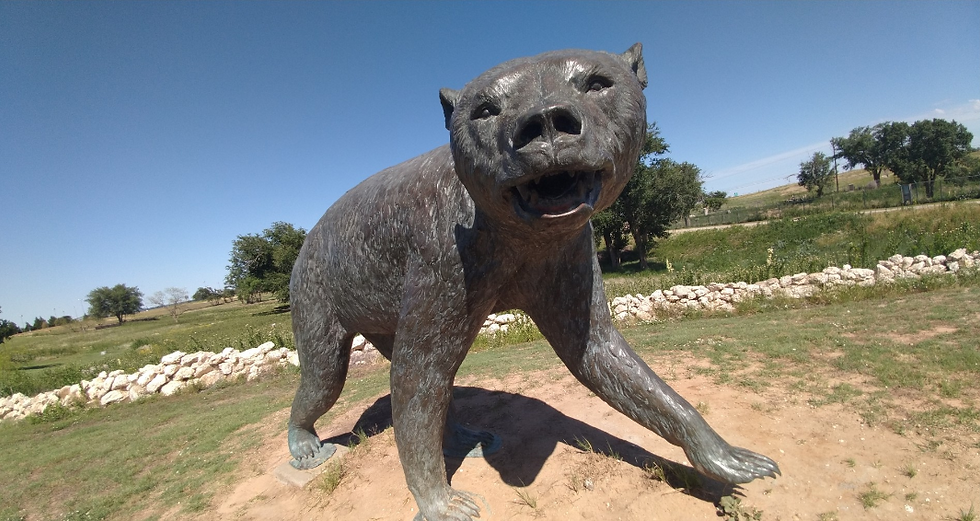
“Happening in Chosky Bottoms” (1977/1995)

Updated: Sep 16

“Are we indeed ghosts? And do ghosts themselves have ghost stories? Sure we are and sure we have. There are many orders of ghosts. You are ghosts to your own cattle, being able to make appearances, having mastery of time and place, having strangeness on you. Some of us seem ghostly to you. And it may be that we have encountered steeper ghosts than you have. We are more receptive of these things than you are. We see out of shaggier eyes.”
Completed in September 1977 and first published in 1995, “Happening in Chosky Bottoms” is an intriguing Lafferty story. On one hand, we have the unexplained nature of the Slew-Foot (Quick-Lout) people. On the other, we see the elaborate rationalization of the central murder plot involving Malcom.
The story follows a towering Slew-Foot youth nicknamed Chalky, who joins Lost Haven Consolidated High School’s football team and turns it into an unstoppable force. His extraordinary strength, quickness, and intelligence make him a local hero, but his success fuels the jealousy of star quarterback Malcom Schermerhorn.
After Chalky quits the team, a series of animal mutilations are discovered around the swampy Chosky Bottoms. Next, two children are murdered and dismembered. Fear spreads into panic, and suspicion falls on Chalky. In the final confrontation, Chalky is shot and sinks into the quicksand, only to rise again.
Overcome with terror, Malcom confesses and dies of fright. His secret is revealed: he had been orchestrating the killings while disguising himself as a hairy “monster,” Chalky. With Malcom’s guilt confirmed, the townsfolk accept the truth. Chalky, who can jog a hundred miles a day, announces his intention to seek a professional football career.
Chalky is a “hairy ghost,” unstoppable on the football field. When he emerges from the quicksand, he has an otherworldly sheen. Crescent Harvestman accounts for it as a matter of mica attaching to his fur:
“It’s the mica,” Crescent Harvestman said matter-of-factly. “There’s always been specks and little sheets of mica in the quicksand slime, and it gathers in pockets. Chalky plowed through a pocket of it when he roused up, and now it sparkles and dazzles on him in the morning light.”
This explains the glitter. It does little to explain the person glittering before them. Lafferty is playing a game here. Chalky’s “glorified flesh” receives a geological explanation, but the explanation reaches only its surface.
Chalky himself offers a separate explanation for his apparent resurrection. The carbine shot merely creased his head and knocked him unconscious:
“I’d have drowned and died in the slough if he hadn’t been taunting me in my head. ‘Die, monster, die!’ was what he was chanting in his mind and in mine, and after a while I woke up. ‘I will not die,’ I said, and I stirred myself. We do not drown in such half-hours as I was down there.”
We are given a causal account, but it requires us to accept telepathy and his people’s extraordinary ability to survive underwater. What looks like a resurrection may have been survival. Either way, explaining the event has hardly restored an ordinary world.
This is how much of the ending works. After the wild violence and the numinous, readers are left with a few pages of apparently limp rationalization. On a first reading, it might feel anticlimactic. While there’s much to explore, I want to focus on this aspect.
Michael Saler’s concept of animistic reason in As If: Modern Enchantment and the Literary Prehistory of Virtual Reality (2012) sheds light on what Lafferty is doing in “Happening in Chosky Bottoms.” In Chapter 3, Saler considers Sherlock Holmes and the interplay of reason and imagination in Doyle’s portrayal of the detective. His argument is worth quoting at length:

Saler’s point is that Doyle makes the incomprehensible legible without dispelling its wonder. No matter how much we enjoy the terror of the hound that haunts the Baskervilles, Holmes is there to explain. He imposes a higher, rationalistic magic that dissolves the supernatural explanation while preserving the adventure. He’s just that much of a genius.
This dynamic reveals something important about “Happening in Chosky Bottoms.” Lafferty’s little town of Lost Haven has no Sherlock Holmes. The residents fail to unmask the real killer until Chalky’s return forces Malcom to confess. After an explosively Peckinpah-esque climax, in which Chalky is repeatedly shot and then swallowed by quicksand, he rises. What follows is that madcap scene of mysticism and rationalization, with something of the exposition at the end of an episode of Scooby-Doo, Where Are You? Every clue must find its place in a satisfying causal chain. Yet the exposure of the costume leaves its extraordinary living original standing before them.
Here is one character near the end:
“Oh, sure,” Coach Goodbeaver said. “You can get several thousand pounds of pull with one of those. It will pull a quarter-mile length of barbed wire clear of the ground. It would easily pull a dog apart, or a kid goat, or the children. That is what chewed up the two posts it was anchored to in the corral of the barnyard where the kid goat was killed. There are probably a couple of sets of trees around here that are chewed up a little bit too. I should have known from those two posts what happened.”
And a little while after:
There were cameras in the “nest” too. There was a little cylinder of methane gas that might have been used to bubble through swamp water to create long-hovering glows of swamp fire. The ape-suit soaked in such methane-water would probably glow in the dark and create a Saturday Night Specter. And it would give an illuminated sort of photo. There were other things there.“I guess it is tied to Malcom,” deputy sheriff Al Moss said. “But, Chalky, to tell the truth I had my heart set on tearing you apart as the monster.”
In a story that over-explains, much remains unexplained. Lafferty leads us to the edge of deeper mysteries: Who are Chalky’s people? How does he stretch so well? Why do his stories change every time he tells them? We get no tidy explanation for how he can run! Or how he “lives in a slightly different world from our own.” In the face of this, the eagerness with which the characters rationalize the modus operandi of Malcom’s crimes becomes black comedy. Their explanations settle the murders while leaving Chalky’s nature largely untouched.
Here, in Lost Haven, the same setting as The Reefs of Earth, solving the crime does not explain away the hound of the Baskervilles. Malcom’s fraudulent monster depends upon a real person whose capacities remain extraordinary. The detective story’s solution cannot make that person disappear.
The larger mysteries remain. How do we understand the Malcom and Chalky mini-drama of the ape costume and the man-costume? We have clues but no settled answers. We learn exactly what Malcom’s mallet and fence-stretcher were for, but we never find out what the Quick-Louts do with their enormous fishhooks:
One of them used to come to the Bait Shop in Lost Haven to buy fishhooks of the biggest size (six inches across the hook) for a dollar each. These were deep-sea hooks, but Henry Stone, who ran the Bait Shop, stocked a few of them especially for the Quick-Louts. “I don’t know what they hook with them,” Henry always said, confessing his ignorance. “Whales, I guess. Yeah, Wagoner County whales, I bet.” These very large fishhooks were the only things that any of the Quick-Louts ever bought, the only commerce that they ever carried on.
Nor has the explanation settled everything about the people doing the explaining. Deputy Moss knows who committed the murders and still regrets losing his chance to tear Chalky apart. When Chalky suggests using Malcom’s corpse instead, Aunt Ronda rebukes him. Knowledge of the crime has not extinguished the appetite for its repetition.
So, back to the ending. The characters respond differently: Crescent offers practical explanations, Reverend Handsome declares a resurrection, and Aunt Ronda still expects decent conduct. But several remain preoccupied with the questions that serve their immediate purposes. It’s like watching Chalky play football and only noticing the football. In overlooking the larger mystery, they fail to see enough of the world before them.
What might seem like a narrative weakness is central to the story’s design. The crime becomes explicable; the world in which it occurred remains strange. A telling clue comes early on: Melvin Schermerhorn concedes that football isn’t the most important thing in the world, then insists that they proceed as though it is. By the end, Chalky’s next football opportunity is once again the subject.
Which means that in talking about football, Lafferty is also, in his own way, talking about the most important things: death, resurrection, and mystery.


Current notes: