Dotty and the Pig People

Updated: Sep 4

Lafferty’s Dotty offers a glimpse into what his literary career might have been had he pursued fiction outside of genre marketing constraints. More significantly, it serves as a tuning fork for reading his later work. Rich in Catholic thought yet presented with sharp ironies, the novel raises questions about its intended readership in my mind. Unlike much of Lafferty’s work, Dotty puts a check on its exaggerated humor and avoids discontinuous allegory, the mode I think Lafferty most often executes with literary genius; instead, it offers a direct meditation on grace, loss, and the nature of human recuperation. (My notes on the novel are in the file sharing section.)
Though not literary naturalism, Dotty shows Lafferty wrestling with that broader Irish and American tradition. I suspect he later reworked Dotty into "The Ugly Sea" (1960), published in The Literary Review. Both stories center on young women who play the piano in coastal towns. The stories are reversals of polarity—one girl excels at the piano while the other does not; one is drawn to the sea, while the other is repelled by it.
If this transformation is deliberate, it may have been Lafferty’s way of freeing himself from the expressive constraints he imposed on himself while writing Dotty. In this light, Moysha Uferwohner reads like Lafferty’s struggle to see Dotty clearly as a writer, only to turn away from her—opening new creative pathways in the process.
Lafferty would return to Dotty to mine it repeatedly. One example. Dotty early on has terrible nightmares about going to hell. She knows she has precociously reached the age of reason. In Past Master, we find her showing up in Evita: “Yes, there is, Charley-boy. I was naive in my methods and in my direction of revolt,” Evita said. “The teachers said that there was no Hell and no Devil, and this angered me; I knew that they were wrong; I had had some personal contact with both. They said that there was no sin. In particular, they said that children were not able to commit serious sins; and in this I knew that the teachers were sinfully wrong.”
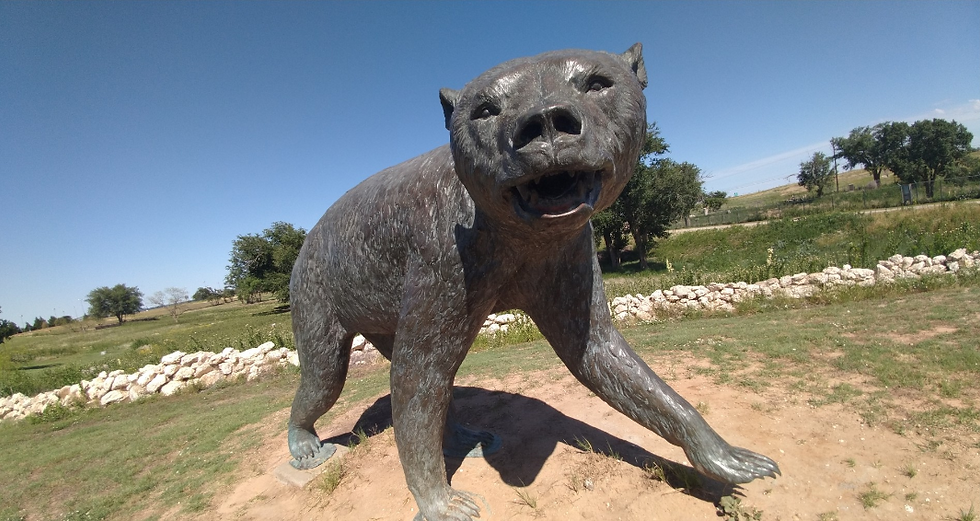
Dotty also gives Lafferty’s full articulation of a recurring motif in his work: the pig-people—one of my favorite Lafferty hobbyhorses. Though the image recurs throughout his stories and novels, Dotty is where its full context is most clearly established within the ghost story. Lafferty, who almost certainly delighted in Plutarch’s Gryllus, tells us a pig-person is out of grace. He does it with a seriousness that may unsettle readers who suddenly realize just how completely earnest he is. (Try, for instance, to see Charles Cogsworth through Valery Mok’s eyes in the same way after reading Dotty.)
"There used to be an invisible world as well as a visible one. And there was a high excitement in running from one to the other. Now there was nothing but Immediacy, Practicality, the Dialectic, Humanism, Liberalism, Pragmatism. Words for a world with the light gone out of it.
The pig people had been right. The pig people ruled the world. There was no world but theirs, and Dotty had become one of the pig people.
'I have traded a kingdom for a mudhole,' said Dotty. 'I have made myself an animal when I was not entirely so before... I wonder why I did it? And if regret will ever grow tired? Have pigs regret after they have settled down to being pigs?'"
This is the Ur-moment of seeing through other eyes.
It is also the novel’s center of gravity: the nature of spiritual degradation. Every Lafferty fan should at least read Chapter 11.