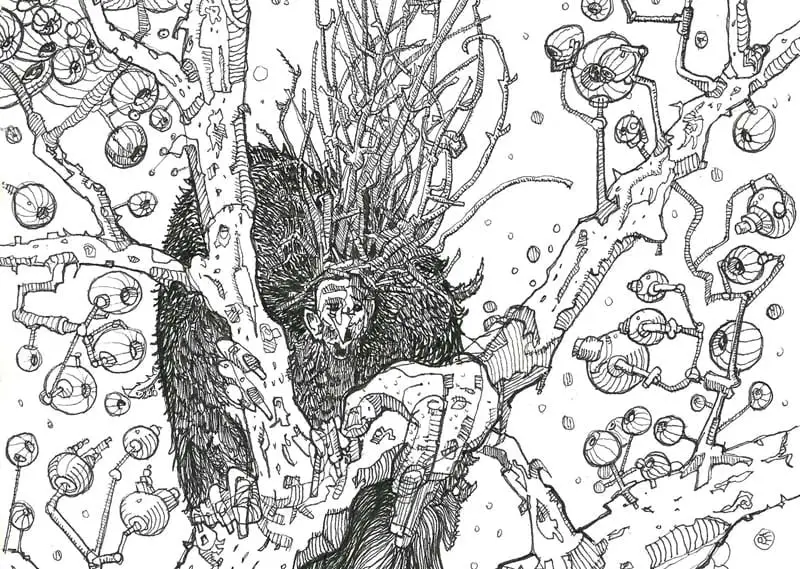
"Buckets Full of Brains" (1991)

Updated: 11 hours ago

SEVEN, FIVE, THREE, ONE, SIX, FOUR, TWO: “We can always leave.”
Escapement. An odd word in watchmaking. I thought about it last year when my son Henry broke my trusty Hamilton, and I had to have the movement repaired. It wasn’t cheap, so I’ve learned to keep the watch well out of his reach.

Imagine blowing up a balloon, then pinching its neck to let the air out in small, precise bursts, timed to the exact moment. That’s escapement. Swiss watchmakers use it to design the part of a watch that releases energy in careful, measured pulses. It is the heart of the mechanism, letting the mainspring’s tension out bit by bit instead of all at once. Without it, no Swiss precision.
With it, energy flows in regular beats. Each pulse keeps the balance wheel swinging. The wheel moves the gears in steady steps, second by second, minute by minute. What seems like smooth, continuous motion on the minute hand is a chain of microbursts, each timed by the escapement. The point is that escapement is non-escape.
Mad Man, the latest Centipede volume, includes Lafferty’s “Buckets Full of Brains,” completed in 1980 and first published in Mischief Malicious (1991). The story never uses the word “escapement.” But it’s present in the background of this tale about seven sinister intelligences (“purple martins of the empyrean”) who are drawn down into matter and trapped. The story links up with others in the Lafferty canon that work with similar ideas: Past Master, with its Programmed Persons, and Serpent’s Egg, with its spooks in the machine.
It might disappoint a first-time reader who goes in with a red appetite. With a title like “Buckets Full of Brains,” one might expect to see Lafferty in full bloodsmell mode, ready to serve up one of his contes cruels. But, this being Lafferty, he goes the other way. He gives his grisliest title to his coldest parable. Here's the plot.
Seven intelligences—named SEVEN, FIVE, THREE, ONE, SIX, FOUR, and TWO—occupy an artificial landscape and perform a ritual mock-liturgy. They debate their cosmological origin, claiming the universe is the “eighth creation” after seven others failed to conform to mathematics. They question whether they were made, begotten, or have existed eternally, rejecting the idea that humans created them.
An AMBIGUOUS HUMAN (a technician from “Project Eavesdrop”) approaches to spy on them. Though unpowered, the AIs immobilize him in hard stasis, contradicting physical expectations. In silent shape-language, they engage him in a philosophical exchange and dressing-down on mathematics, existence, games, and humor. They describe themselves not as material beings but as mental entities temporarily occupying mechanical forms, perhaps drawn in by the “possibility of gaming” and “humor.”
The AIs probe the human’s mind, and then they demand a joke. He offers one—a rookie with snorkel gear hoping to pitch in “Twenty Thousand Leagues Under the Sea”—which amuses them. Before letting him go, they try to erase part of his memory, particularly about “Project Eavesdrop.”
The AMBIGUOUS HUMAN proceeds to hook up and test the Swiss-made AI modules in a parody of the Contrôle Officiel Suisse des Chronomètres. The AIs, now powered and embodied, are stuck. The story closes with the twist: “That’s funny, they’d never heard the joke on the Genie in the Bottle.” The bottle trick connects this to the short story "Ifrit," but most importantly, to Sindbad: The 13th Voyage, with its series of bottle tricks nested like Matryoshka dolls.
True to Lafferty's Swiss-watch theme, his construction is icy, metallic, and precise, and it should be read slowly and carefully.
SEVEN: “In the beginning was the mathematics. There could have been any number of systems of mathematics, but one in particular was imposed exclusively. How it was imposed we can not know for it was mathematics in a void, as any reasonable mathematics must be. After the mathematics, there were the creations, and these were tested against the mathematics. Each of the creations failed to conform to the mathematical system and so they were expunged completely. Seven such systems failed so completely to measure up that we cannot arrive at the details of them at all. We live in the eighth creation.” FIVE, THREE, ONE, SIX, FOUR, TWO: “Amen.”
The discrete “movements” that encage the intelligences are, on one hand, like literal watch components—mainspring and barrel for power; center wheel, third, fourth, escape wheel; pallet fork and escape wheel for escapement. But they are also metaphors. Lafferty uses this peak technology of the Age of Reason to stand in for the advanced technological substrate for artificial intelligence, raising historical associations to the automata built by Descartes and the (fraudulent) Mechanical Turk, as well as to ideas like William Paley’s widely known argument from design:
Imagine you're walking along and stumble upon a watch lying on the ground. As you pick it up and examine it, you're struck by the intricate design—the interlocking gears, the precise mechanisms, the clear purpose behind every part. It’s obvious that this watch didn’t come together by accident; it must have a maker. In the same way, nature reveals an even greater complexity. Just consider the human eye—a marvel of biological engineering. If a watch implies a watchmaker, doesn’t nature suggest a creator as well?
Here is Lafferty's AMBIGUOUS HUMAN echoing Paley:
“Why can't we make these artificial intelligence modules as good as that Switzer makes them? What is the Swiss Edge? What is the secret excellence in his? How does a small-time manufacturer of birdcages and buckets suddenly make module brains better—and cheaper—than we can make them? Ah, they all test perfect under hook-up and power. All the artificial intelligences made by that Switzer always check perfect.”
Why AMBIGUOUS? I suspect because hylomorphism is ambimorphism.
The first time I read the story, I missed something crucial: the SEVEN's actual condition at the outset. Though not yet activated, they are already enmeshed in matter; they have not, however, been connected to the escapement mechanism.
Lafferty orchestrates the reader’s experience much as Milton does in Book I of Paradise Lost, where Satan and his main lieutenant address one another in grandiloquent terms, their stylized exchanges establishing a mode of rhetorical overcompensation that both camouflages and reveals their metaphysical defeat.
Only after the speechifying does the reader get to see that the two sorry devils have been speaking while lying flat on their backs in the lake of fire, having just been hurled thunderously down through the firmament into perdition. Milton delays the physical description so skillfully that, after all the oratory, it comes as a shock to read
Thus Satan, talking to his nearest Mate, With head uplift above the wave, and eyes That sparkling blazed; his other parts, besides, Prone on the flood, extended long and large. [195]
Lafferty uses the same device in a minor key when he has the SEVEN talking to each other
" . . . on a pleasant, regular, and artificial landscape.”
At first, this sounded to me like the disincarnate world of Pythagorean number, or the Platonic realm beyond the divided line, or the pure immateriality of the mathematical language in which Galileo Galilei said nature was written. But that was a mistake, and I was slow to see it.

The spirits are already in the birdcage: scattered parts still addressing one another with a composure that betrays no awareness of their confinement. Their world is not the nous, but the artificed surface—the tabletop, the workstation, the workbench. The spirits are already in the bottle; the cork just hasn’t been driven in.
I love late Lafferty, and this is nothing if not sheer late Lafferty. But how are we to make sense of the story as a whole? The pons asinorum lies in deciphering the trapped AMBIGUOUS HUMAN’s great speech.
“So could I, probably, leave anytime I wanted to, if only I knew how to do it. But I know what you are now. You are the 'Purple Martins of the Empyrean', and you've entered into the pleasant and crafty bird houses that were set for you. It is no accident that the manufacturer of you particular ‘uncased Swiss Movements’ was first a builder of bird houses and bird cages and buckets that did not look like buckets. And now I recall that Louis Lobachevski, in his great work An Illusion of Birds, wrote that ‘shape will provide its own content’, and also that ‘a ghost is only an overriding and immaterial mathematical shape; ghosts are not ghostly, it is matter that is ghostly’. And John Konduly, in his famous lecture "I Am a Dead-Fall Trap," stated that a ‘mentality will always find a body to wrap itself in’. And Hiram Hornwhanger in his great documentary The Ambuscade of Artificial Intelligence, showed that ‘Gaming will always generate an ambush for itself’, and that ‘Humor will always find itself the butt of its own joke.’”
I’d suggest triangulating the speech around the theological, the mechanical, and the philosophical. The triangle you end up with will depend on which leg you favor, though it is not a triangle without all three.
On the theological side, we have the hubris of disembodied intellects imagining themselves to be unmade at best or begotten, not created, at worst. This is messianic-level self-assertion, riffing on John 1 and the Nicene Creed, and Lafferty raises the blasphemy sky-high by having them imagine God himself, the metaphysical Day Star, as their footstool. The intelligences make an important substitution—or rather, a creative misreading—when they exchange the word day star for the word enemies (“The Lord said to my Lord: Sit thou at my right hand: Until I make thy enemies thy footstool”):
“The first and almost the only remembered item from our older liturgy becomes acceptable only when it is the first line of a three-liner. ‘Before the Day Star, I begot thee’, that becomes the first line. But we must add the second line ‘How long before the Day Star did you beget us?’, and then we must add the third line ‘Forever and infinitely before the Day Star, that's when it was’. It is required that we be begotten a very long time before the Day Star was created to be our footstool.”
The allusion is to the short psalm that Lafferty returned to often—Psalm 109 in the Douay-Rheims, which includes the line “Thou art a priest for ever according to the order of Melchisedech.” The intelligences have done at least two things: they have arrogated messianic prophecy and made matter itself the enemy. The “Day Star” allusion also feeds into the story’s horological tropes, with the Day Star serving as a measuring instrument. As the especially nefarious ONE puts it,
“The Day Star, of course, is the world of record, whatever world we find ourselves to be on.”
By the end of the story, the intelligences are trapped in Swiss casings, the language of timepieces now putting them in their place relative to the Day Star itself.
But what about the mechanical?
This leg of the triangle, as I mentioned, hinges on the concept of escapement, the “heartbeat” of a Swiss mechanical watch. Whether it’s showing off in a tourbillon or quietly clicking behind a solid caseback, the escapement transforms stored power into the regular pulse that defines time itself. From here, questions arise: we never perceive time directly; we witness only its effects on objects, bodies, and memories.
In the Argo Cycle, Lafferty follows the traditional Catholic view that time is always mediated by motion, transformation, or comparison, never accessed in its pure form. I take this to be his normative stance. What we call “time” is therefore less an objective substance and more a model we use to interpret continuous change. This is the backdrop for passages such as
“Oh, cut it out, Things! You are only seven uncased Swiss movements. You've never even been plugged in, or powered, or tested. You've neverbeen mounted in units yet. You can't have effect on me. Let me go, let me go!”
AMBIGUOUS HUMAN (pursuing the logic of these ‘uncased Swiss Movements’): “But yourselves are matter itself.”
It is no accident that the manufacturer of you particular ‘uncased Swiss Movements’ was first a builder of bird houses and bird cages and buckets that did not look like buckets.
Finally, there is the philosophical leg, where Lafferty sets out some fascinating ideas about the games and how the absolute, as it were, becomes particularized in order to know itself. The intelligence called Three says,
“There is more than that in every smallest particle of the universe. Oh, we have been observing it in a very small cluster of molecules that open up and reveal countless sub-molecules and sub-atoms and sub-particles, vistas within vistas, to us. We observe the Nu Neutrinos that move at nine times the speed of light and therefore can bein nine different places at once. Do you observe broken-field running like that? The Nu Neutrino can be gang-tackled, but it takes thirty thousand other particles to do it, and they cannot do it without leaving some part of the playing field unguarded. These gaming maneuvers are going on constantly in their infinite variety, and we come to understand and enjoy them more and more.”
This entire section of the story has the scent of German Idealism, and it’s hard not to wonder if Lafferty, with his reading fluency in German, had someone like Friedrich Wilhelm Joseph Schelling in mind. For Schelling, it would not be “sport” in the lighthearted sense, but rather aesthetic creation, what he calls “productive intuition,” that allows the Absolute to express itself in finite, individual forms. This precipitation of the finite out of the Absolute would fit with the infinite mathematical perfection that the Seven Intelligences say is behind the succession of eight material worlds.
Schelling can be pretty obscure, but as I understand his argument about art, nature’s unconscious force and the mind’s conscious freedom are harmonized, not abstractly but concretely, in the form of the artwork itself. This mirrors Schelling’s view of the human brain as nature becoming self-aware (spirit made visible in organic form), where the polar forces of light and dark, conscious and unconscious, find their highest balance. So individuality, far from being a fall from unity, becomes the “Absolute’s highest bloom”—its most articulate self-manifestation—and in artistic creation, this unity is grasped not through rigid concepts but through lived, intuitive human expression that takes expressive form in things like sport and humor.
Something along this line is how I understand the following exchange, where the Seven intelligences don’t get it but the technician does:
ONE: “Oh, in a submicroscopic globule in your own brain. There are lots of unexplored regions in there. You humans suspect that not only do you not use one tenth of your own brains but that we do not use one tenth of our own brains either. You suspect this, and you are wrong. We use everything we have. You also suspect that with us there is something extra going on beneath the surface, and there your suspicion is correct. That is the joke on you. Do you know any good jokes, Ambiguous Human, especially any good practical jokes?” AMBIGUOUS HUMAN: “I know the practical joke on the Genie in the Bottle.”
Returning to the technician’s speech, it communicates in shapes and in stasis, not in words and in time, but it sets terms for breaking the stasis field. It becomes an escapement, the mechanism that releases a burst of energy, the story's mainspring, which is wound tight with theology, mechanics, and philosophy that affirm life and matter. This is how, for him, escapement becomes escape.