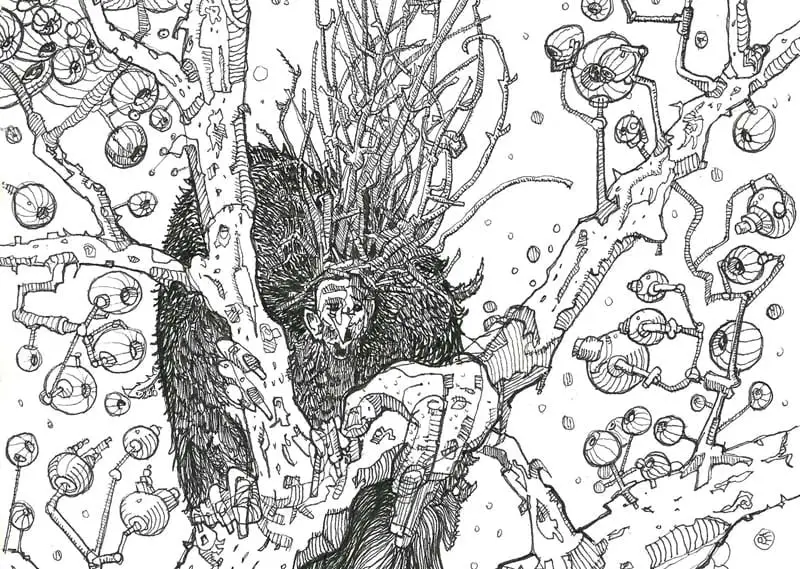
"Bright Flightways" (1975/1978)

Updated: 1 day ago

Let's begin with being right. The English reformers who enclosed the commons were right. Efficiency rose, though it cast peasants into poverty for centuries. The American temperance advocates were right that banning alcohol could curb abuse, and America got gangster empires and political corruption. The chemists who added lead to gasoline? Engines ran more smoothly with less knocking, poisoning generations. Then there is asbestos, antibiotics for livestock, and Mao’s war against the sparrows.
In Lafferty’s “Bright Flightways,” Leo Carrottop is one of these people. He is right about the small thing, but wrong about the big one. I enjoy the story because it pushes this idea as far as it can go. What if you were right that fire could be such a useful thing for people to have, but you were wrong that it would be worth it? It's Lafferty playing a high-stakes game.
"Bright Flightways" gives the reader a society in Detroit, an alternate-universe Detroit, where folks migrate south each year to survive the winter. It is a tradition-bound community, with simple tools like cold-hammered iron and simple techniques like natural enzyme preparations. A group of radicals wants to challenge this way of life by using fire for cooking, forging, and power.
One spring, during a dangerously dry season, the revolutionaries, led by Leo Carrottop, form a plan. They dress as scarecrows and stuff their clothes with straw. Then they use a lightning strike to set themselves on fire, thinking their destruction will clear the way for a new and more advanced world. Instead, they set the world on fire, and the beautifully eccentric alternate universe Lafferty has created becomes a cinder.
This is a story about the warmth of culture, about preserving it, and about how fragile it can be. But it also treats fire in a way that breaks from how fire usually works as sign and symbol. Lafferty’s signature counterfiguration is at work.
In Sacred Signs (1922), the Catholic theologian Romano Guardini (1885-1968) writes,
Fire is closely allied to life. It is the aptest symbol we have for the soul within that makes us live. Like fire, life is warm and radiant, never still, eager for what is out of reach. When we watch the leaping tongues of flame, as they follow every current of the draught, soaring up not to be diverted, radiating waves of light and heat, we feel how exact the parallel is, how deep the kinship. This fire that forces its way through the intractable material that impedes it and reaches out to touch with light the things around and make for them a center of illumination, — what an image it is of that mysterious flame in us that has been set alight to penetrate the whole world of nature and provide it with a hearth.
So what is going on in "Bright Flightways?" On one level, Lafferty detaches the hearth, that great sign of life, from culture to make an audacious statement about culture. And he is doing it in as extreme a way as can be imagined.
That fire is the great enabler of civilization is nothing new. The ancients thought it, from Prometheus to Mātariśvan. The notion has lasted and grown, becoming richer in modern thought. You see it in the sociology of Claude Lévi-Strauss’s The Raw and the Cooked (1964) and in many other places. One of the works that Lafferty’s story brings to mind is the primatologist Richard Wrangham’s Catching Fire: How Cooking Made Us Human (2009), not least because of its title and because the whole world in Lafferty’s story becomes an inferno.
More than a decade and a half ago, copies of Wrangham were everywhere. Many people take its big idea for granted: the control of fire and the invention of cooking were key steps in human evolution. Wrangham pushes hard on this, arguing that cooking with fire was the crucial fact. It changed our ancestors’ diets by making food softer, safer, and easier to digest. It saved energy, allowing for larger brains and smaller guts. He sees this shift in diet as more important than hunting or tool use in shaping what we became, something that we were not before we caught fire.
Lafferty, who strongly rejected Darwin, would have dismissed Wrangham’s argument, at least where it depends on a story about selective pressure. Wrangham’s chapter “Brain Foods” is especially relevant to "Bright Flightways" and its radical cohort who want to catch fire. In the “Brain Foods” chapter, Wrangham writes, “A series of improvements in cooking techniques most easily explain the steady rise in brain size between the major jumps.”
Lafferty’s revolutionary Leo Carrottop would agree. Arguing with the traditionalist Ramsworth Armstrong for the importance of harnessing fire, Carrottop comes up against a wall.
“Better minds? How? There's no way,” says Armstrong. “Oh, absolutely there is. We could make a great mental leap now. The new technique, if it is attempted, and even if it fails again and again, can open the mind itself to a new sense of curiosity and achievement. We have never yet entered the real houses of our own minds; we have been shuffling our feet in the anterooms, only. It may be that if wecome to eat more fulfilled food, if we come to manufacture and live with more fulfilled equipment, if we arrange to control our surroundings, then our own persons and minds will be more fulfilled by it all. Then there will be room for more intelligence, for more thought, for more life, aye, for more people in the world.”
Lafferty is having fun, not just with his inventiveness, but with frustrating certain kinds of readers, the kind he called the “science fiction people.” Part of that fun is the enzymes the "Bright Flightways" people use to cook. Meat makes sense. But bread? Really? Then there are the automobiles built by a primitive culture, with wooden frames and powered by cells. But that’s straining at gnats. The camel to swallow is failing to take Wrangham-style arguments seriously. It’s a cheat. It gets things backwards. It lets civilization, and man in his full dignity, appear before the control of fire.
At one point, Leo Carrottop says,
“I believe there are alternate worlds where controlled lightning, fire to use the plain word for it, is in common use for many things.” “And just where are these alternate worlds to be found, Leo?” Argus Brownscum asked
One can imagine the same being put to Lafferty: How is all this civilization possible without fire? While someone like the philosopher David Lewis might have to grant the possibility (“A proposition is possible if and only if it is true at one of these worlds”), a lot of modern people are going to have the strong intuition that this sort of alternate world can no more be actual than Candyland or Cockaigne.
This must be deliberate provocation. Lafferty believed such a world had existed. It was called Eden, which is connected to the Law of Intellectual Constancy, so important to him. Adam was just about as smart as any of us. The views of Leo Carrottop and Richard Wrangham deny this.
Lafferty knew how hard this is for the science fiction person to take. His intransigence on the theme is a dividing line, showing he wasn’t really a science fiction writer. Just a few weeks ago, I read a comment about how shocking it is Lafferty didn't believe in evolution. I pointed out that Lafferty obsessively writes about evolution, just not the kind that uses genetic variation and environmental filtration as its mechanism.
What Lafferty called the science fiction person will always be puzzled that a man as smart as Lafferty didn’t accept it. From the other direction, Lafferty himself was baffled. “Why has Darwinism, an inferior and comparatively late form of evolutionism,” he wrote in “Notes From the Golden Age,” “taken and held the stage for more than a century? Oh, somehow Darwin made evolution into one of the lively sciences, and it hadn't been lively before.”
“Bright Flightways” is built on this split.
The revolutionaries are right about a small, practical truth; right on the facts about “cooked food, and furnaced iron,” yet wrong about a larger, spiritual one. The Lafferty twist is that the practical truth is catching fire itself (how dare Lafferty do this to Prometheus!), hilariously validated when Agnes whispers, “Yah, it's better cooked. It really is.” And it costs the Flightways people everything. Their world, a place where a Rabbi could liturgically bless time as “the circuit of the seasons and our own road-journey through them,” is destroyed. Lafferty ends it all with one of his more powerful images, the “brilliantly bright flightways shining in every direction, but no one would ever travel on them again.”