28 Misc Laff: Asimov and Ginny in the Sun

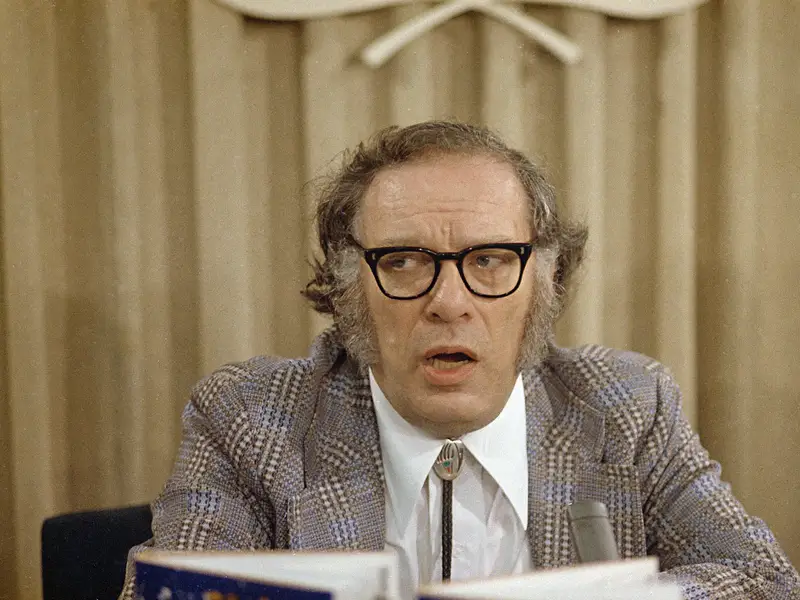

“Ginny Wrapped in the Sun” (1967) draws on a few unusual sources, including Isaac Asimov. Lafferty takes what should be a reassuring calculation from Asimov and turns it into evidence that humanity may be living on borrowed time. The source of the calculation is pretty obscure, and I came across it in some incidental reading. Lafferty, breaking into science fiction, must have read “The Slowly Moving Finger,” published in the February 1964 issue of The Magazine of Fantasy and Science Fiction and collected the following year in Of Time and Space and Other Things.
Asimov’s piece belongs to the genre of the personal science essay. If you dig it up, you’ll find that his pet parakeet has died at a little over five. The Asimov family treated it like a human, but as a bird, it aged like a bird. In the piece, this prompts Asimov to think about his approaching birthday: the former child prodigy, who would later become an honorary vice president of Mensa when Mensa wasn’t a total joke, has become middle-aged. He takes this as the launching point for asking how long different organisms can live.
He compares approximate heart rates and maximum lifespans and creates a table. Most of the mammals in his table come out somewhere around a billion lifetime heartbeats. Humans are the exception. Using a maximum lifespan of 115 years, he arrives at approximately 4.35 billion.

And he writes, with joy:
Measured in heart beats, we live four times as long!
Lafferty is going to flip this on Asimov in his short story, but it is clear that it consoles Asimov. At the end of the essay, Asimov imagines himself as:
a young fellow, a child, an infant prodigy.
Now consider what Lafferty does. Ginny is four years old, and her refusal to grow up may herald humanity's end. Dr. Minden believes our comparatively long-lived species is an unstable mutation from an ancestral form that matured at four and died at fourteen. That form may be returning. All from the Asimov family’s dead parakeet.
Explaining his theory, Minden recalls a biologist (Asimov was a chemist) who also writes science fiction, a reference to Asimov:
All the mammals but one, he found, live about the same number of heartbeats, the longer-living species having correspondingly slower heartbeats. But one species, man, lives four or five times as long as he should by this criterion.
The table, the numerical exception, and the scientist’s involvement in science fiction lock it down. It is Asimov’s essay. Minden adds:
I forget whether the biologist implied that this makes man a contingent species living on borrowed time. I do imply it.
There is a coda. Writing to Dan Knight on April 13, 1992, Lafferty was shaken by Asimov’s death. He wrote:
Asimov died since your last letter. He had no business dying. He was five years younger than I am, and people who are five years younger than I am have no business dying.


