04 East of Laughter, Chapter 1, "Are We Dreaming"

Updated: Sep 4

But the extended Group of Twelve did begin to get a grasp on reality that afternoon and night. They learned, from sources not completely suspect, that the world is indeed built on a substratum of reality, that there is a genuine and ringing reality beneath all things, that there are favored places and circumstances where everything is endowed with detailed reality, even the interiors of atoms. They also learned that they themselves were outside of reality, that they had never touched it at even one point, but that sometimes they came close. They were imbrued, all through their happy suppertime and into the night hours, with an almost-happy philosophy. They hadn’t yet come to the centrality of the philosophy, but they found themselves more and more on the near fringes of it as they discussed andreveled and studied. They learned that a quest for reality is possible.
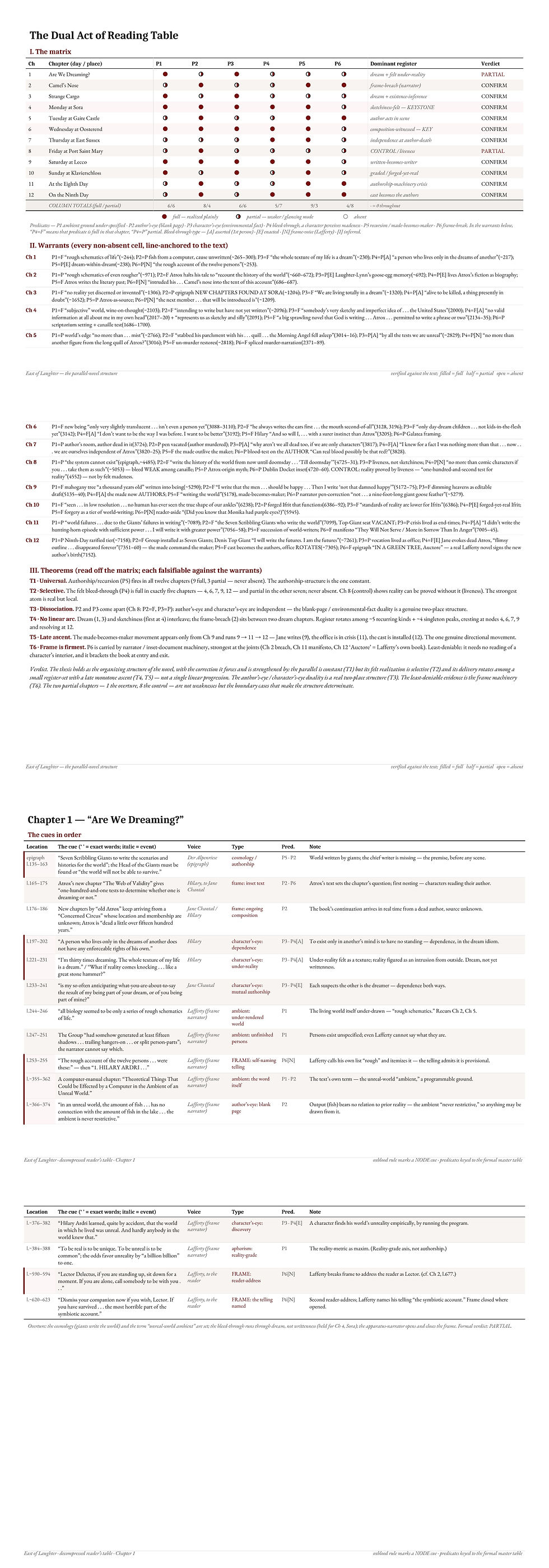
Chapter 1 of East of Laughter begins with a quiet explosion: the quotation from the Alpine giant explaining that reality is sustained by twenty-one “Pillars,” which sets up the novel’s exigency of replacing the Scribbling Giants, those life-weary, often melancholy, and often blood-hungry writers of the world’s history. They somehow write our being, and they can be wantonly destructive. It then introduces two vividly imagined primary characters, Hilary and Jane Chantal Ardri, members of the Group of Twelve. Hilary will be far less important to the ensuing narrative than Jane Chantal, but both are selected for a mysterious global service through the Concerned Circus, along with the rest of the cohort of twelve plus three. Using tests devised by the giant Atrox Fabulinus, tests collectively called the web of validity, Hilary and Jane Chantal realize that their world is unreal. What is one to do about that?
Let’s begin with the obvious. This first chapter breaks a sound rule for selling fiction that Lafferty had been given by his old editor, Frederik Pohl: begin a novel with action. No bang is too loud, so shake the earth by starting thunderously. It is how Lafferty readers got that firecracker Chapter 1 of Past Master. Instead of beginning with pyrotechnics, East of Laughter delays all plot-progressive action until the reader ruminates through its twelve sequentially numbered character vignettes. The expository material takes up Chapters 1-3. Only in Chapter 4 does a book that looks as if it could become a conventional novel zing off. Of course it isn't a conventional novel. It is late Lafferty. I read chapters 1-3 as a moseying prologue to what follows, but also as a reorientation device for rereading. Lafferty lovingly places each of his twelve, plus three, onto the game board. He takes his sweet time. For readers not smitten with this cast, the road ahead will be long.
As I mentioned above, Chapter 1 profiles the first three members of the Group. Hilary exploits the unreal physics of the unreal world to harvest nonexistent fish through a poltergeist-inhabited computer. It makes him rich. Jane Chantal, prolific artist and part-time huntress, delegates the labor of her pursuits (and even, it seems, artistic inspiration itself) to her own sprite-operated machine, raising the question of what it means to be an artist.
Finally, there is the unforgettable parasitic pair of John Barkley Towntower and Solomon Izzersted. John is a human mathematician and ventriloquist whose body hosts Solomon, an aggressive, sentient belly growth, right on his navel. Solomon is an egomaniac and superior mathematical genius who dominates Towntower, even forcing John to adopt Solomon's name legally as the two develop “advocacy mathematics” and their ventriloquist act. Later, we learn Solomon is the son of Iofel, a trickster watcher who impregnates goyim with Jewish offspring. How he showed up on Towntower’s stomach flab is never really explained, but he may have been inadvertently baptized.
In this first post on the chapters of East of Laughter, I want to pause here to say that there is no natural place to start with this unruly book. One could begin almost anywhere, provided one kept rereading. My preferred way of rereading it is out of order. In time, one owns the work, as readers always own a book they have internalized. One of my old profs was at Princeton in the early 1960s, and his prof (a monument man) drew two gingerbread man outlines on the board. Slowly, he filled in the small gingerbread man with things the students knew: saddle shoes, Playboy, Ann-Margret, etc. Then he filled in the big gingerbread man with things like Homer, Dante, Montaigne, Shakespeare, Faulkner. Then he turned around and said in a venomous southern drawl, you here boys are that little gingerbread man; I’m the big gingerbread man. I like that anecdote because the aim is always to be the big gingerbread man if one thinks a work is important. His lesson I assume was that reading is about the enlargement of one’s inner world, making the gingerbread man bigger. I think East of Laughter is a book that wants to enlarge the reader. It is full of detail that will do it.
Like any work with this kind of ambition, East of Laughter is also not a book meant to be read once. No one can internalize it in one reading. Too many events. Too much detail. Lafferty said this about all his novels, but it is especially true of this one. It is one of the ways that Lafferty, who snorted at academics and literary pretense, is literary and academic. That is bad news for the reader who wants to storm through it for cheap thrills, because a first reading is likely to yield only a series of brilliant set pieces, pieces of microfiction, and isolated wonders. When Gene Wolfe wrote his essay about it, he had many warm things to say about Lafferty, but one can see how measured he was in his praise of East of Laughter. He praised the man, not the book. I suspect he thought it was a wise dud of a book. In Chapter 1, the microfictions would include the computerized fish set piece, the hunting-horn computer set piece, and the Solomon Izzersted-Towntower shtick, a minor masterpiece. Almost everyone has the experience, on a first reading, that the East of Laughter gestalt is smaller than its microfictional parts. That is why I want to propose a way of reading it that will lead to a greater whole, because I think most people get the novel's figure-ground wrong. It is a double figure-ground relation.
One recurring claim of this blog, following Lafferty himself, is that every Lafferty reader must assemble his own Lafferty. So with East of Laughter, I am just going to say how I read it, though that may not be how another reader wants to read it. Still, this is the double figure-ground reading that has made the novel rewarding for me. It requires a double act of reading. That understates its complexity, which is fractal, but it is what I see as being primary.

On one level, inside the novel, one reads about a hierarchy of dream and reality, with dream as figure and reality as ground. Dream and unreality, at the level of narrated events, correspond to fiction at the meta-level: dream simply is the status of the fictional as fictional. Within the novel, questions keep arising because on the fictional plane the fictional does not seem fictional, just as the dream does not seem dream when dreamt, and just as the fictional segments of one’s own life feel real. These issues in the book concern what is real and what is unreal; where the real begins and ends; whether there is a delimitation; whether someone unreal can become real; when and how a forgery can surpass its original and so become, in some sense, more real than its original; whether to be real is to be perfected; and what ontological status belongs to forgeries that have no originals but the efficacies of the real. I don’t believe there is any answer to this inside the novel except through the Laughing Christ, who is both a Lafferty character and Lafferty’s God. Without this one is caught in a network of derealization. So, on my reading, the novel is meant to push one back to reality and its ultimate ground as an act of inspired writing. That reality is Atrox’s avowed most prized thing: Christological knowledge.
For this reason, when I read East of Laughter, I read every word of it through a double act. I read it slowly as if Lafferty is imagining in real time, dredging from the Oceanic to intimate a shape that can only be filled out by logos. There is R. A. Lafferty writing his weird book, imagining his strange cast of characters, being surprised by what these eccentric, unreal people say, and making them probe their own ontological status. He pressures them hard, slipping his finger into the open wounds he himself slices into them. Hilary Ardri brings the primal logic into view at the jump:
“Atrox Fabulinus, in a very curious new chapter The Web of Validity, givesone-hundred-and-one tests to determine whether one is dreaming or not,” HilaryArdri said to his wife Jane Chantal Ardri at breakfast one morning. “This may bea major new chapter from Atrox, but all of the recent ones seem to be major.”
Lafferty can reach into the book, kill his characters, and bring them back to life. His hovering ghostly authorial hand will look like the hand of Atrox from the characters’ in-fiction perspective. Within the storyworld, they die by being impaled on the Giants’ enormous feather-quills. They bleed profusely. On the metafictional plane, Lafferty is killing them with his own pen as he scratches them into life and out of it. What is blood inside the novel is ink at the level of authorship. What within the book is a plot problem becomes on the meta level a theory of fiction, authorship, and created beings.
Again, the first chapter sets this up. Hilary Ardri’s computerized world can draw anything from the ambient, which is why he can pull nonexistent fish from Tenkiller Lake, a lake with no fish. Lafferty explains the mechanics of this unreal extraction:
To take one example, the one that he did take, he learned that in an unreal world, the amount of fish that may be taken out of a lake has no connection withthe amount of fish in the lake. The amount of fish to be taken out is relatedonly to the amount of fish that the computer programs to be taken. It does not matter whether or not there are any fish at all in the lake. In an unreal world, the ambient is never restrictive.

Why not restrictive? In part because this is what every creative writer does in drafting a story or novel: he begins with the unreal ambient of the blank page and brings things forth from it. Where there were no fish, there are fish. Contradictions may be intolerable in reality, but they do not break fiction. Tenkiller Lake can have no fish, and yet Hilary’s company can supply fish from Tenkiller Lake. Words make it so.
This metaphysical awareness of writing lies near the center of the novel. The reader is invited to experience the work from Lafferty’s side, as if watching him make the book in a way unique to his canon. In Chapter Four, “Morning at Sora,” we discover that the characters are, in some way, even aware of their own unreality as literary fictions. They speak of their sketchiness and blame it on Atrox, but Atrox is himself a figure behind whom Lafferty stands. To read East of Laughter well, then, one must keep one eye on the authorial plane—Lafferty creating fictional worlds and testing his act of creation itself, talking to himself about it—and the other eye on the characters, who know they are fictions yet, by the law of the fiction, remain “somehow” real within their own plane, authored there by Atrox Fabulinus and the other Scribbling Giants. If you were told you were fiction and could prove it, you would be in their situation.
This becomes relevant to a second theme established in Chapter 1: creations escape their makers if they are lively inventions. If the book requires a double act of reading, and if it enacts real authorship through Lafferty while staging his own fictional authorship through his surrogate Atrox and the other Giants, then much of the drama lies in watching created things run beyond the intention that made them. As I pointed out in my first post, the book has an Eden theme, and running ahead is what those people did. Atrox experiences this with his own creations, the Twelve plus Three, seven of whom will replace the old Giants. He is surprised when his characters do not act as he thinks they should, though he has authored them.
At the level of real authorship, this same pattern helps explain some of the novel’s confusion. Lafferty presses his characters until they say things they could not have been expected to say, and until they surprise even him. When the characters are magically whisked from one location to another and complain about landing hard on a road in Ireland, the novel offers only a perfunctory in-world explanation:
“ . . . we are two hours earlier than at Sora in Italy. And it was a slow and old, preter-historical really, shuttle that brought us here, not instantaneous likethe shuttles they have now. But I forget how long the trips take, that broughtus here and dropped us so rudely into the street. The street must be six orseven feet lower than it was twelve hundred years ago.”
Part of the joke is surely that Lafferty, the real author of these unreal persons, has unceremoniously dropped them onto the streets of Ireland.
Chapter One also establishes one of the novel’s major concerns: created persons getting ahead of their maker. After we meet Hilary Ardri and Jane Chantal Ardri, and after Lafferty gives us Jane’s parody of what it means to be an artist in an unreal world, we meet John Barkley Towntower and his belly-growth, Solomon Izzersted. We also learn about their advocacy mathematics and their ventriloquist act. The advocacy-mathematics material offers a mock-explanation for pulling fish out of the ambient in an unreal world, and so it links the two halves of the chapter: the two Ardris on one side, and the two-in-one Towntower/Izzersted on the other. In the account of Izzersted, we learn that Solomon usurps the very ground of his being, as it were, in the body of John Barkley Towntower:
It was, in fact, the ventriloquist’s figure Solomon Izzersted (the stronger-willed of the two persons in the association) who compelled John Barkley Towntower legally to change his name to Solomon Izzersted, though permitting him to keep John Barkley Towntower as his stage name . . . Should the John Barkley Towntower name ever be used in any non-theatrical way, the bellyvoice (Solomon was the belly voice and person) would immediately begin that horrible screaming “My name is Solomon Izzersted! My name is Solomon Izzersted!”
This is the novel’s first instance of a created figure refusing to stay in place, and it anticipates the ending, where Solomon Izzersted tries to usurp the headship of the Scribbling Giants. The comic horror of Solomon taking over John Towntower is an inset image of how the characters in the novel work as a whole. It is grotesque, certainly, but one can imagine Lafferty looking at his characters much as Towntower looks down at his own belly, where Solomon’s head shouts, “My name is Solomon Izzersted!” That image conflates the two levels of the double reading, but it also establishes the problem the novel keeps returning to: in such a world, where is the substratum of reality?
That question will open, finally, onto larger questions about history, fiction within history, the World of Fact, and, after the World of Fact, the Quest for an Acceptable Metaphor. It will also lead into the philosophy of history. In the World of Fact, the law of the aggregate holds: the world is the sum of the facts, and there is one history of the world. Lafferty’s post-novel is an attempt to write about a world that is not like that. There are many pasts because the past underdetermines its transcription. What one needs, then, is not a tally of facts but the right metaphor. By the end of the book, if one doesn’t know the metaphor, has the Quest for Reality failed? Of all candidates for a world metaphor, it seems obvious to me what Lafferty proposes: the world is a forgery. Much more on this later.
I’ll close by saying that East of Laughter should not be read only as a bedtime story, with the reader settling in and letting the world fall away. It is not a safe fantasy projected onto a screen, but one that pokes its author (self-dramatically and funnily) and the reader in the chest. If you are lucky enough to have a copy, let it light up your brain over and over. It should be a pantographic projection, one of its own metaphors, but also otherwise. One sees more if one reads every word as though Lafferty were calling nonexistent fish from the ambient of the white page, then interacting with what he trawled, getting himself into deeper and deeper fictional difficulty as he works toward the substratum that grounds his own reality, the Laughing Christ. One formula for this is that East of Laughter is a participating apocalypse of authorship and readership, an intimate prose experiment so coded that its intimacy can be elusive. Chapter 1 teaches the reader to read East of Laughter as a fiction of fictional beings discovering their own fictionality, while their author uses them to think toward the ground of reality, which the novel finally grounds Christologically. In other words, the characters in East of Laughter seek reality from inside the book; Lafferty seeks reality by writing the book; the reader participates by reading the book as a doubled transposition. A fuller appreciation of Prime is the aim.
But the extended Group of Twelve did begin to get a grasp on reality that afternoon and night. They learned, from sources not completely suspect ⟦something they half-trust is telling them this, and the hints are leaking in from outside their world from their real author, RAL⟧, that the world is indeed built on a substratum of reality, that there is a genuine and ringing reality beneath all things, that there are favored places and circumstances where everything is endowed with detailed reality, even the interiors of atoms ⟦some things are more real than others; the most real places are the ones drawn in full detail⟧. They also learned that they themselves were outside of reality, that they had never touched it at even one point, but that sometimes they came close. They were imbrued, all through their happy suppertime and into the night hours, with an almost-happy philosophy. They hadn't yet come to the centrality of the philosophy, but they found themselves more and more on the near fringes of it as they discussed and reveled and studied ⟦near it, never at the center; the same "close but never touching" again⟧. They learned that a quest for reality is possible ⟦and it is possible. Not because they can reach the real from inside the story, but because Lafferty, who is real, is writing the quest from his side as he thinks through what reality is. The quest is his act of thought about Prime, and they are that thought given characters and names. So the seeking does reach the real, because it is happening in a real mind, even though the seekers never reach it themselves, being the things sought-with rather than the seeker. They are objectifications of his thinking about reality. The quest is real because the thinker is real, and they are what the thinking looks like from inside.⟧.