03 East of Laughter: The Laughing Christ

Updated: Sep 4

“We already had the World of Fact. Oh, the poor, dingy, hopeless, small-minded World of Fact! It didn’t deserve much, but it deserved at least to have its nakedness clothed with metaphor and mythology. The World of Computers is bearable. The old World of Fact was ceasing to be. “Even the Quest for Reality of the talented but diminishing Group of Twelve has now changed (without their knowing it) into the Quest for Acceptable World Metaphor.”
East of Laughter buries the lede, so I want to say something about that. The lede is the nature of reality, which for Lafferty is Christological. Hence the importance of Lafferty’s strangest and perhaps most challenging creation, the Laughing Christ, the seemingly center of his worldview and his most radical break with the Catholic tradition. For most Christians the idea of the Laughing Christ is uncanny. None of the major theories of humor can accommodate it.
Lafferty first introduced the Laughing Christ in his novel The Fall of Rome, which he wrote in the early 1960s, although it wasn’t published until the early 1970s. There, the "laughing Christ" is an extraordinarily profound and fulfilled image originally carved by Creophylus. And who is this Creophylus? Well, Lafferty never tells us. There is just the name. Immediately problems arise because the historical Creophylus of Samos was a legendary poet, said to have been a pupil of Homer. He is associated with a lost epic, the Capture of Oechalia. This makes the known Creophylus flagrantly anachronistic and pre-Christian. The legendary figure was a poet, not a sculptor. In the Creophylus legend, the idea for the epic poem, and in some versions actual work itself, had been given to Creophylus by Homer as a sign of friendship.
In The Fall of Rome, whoever Creophylus is, his depiction of Christ plays an important narrative role. It is embraced by the clever Greek-Goth Singerich, who sees it as representing a much truer Christ than the solemn figure revered by the Puritans and Manichees. It is a hopeful image that points beyond a Rome that has exhausted itself. In creating it, Lafferty clearly drew on Chesterton for inspiration, just as he did for the entire theme of The Fall of Rome, which takes Chesterton’s The Ballad of the White Horse as one of its launching points. The following lines should be known by every Lafferty fan because of the weight Lafferty gave them and because they are present in every one of his world endings.
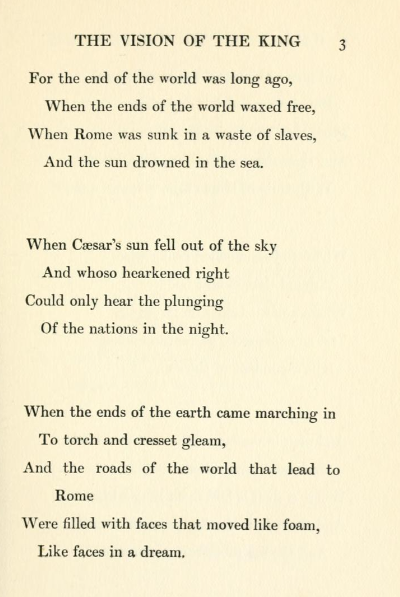
Christianity, in other words, is not Rome. These lines about the world having ended many times before are the source of so much of Lafferty that it is remarkable that no one has emphasized them. In The Fall of Rome, the Laughing Christ is specifically linked to a latent Gothic inclination toward grotesque playfulness and unruly humor Lafferty likes, something uncanny and yet regenerative. We learn that this Gothic trait blossoms centuries later when French cathedral builders craft "another Laughing Christ" by a Gothic hand. Think of all the gargoyle love in both Chesterton and Lafferty. Chesterton wrote a poem where Christ laughs alone, away from all observation, but Lafferty wants the reader to see the laughing face of Christ.
In East of Laughter, Atrox dies his second death, and we know that as he dies, so finally dies the fifth century, which makes East of Laughter an offshoot of The Fall of Rome:
“Oh, it is a memorial. The Fifth Century is finally over with. The last man who was still living in the Fifth Century is dead now, so that era is finally finished. I wonder whether any other century can now dispute the twentieth its reality?” That was Gorgonius giving those words.
East of Laughter, one could say, buries The Fall of Rome. Rome has finally fallen completely. The age of the great cathedrals, in which the Laughing Christ reappears in The Fall of Rome, belongs to the holiness of the thirteenth century, which Lafferty calls in East of Laughter the holiest of all centuries. It is the one century untouched by the strangulation sickness that is starving the world of input:
“The Thirteenth, the Holiest of Centuries, was spared the apprehensive sickness,” Father said. “But Friday night, the fifth night, is usually the worst for the victims. That is the night of the nightmares, of the deliriums, and of the deaths.”
In East of Laughter Lafferty rewrites this. At one point, Denis Lollardy says that the Laughing Christ is his greatest "creative forgery," a piece he sculpted from fine travertine marble with no physical original, which he then buried for 15 months to give it an authentic patina of age. Atrox Fabulinus will reject this and then vehemently accuse Denis of theft. We hear the cogs turning as one aeon leads to another. In fact, Atrox goes further. He says that the artifact is not a statue at all, but rather the living Christ himself "in the train of his second sepulture," whom Atrox had buried in the Italian earth to one day rise out of the ground and renew the world:
“Denis Lollardy, besides you being a common forger, you are an uncommon thief. You stole from me the thing I most prized in my life, the thing that has authorized my strange continued life. That was the statue or figure of eidolon The Laughing Christ. Well, it has been mistaken for a statue or an eidolon, but I believe that it is the Christ himself in the train of his second sepulture. I buried him, as he had instructed me to do, in the ground of Italy. And after three quinque-centums of years he was to rise out of that ground again and renew the world.”
As the thing that ties the old top scribbling giant, Atrox, to his replacement, Denis (complicated by the rotation principle in the novel), no matter what one makes of it, the Laughing Christ is deeply important. Unless one struggles with it, the novel will refuse to disclose its inciting meaning: how does the Laughing Christ span all aeons. The Laughing Christ drives what is happening as the World of Fact ends and the Quest for Acceptable World Metaphor begins. We are told that it is a thing of overwhelming joy and profound beauty:
Well, this was the most pleasant piece of statuary that any of them had ever seen, slightly larger than life-sized, and wrapped in the colored cleanliness of its own laughter.
It can work genuine miracles, and this terrifies Denis, who is somewhat like Thomas More as depicted by Lafferty in Past Master: often a borderline believer. The Laughing Christ can cure the melancholy of anyone who gazes upon it, and miraculously changes a Roman lady's horrible nose into a feature of immense joy and pleasure:
Thunderation! The statue did work genuine miracles. And it terrified one man. Denis Lollardy had never been a pious man. He had only been a borderline believing man. But he knew miracles when he saw them, and he was terrified (Oh, but there was joy mixed with the terror also) by the miracles worked by the Laughing Christ that he himself had carved.
It will also have an interesting connection to Saint Faunus, who, it turns out, inhabits it in Lollardy’s garden like a "Superman telephone booth to change into his Superman costume," a point that I’ll get into when touching on the chapter where it appears. Just note that this trope is the one finds in Milton’s great nativity ode with the death of the oracles.
At the center of the whole mystery of the Laughing Christ in East of Laughter is a stubborn contradiction. Atrox says he buried the real Jesus Christ in the ground of Italy fifteen hundred years ago, at Christ's own instruction, and that Christ was to rise from that ground in 1998 and renew the world. That is the promise of the parousia. The future has been botched, from Atrox’s perspective, but it is the perspective of the fading old regime, and it is one sided. Denis says the figure unearthed at Lecco in 1998 is his own forgery, carved from travertine in 1996 and buried briefly to age it. He explains to Atrox exactly how this paradox came to be:
“No, Atrox, you are wrong,” Denis Lollardy said firmly. “You did not bury him in the ground, you buried him in your mind. And I found him there, for all of us can raid into your mind as you can raid into ours. And then I carved him out of fine travertine marble. He was one of my greatest forgeries, forgeries for which there was no physical original.”
The two accounts look incompatible, but are they? It is perhaps the deepest mystery in the book, and as I said the lede has been buried. We will want to keep an eye on it as we proceed through the novel.