"Try to Remember" (1959/1960)

Updated: 8 hours ago

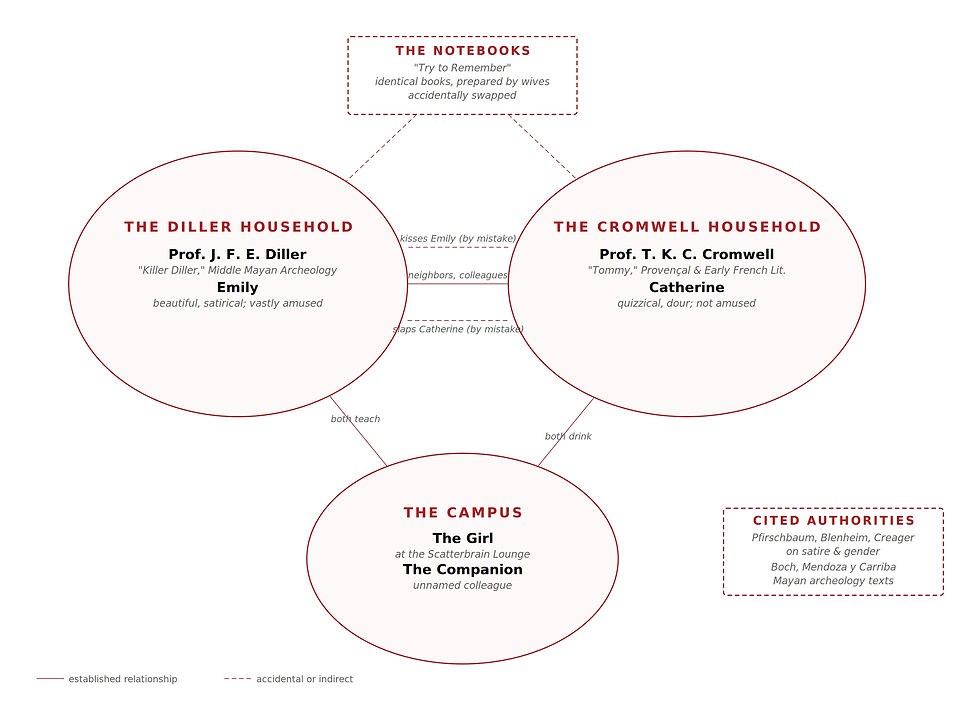
The professor looked at his watch, looked at his schedule, saw that he still had a little time before his final class, glanced at the final entry in the book, "I love you, Emily," smiled, closed the small notebook, and put it in his pocket. "Women have a satirical turn of mind," he said to his companion. "What? Are you sure?" the companion asked. "Blenheim denies it, and the evidence in Creager is doubtful. And Pfirschbaum in his monumental monogram Satire und Geschlecht has gone into the problem rather more thoroughly than most, and he is not of your opinion. And we have here on our own campus a fellow, Kearney, who is widely read in the field. If you have independent new evidence, you might go to him with it. He will appreciate it." "No. I am sorry. I phrased myself badly. I should have said that my own wife, in a particular instance that has just come to my hand, shows flashes of satire. I realize the dangers of generalizing. As to making a statement about the mind of women generally, that is beyond my scope."
One of my favorite books of the last twenty years is Christopher Miller’s American Cornball: A Laffopedic Guide to the Formerly Funny, his documentation of a crazy array of bygone Americana. While Miller sometimes goes wrong, he had a terrific idea when he conceived his pseudo–reference work on formerly funny because few cultural questions are as puzzling and interesting as the formerly funny. It belongs on the same shelf as Gershon Legman's two volumes of The Rationale of the Sexual Joke.

The illustrations in Miller alone are worth the price of admission. What Miller identifies are many things Americans used to laugh at. They are present now as cultural residue when we stream old media or read older materials. There are tough alley cats perched on dent-dimpled trash cans belting out “Sweet Adeline” into windows, cabbages, scrunched faces saying “Phooey,” rustics, dowagers, the too fat, the too thin, banana oil, gold diggers, mothers-in-law, visions of whole hams, dishwashing husbands, and so on.
Reading it, one will be struck by how much of it overlaps with Lafferty, though he transmutes the cornballisms. A Miller entry sketches his thoughts on a cultural object's path from a sure bet for a cheap laugh to a cultural corpse. The first entry in American Cornball is Absentminded Professors.

Even though I like Miller’s eccentric little book, the Absentminded Professors entry shows some of Miller’s weaknesses. Miller focuses most on Disney’s The Absent-Minded Professor (1961), noting that the film came from Samuel W. Taylor’s short story “A Situation of Gravity” (Liberty Magazine, 1943). He knows this is not enough, so he makes an aside about Rube Goldberg. That is crowd-pleasing.
One reason Miller does not seem to know is why Disney retitled Taylor’s "A Situation of Gravity" during its adaptation. Certainly, The Absent-Minded Professor (AMP) is catchier, but that is only one part. Recognition played its role.
The phrase absent-minded professor was a staple of American popular humor. Disney knew it would land because everyone in America recognized it, because AMP jokes were everywhere, and because they had once been pure Americana. One found them in places as different as old engineering magazines and ladies’ magazines.
The AMP joke had a form, a basic setup that had been in the popular imagination since the late nineteenth century. To begin, one would say the magic words “absent-minded professor,” and then roll out the rest of the joke. Everyone knew the silliness that was coming and tried to anticipate the twist.


In the wake of Sputnik, a writer in a 1957 issue of Commonweal even wagged a finger at the popularity of absent-minded professor jokes, blaming them for discouraging young men from pursuing careers in science.
If we could recall all the absent-minded professor jokes that kept young men of talent from turning to abstract science, how gladly we would do so. If we could go back in time and reward all those of talent and genius who gave up scientific speculation for industry and larger paychecks, how pleased we would be to do so.
It would not be a problem for long. The AMP would disappear, and the nerd would appear. After the enormous success of Walt Disney's The Absent-Minded Professor, any child who heard the AMP phrase immediately thought of flubber. Earlier ephemera—like The Absent-Minded Professor comic strip that once ran in daily newspapers alongside Harold Teen—were consigned to the memory hole.

Really, after Walt Disney put flubber on the soles of the AMP's shoes, the absent-minded professor joke form didn’t have a chance. Disney overwrote the phrase “absent-minded professor” in the American mind and memory the way it overwrote Andersen's Little Mermaid, Salten's Bambi, and Travers' Mary Poppins. The absent-minded professor joke was torn apart like a low-culture Orpheus and handed over to the aggies, blondes, Poles, and the rest. To be fair, it was probably time.
I point this out because a reader of Lafferty’s 1959 short story “Try to Remember” will miss much of what the story is doing if it is read simply as a very amusing light tale about two absent-minded professors. Read that way, it will amuse, but the story originally depended on Lafferty’s readers being familiar with the groan-worthy old joke-form, not just a character type.
Lafferty is being very Lafferty here. He is about to tell the longest, shaggiest, most belabored version of one ever written. He makes the joke-formula impossibly shaggy, running it through all the familiar places and scenarios: the faculty lounge, the classroom, the exchange, the bar, life with the wife, and so on. All of it is the mise-en-scène of the absent-minded professor joke.

Most readers today have probably never spotted an absent-minded professor joke in the wild. I certainly haven't. It makes this feather-light story an example of Lafferty’s not-at-all-light theme of cultural amnesia, a sliver of loss in the cultural peneplanation of Flatland.
Consider that “Try To Remember” first appeared in Collage Magazine in 1960, about four months before Disney’s The Absent-Minded Professor premiered, when the joke form was still culturally obvious.
What does amnesia look like? Behold Roy Torgeson introducing the story in 1979, when "Try To Remember" was reprinted in Chrysalis 6 (Zebra Books):

The main character in "Try to Remember" is Professor Thomas K. C. Cromwell. He begins his day relying on a small black notebook prepared by his wife, which manages the “unessential” details of his life. Unknown to him (and to the reader at this point), he has an identical-looking notebook to a colleague, Professor J. F. E. Diller. The notebooks of the two absent-minded professors are accidentally swapped in the teachers’ lounge. The entire story plays out as Cromwell, now living as Diller, follows the instructions in the wrong book.
Cromwell is so absent-minded that he steps fully into Professor Diller’s identity. He thinks his name is John, that his nickname is Moxie, and that his academic specialty is Middle Mayan archaeology. Lafferty is very funny about all of this.
When Cromwell teaches an elementary archaeology class (he is a naturally gifted speaker), he has a nagging sense that he may be lecturing on a subject he does not actually know. After class, he visits the Scatterbrain Lounge and follows the notebook’s precise instructions to drink exactly four Cuba Libres, prompting another round of Lafferty jokes. He then takes a taxi to the Diller residence. There, he greets Diller’s wife, Emily, whom the notebook identifies as his wife, with a passionate kiss and affectionate conversation. It amuses her.
Although Cromwell is the story’s main character, Emily acts as a displaced co–main character, the archly witty voice behind the notebook’s instructions.
Everything is resolved when the real Professor Diller arrives at the house, accompanied by Cromwell’s actual wife, Catherine. Cromwell remembers. Emily is amused by the confusion, but Catherine is frustrated, since Professor Diller has made the same mistake at her home. The two men swap notebooks. Cromwell finally reads his own instructions and returns to being a professor of Provençal and Early French literature. The story ends by jokingly blaming the wives for making the two reminder books look so similar.
Lafferty loves lampooning professors, from the outright cartooning of “A Special Condition in Summit City” to the more philosophically interesting takedown of Professor Potter in “The Cliff Climbers.” We meet Professor Cromwell and Professor Diller again in “The Man Who Walked Through Cracks,” which is much more serious about amnesia; it is called “long-toothed fog,” a condition that obscures the cracks in reality. Lafferty’s critique becomes a real one in that later story, with the two men using knowledge as a means of control.
“The Man Who Walked Through Cracks” was written about a decade and a half after "Try To Remember." The college meltdown of the 1960s was over. No longer collegial, the two professors are treated as ideological enemies. It is a story with a much harder edge. Then there is that far stranger story, on its own plane of fictional reality, "The Man Who Walked Through Cracks."
Americans now feel very differently about the professoriate than they did in the 1950s or the 1970s. The culture wars have erased the better-natured anti-intellectualism of the 1950s, which, of course, had its dark side. The hatred once directed at the student movement by the right in the 1960s now attaches to the professoriate itself, the students having become the teachers, and their students having become the teachers. People now look at professors, and they don't think of absent-mindedness. They think about student loans. Between it all drifts Walt Disney’s Professor Brainard, puttering past in a Model T and leaving a cloud of amnesia in his wake.