"Told As Twilight Fails" (1976)

Updated: 10 hours ago

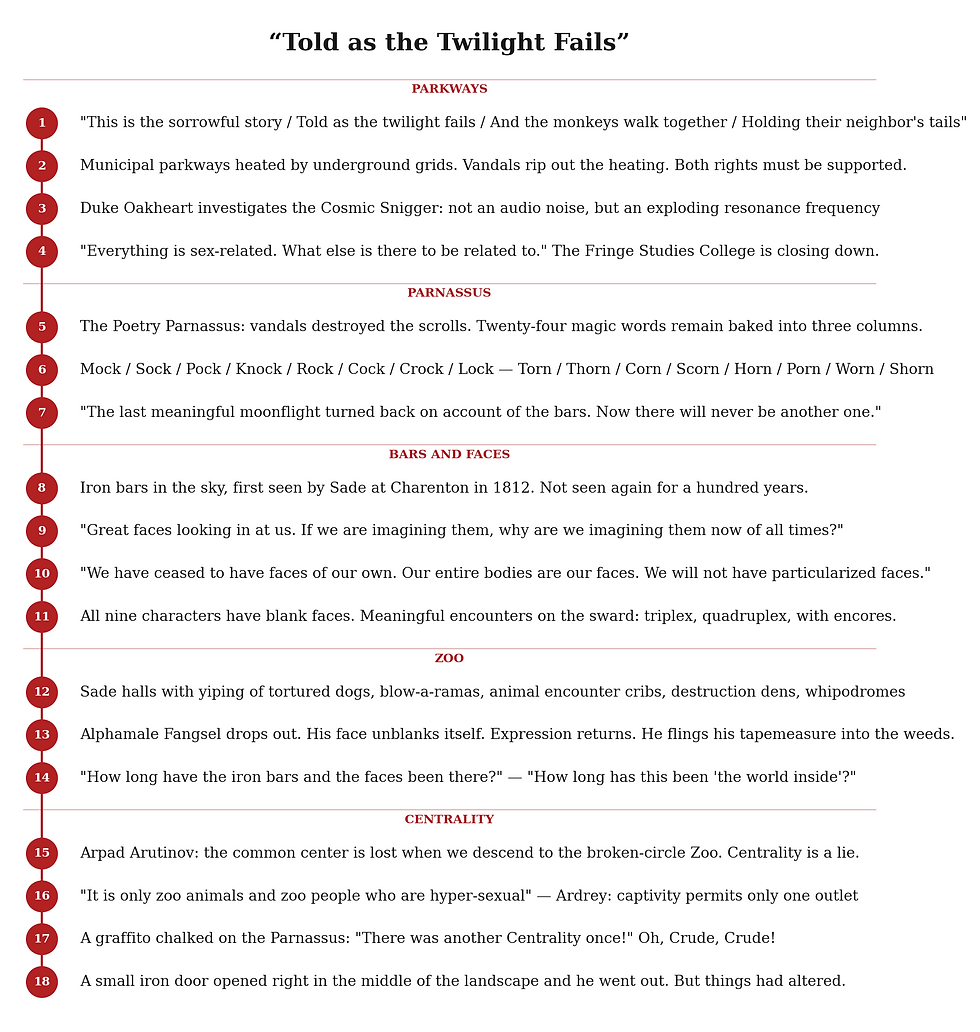
“That may well be,” I argue. “Sex may be implicit in everything. But I want it out of everything and right here in one piece where I can see it and smell it and taste it and feel it and watch it. When is the main act? When do the people do it? What is this run-around that you keep giving me?” — “Sex and Sorcery” (1973)
There are more than a few unrealized but fascinating story premises and unfinished fragments in Tulsa. One of the stranger and more interesting is “Told as Twilight Fails.” It belongs to a small group of stories that Lafferty never quite got right. These are angry, combative, and more than a little crude stories. They mock by going low, and in that sense, they are closer to morally serious lampoons than to satire. The most finished example is “Sex and Sorcery,” with its grotesque porn-star protagonist. It has been called funny, but it makes me cringe. A story like “Brain Fever Season” touches on the edge of what these stories treat as their center, but it keeps its distance. Even though I find it unpleasant.
These are works in which Lafferty explores the question of what went so wrong with sex in the 1970s, the period of Porn Chic (1969-1984). “It is named Pit and Crotch and is just plain the latest thing in scents,” as the protagonist of "Sex and Sorcery" puts it. Before I get deeper into this post, I will say that Lafferty was prescient about the pornification of America and what has happened to its culture. What has me thinking about it today is porn being spammed on his Facebook group.
“Told as Twilight Fails” is one of the stories where he tried to attack the problem. For all his powers as an artist, this was not his strength. The story takes place in an enclosed society known as a “Life Park” or “Zoo.” In the Life Park, there are manicured lawns kept warm by underground heating grids. The culture is built on a central contradiction. It supports, by law, both “the people's right to comfort” and “the people's right to vandalism.” Daily life has two main aims: to protect a state of “blessed tedium,” and to engage in “meaningful [sexual] encounters.” These encounters are public sexual acts, often performed in groups on city lawns. Lafferty says they occur at a measured density of “2.7 per square meter per twenty-four-hour day.”
The story takes place in a world of deep intellectual decline and deathly pomposity. People group themselves into scholarly institutions, but these are becoming obsolete under a dominant ideology called the “Centrality” or “Central Validity.” There are groups like the Fringe Studies College, the Kinky Flexibility Foundation, and the Swinger-Dinger Institution of Packaged Life-Styles. These institutions are being shut down or are going out of business as society turns its focus to boredom and rutting.
As in a few other stories Lafferty wrote, the principle at work is anti-life, and here it is described as sniggering. In this case, the snigger is vast. It is the “Cosmic Snigger,” not a sound but an “exploding resonance frequency” that gives people confidence in their beliefs. Lafferty invents an elaborate backstory for the Cosmic Snigger, but it turns out to be exactly what it sounds like. It reduces life. It makes people smaller. Its spirit is captured in the Poetry Parnassus, a monument where the great works of the poets have been destroyed by official vandals. In their place are 24 rhyming words, described as a “distilled essence,” on three columns.
First Column | Second Column | Third Column |
Mock | Torn | Chew |
Sock | Thorn | Skew |
Pock | Corn | Slue |
Knock | Scorn | Shrew |
Rock | Horn | Mew |
Cock | Porn | Screw |
Crock | Worn | Loo |
Lock | Shorn | Zoo |
Aesthetically, this is Lafferty at his worst, so very on the nose it honks. But he had the good sense not to publish this story and the good sense to feel it acutely. Even so, because it is a Lafferty idea, there are some remarkable things here.
That brings me to the story’s most interesting part. The world it describes has vast, possibly hallucinatory boundaries. It is surrounded by bars or grates that some characters see as illusions, but the bars are spiritually solid enough to cause a moonflight to turn back. Where did the bars come from? They were first seen by the Marquis de Sade in 1812. The bars are now accepted as a comforting barrier that keeps the outside world out. Along with the bars are the “Great Faces,” huge, silent observers who watch the people inside. These outward-looking, expressive faces appear just as the people themselves have lost their own expressions. Nearly every character is said to have a “blank face.”
This is the story I wish Lafferty had written. In general, I do not care much for the French theorists when they go double Dutch, but I think they were right about the importance of Sade in modernity. I think Lafferty was right.
I want to give a few examples of why. In books like Erotism: Death and Sensuality (1957) and Literature and Evil (1957), Georges Bataille made a well-known argument. He claimed that the Marquis de Sade is essential to modernity because he represents the ultimate case of sovereign transgression. Bataille could hardly have been more different from Lafferty. He believed that society runs on a limited economy of reason, usefulness, and rules, which superficially sounds like RAL. This, he said, represses the human need for excess, violence, and waste—the “accursed share.” For Bataille, Sade’s work maps this forbidden zone. His libertines may be immoral, but they are involved in a strange and serious quest to break every taboo. They aim to achieve a form of sovereignty that transcends rational law and human community.
I do not doubt that Lafferty would have seen this idea—that eroticism, violence, and the sacred are tightly connected—as being given a Luciferian color in Bataille. But readers of The Flame is Green (1971) will remember that Lafferty eroticizes both violence and the sacred there, first in the stripping of Elena Prado, and then in Dana’s slashing of Catherine’s breasts with a foil. Bataille would have made Lafferty retch, but Lafferty was drawn to some of the same questions about human nature. These are difficult facts about our damaged human nature.
Then there is Maurice Blanchot, who wrote a well-known essay called “Sade,” part of Lautréamont and Sade (1949). The argument it makes is now familiar in many parts of the humanities. It sees Sade as a philosopher of radical negation and of the sovereign individual. His importance lies in showing what Blanchot calls “integral reason”—a cold, systematic logic that, once it denies God and Nature as moral guides, follows its own rules to the farthest possible limits. This connects to Lafferty’s story, where the society is built around boredom and sex.
Blanchot says that Sade’s characters try to reach a state of “apathy.” This is a chosen emotional numbness that turns them from passionate people into impersonal and destructive forces. It is how they try to reach total freedom. In this way, Sade shows something about the logic of middle modernity. It leads to the Sadean person: a self-governing individual stripped of all external limits.
In school, I recall studying the works of Jacques Lacan and Michel Foucault on Sade. Lacan wrote a piece called “Kant with Sade” (1963). It argues that Sade is the dark key to understanding the hidden side of modern ethics. Sade’s claim, “I have the right to enjoy your body,” is not the opposite of Kant’s universal moral law. Lacan wants to say that it is the corollary. To see why, consider that Kantian ethics require a rational duty that rises above personal desire. Sade replaces this with a perverse yet universal duty to enjoy. This sense of duty removes it from the realm of heteronomy. Lacan imagines that this exposes the sadistic will that hides within a strict, formal conception of reason.
Foucault also wrote about Sade. He saw Sade as a turning point in how people talk about sex. Sade’s long, mechanical lists of perversions may look like attacks on the old rules against sin. But in Foucault’s view, they are a historical turn. They stand at the start of the modern way of endlessly talking about, classifying, analyzing, and obsessing over sex, the beginning of the endless scientia sexualis. An argument can be made that it engulfs and diminishes our civil religion, though Foucault would not have seen it that way.
“Told as Twilight Fails” portrays a society that has understood and actualized the philosophical endpoint envisioned by mid-twentieth-century French thinkers fascinated by de Sade. It is a twilight civilization built on a universal law, a Lacanian duty to enjoy through "meaningful encounters" that receives statistical tracking that we now see as the darker signature of Enlightenment rationality. Its citizens, products of a Centrality system (I think there is a pun on sin here), accept Sadean apathy. It’s written on each of the people’s uniformly blank faces.
I'll end by saying that there isn't much of a plot here, but there is at least a hero, one named Alphamale Fangsel. Fangsel breaks from the Sadean system. At one point, his face unblanks itself as he blinks his way out of the numbness. The story pattern reminds me of the Astrobe Dream and Catshead in that Fangsel rejects the orgiastic parkways and travels toward “junk-town.” I am not sure the story could ever have worked, but I find the image of the Marquis de Sade looking out from the Charenton Hospice, seeing the night sky bars, and welcoming them, to be strangely powerful.