The Mercurius of Fourth Mansions (1969)

Updated: 2 days ago

You may already have guessed that I once joined their company. But I was a very recent recruit of theirs and I have broken away. To make up for the part I have had in it I will try to stop the thing. Now, here is what you will do—
“This is the way the world ends,” said Larker at the table across. “The lights go on and it's revealed that it was all a play-act. There wasn't any world. There was only the fiction of a world.”
Let’s play with an idea.
One of the great puzzles in Fourth Mansions is the identity and nature of Leo Joe Larker. I wouldn’t abandon the search for clues, but he seems to belong to a recurring type that Lafferty creates in his novels, a cousin of the mysterious man who addresses Thomas More in Past Master; of Mr. X in the Devil is Dead trilogy; and—perhaps in his donor function—of Fulbert Fronsac in The Reefs of Earth.
Fourth Mansions fans know that Lafferty, fluent in German, drew on Carl Jung’s Aion: Researches into the Phenomenology of the Self (Aion: Untersuchungen zur Symbolgeschichte, 1951; Princeton University Press, 1969). From Jung came the idea of the quaternity of the four factions. Did Lafferty also absorb some of Jung’s Alchemical Studies (Studien über alchemistische Vorstellungen, 1967; Princeton University Press, 1968), the work where Jung developed the mercurius archetype?
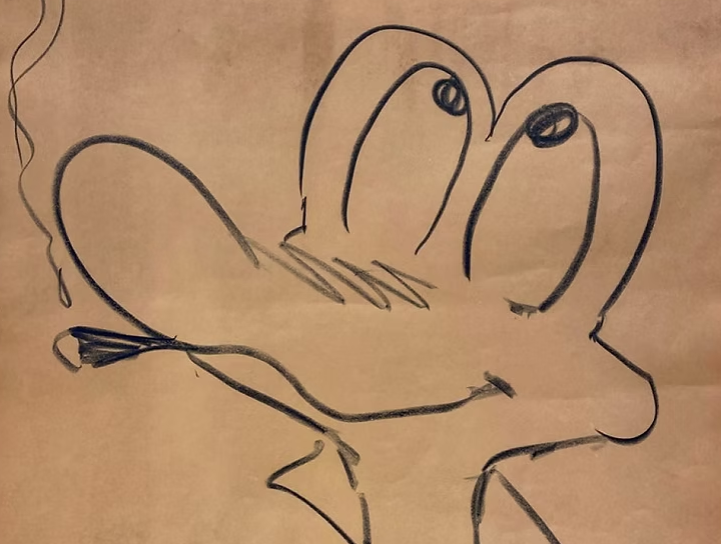
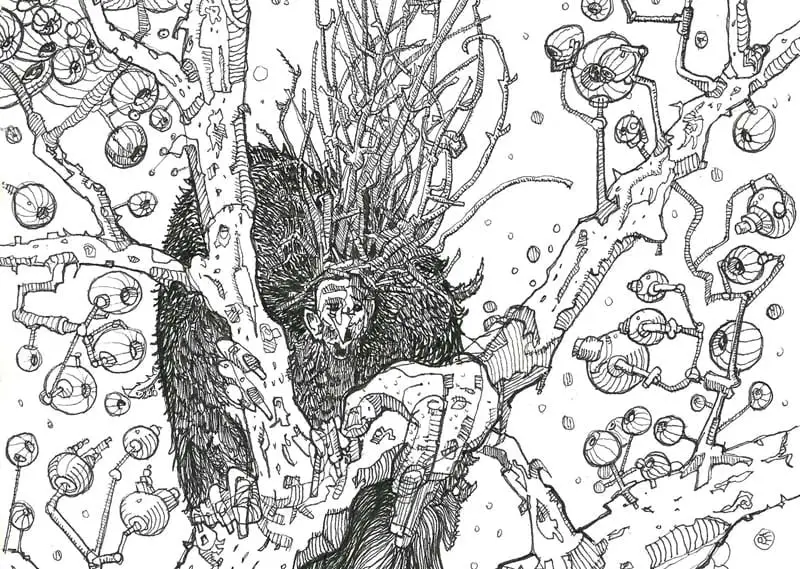
Mercurius is the alchemical yeast, the trickster—mischievous, high-spirited, and often tutelary—and Leo Joe matches this to a T. But Mercurius is also duplex (see the head image) and appears as the senex, the Saturnine old man, rigid and leaden. Jung calls this version of him Mercurius senex and stresses that the two belong together: puer and senex are the poles of its nature, the volatile and the heavy, the playful and the constraining (CW 13, Alchemical Studies, p. 226). I would argue that Carmody Overlark in Fourth Mansions reflects the mercurius senex aspect, standing in counterpoint to Leo Joe’s mercurius puer.

Whoever or whatever Leo Joe Larker is, his surname is no accident. It ties him to Overlark. Carmody Overlark must thwart Leo Joe Larker just as the senex snuffs out change to preserve order. At the same time, the mercurius puer forces transformation on the mercurius senex.
Interestingly, Freddy Foley—as Holy Fool, and perhaps mercurial instrument and mediator—perceives Leo Joe as a puer. In Jungian terms, Leo Joe is Freddy’s individuation of the mercurius puer archetype:
But Leo Joe Larker, who was the oldest of the Larkers and four years older than Freddy, said that they were Gypsies. He said that they could tell who was going to be murder and who was going to die that year. He said, moreover, that they could work magic, and that he himself had raised a man from the dead.
And Freddy also knows something important, namely that the mercurius puer is timeless, always puer aeternus:
“You haven't changed, Leo Joe, except in your voice. I used to know you when we were boys.I can't see you in that dark doorway, though.” Nothing was changed in Leo Joe except his voice.

Here are the relevant passages about Leo Joe from Fourth Mansions:
Passage 1: Childhood Memories (Chapter III)
Among these was the Larker family. The Larkers could have been any of the three, or could have been something else... But Leo Joe Larker, who was the oldest of the Larkers and four years older than Freddy, said that they were Gypsies. He said that they could tell who was going to be murdered and who was going to die that year. He said, moreover, that they could work magic, and that he himself had raised a man from the dead.
But Freddy's father had said that the Larkers were a blacknecked bunch of Irish tinkers, the last of them, and that the world would be better when they were gone.
Passage 2: The First Encounter in the Doorway (Chapter III)
But what gave Fred Foley the creeps was that he knew what man was standing there, and he couldn't have. Ah well, a fellow who raised a man from the dead when he was no more than nine years old will always have a certain presence about him.
"Hello, Leo Joe,” Freddy said boldly. “Is it yourself I am to meet?”
It was Leo Joe Larker standing there still unseen, either as blood-curdling boy or as man.
"You know my name? I underestimated you. I'll have to find out how you know my name, since it wasn't told to you,” said the black gap behind the cigarette."
"You haven't changed, Leo Joe, except in your voice. I used to know you when we were boys. I can't see you in that dark doorway, though.” Nothing was changed in Leo Joe except his voice. But the voice was all that could be encountered of him. If the boy's voice could not be recognized in the man, and if the man himself was invisible in the dark, then what was it that identified him?
Passage 3: The Warning (Chapter III)
“But if my meeting isn't with you, how do you have any part of it?”
“Never mind my part. Upstairs you're going to be threatened by a couple of rough-talking gentlemen . . . They can kill you, and there's a fair likelihood that they will.”
“Well, what do you want me to do?”
“I want you to stay on it, Foley. Be dumb, blind, blundering, and silly, but stay on it. You may be dumb enough to get to the core of it.”“Well, will you help me with it, Leo Joe? I'm totally in the dark.”
“No, I won't help you . . . I'm just telling you not to lay off. If they can kill you, Foley, I can kill you worse. If they can scare you, I can outdo them at that too. Now go up to your appointment. You better not be late.”
“What will I do?”“Whatever they tell you to do, don't. Whatever they tell you not to do, do it. But say what you have to, to get out of there alive. And don't keep any more appointments in dark rooms with people you don't know.”
"I don't know anything about old kids. I'm probably not who you think I am.” The man came out of the doorway still wrapped in dark, passed by Freddy Foley silently and disappeared. He didn't look much like Leo Joe Larker should have grown up to look like; he hadn't sounded like him at all. The dark glimpse had shown a man who might be a Negro. The voice, remembered now, had something of that tone. Nevertheless, Fred Foley believed that this interloper man had been Leo Joe Larker when he was a boy.
Passage 4: Carnival Memories (Chapter III)
But what really happened, Leo Joe Larker had told him (Leo Joe the boy who seemed to have grown into an altogether different man), was that the man sawed her in two all right and she died. Then they got a different lady to show the people out in front. They used up about five ladies a day with the act. Freddy had always believed Leo Joe's explanation...
Passage 5: Recollection in "The Bug" (Chapter XI)
And one other detail made Fred Foley doubt his sanity a little. Leo Joe Larker might be there in the Bug. And he repeated an earlier warning:
“Whatever they tell you to do, Foley, don't do it. Whatever they tell you not to do, do it. Be dumb, blind, blundering, and silly, but stay on it. You may be dumb enough to get to the core of it.
Passage 6: Encounter in "The Bug" (Chapter XI)
"You're on your own with it all the way. I'm just telling you not to lay off. If they can kill you, Foley, I can kill you worse. If they can scare you, I can scare you double. Now, go to your appointments. Oh, I forgot! You've already been to your appointments. You're in here with us now. A lot of good it did you to be dumb and blind and silly. You didn't come any closer to whipping the thing than us smart ones did.”
“Are you all right, Leo Joe?” Foley asked him. There was a puzzle about this Leo Joe Larker. He was a Negro now. There was no doubt about that. But he hadn't been one as a boy. Mexican, Gypsy, Indian maybe, or dirty-necked Irishman, but Negro, no. He didn't grow up to look anything like himself as a boy, his voice was not anything like that. He was, however, the same man who had spoken to Freddy from the darkened doorway one night. Yes, and he was Leo Joe Larker who had raised a man from the dead when he was a little boy. You're sure of some things, even after you're crazy.“Why do you call me by that name?” Leo Joe asked. “That isn't the name I'm committed under.”
[. . .] “I know it. But that Leo Joe stuff wasn't the name I had been going by either. I'm not even sure that I remember it. Are you sure that's my name? I'm probably not who you think I am."
Passage 7: The Ice Cream Man at the Fence (Chapter XII)
The ice cream man, selling ice cream bars to the inmates through the iron fence, was Leo Joe Larker. But wasn't Leo Joe Larker still an inmate of the Bug? No he wasn't. He had escaped that very morning...
They didn't capture him because they didn't recognize him. He did not look anything like what he had looked like inside the Bug. He was a different man entirely in appearance; he had been several such different men; only Freddy Foley could recognize him. [. . .] "You, Leo Joe, or I?” Foley asked him."You, Foley, you're the fool . . . "
"Little Leo Joe, the man who changes faces and never gets a very good one. What are you doing with an ice cream pokey?”
Passage 8: The Sherbet Bar and the Final Warning (Chapter XII)
(But this Leo Joe wasn't a clown. He had told Foley. “If they can kill you, I can kill you worse. Whatever they tell you to do, don't do it. Whatever they tell you not to do, do it.” This was Leo Joe Larker who had perhaps raised a man from the dead when he was only a boy.)“I'm not Leo Joe. I'm no one you ever saw before. The ice cream pokey gives me certain vantage points.”
[. . . ] “Here's a grape sherbet bar for you, Foley,” said Leo Joe. “Digest it well.”
Passage 9: The Note (from Chapter XII)
(That was the sticky scribbling of Leo Joe Larker on the lavender-stained paper.)I know that you haven't any plan, and I haven't much of one. I have a few men. I need a few more. At sundown you will take three good men and go over the fence.
(But will you be ready for it? asked the note from Leo Joe Larker that Freddy had taken from his sticky pocket. Ready or not, you will have to come. I am prepared to visit some plagues of my own; but only on the returnees, not on the world. You may already have guessed that I once joined their company. But I was a very recent recruit of theirs and I have broken away. To make up for the part I have had in it I will try to stop the thing. Now, here is what you will do—)
(Meanwhile, back in our main context, Foley-Smith had finished reading the note from Leo Joe Larker. There were some straight specifics in it. That Larker was a real strategist, a poor man's general. He knew how to go about a street fight, a town fight. And the last words of the note: Now eat it. Chew it up and eat it. It should have a pleasant sherbet flavor... Now swallow it.
Foley was to take three of the inmates over the fence with him. Larker had written that more would be useless.)(Meanwhile, Foley briefed them again rapidly, armed them from the cache that Leo Joe Larker had hidden and told of in the note... what Larker had called the Night of the Long Knives in his notes. Like all unstarred generals, Larker was something of a ham.)
Passage 10: The Final Encounter at Proviant's
They sat across from Larker (or a man who was just possibly Larker; he had still another appearance now), who was with some people Foley didn't know. Foley and Larker exchanged glances and maintained the fiction of not knowing each other.
“This is the way the world ends,” said Larker at the table across. “The lights go on and it's revealed that it was all a play-act. There wasn't any world. There was only the fiction of a world.”
Comments