"The Man Who Made Models" (1974/1989)

Updated: 1 day ago

Although the human race must be regarded as a unit intellectually and physically, there have existed and still exist differences which permit a classification into various groups and races. Even the most ancient remains of man, dating from the glacial period in Europe, show differences that justify the acceptance of at least two races. Remains of skeletons that certainly belong to the Quaternary age have been found in France, Germany, and Austria. The shape of the crania found at Spy, Krapina, La Chapelle aux Saintes, Le Moustier, etc., resembles that of the skull discovered at Neandertal, the geological stratification of which is uncertain. These remains can be grouped together as the ‘Neandertal race’, which had a long, narrow, low skull with very retreating forehead, enormous brow ridges (torus supraorbitalis), powerful masticating apparatus, upper jaw with the fossae caninae, heavy under jaw with broad ascending branch, no chin, and chin part with an outward convex curve. Some of these characteristics are still to be found among the Eskimo and aboriginal Australians. — Ferdinand Birkner, “Human Race,” The Catholic Encyclopedia, vol. 12 (New York: Robert Appleton Company, 1911).
“You really thought that the white giant could shrink the black giant?”
Challenging Lafferty today. About Lafferty, a man who made models.
“The Man Who Made Models” is one of my favorite minor Lafferty stories. I will focus on how its success as a short story is inseparable from Lafferty’s ethno-essentialism, clarify what that ethno-essentialism involves and why the word "essentialism" is somewhat misleading, and argue that while it is complicated, it does not warrant hand-wringing or evasive discomfort. The issue of cultural identity in Lafferty is finally being discussed, so this seems like a good time to be direct about it. But first, a brief summary—just enough to establish the context for what follows, since much of the plot will need to be revisited in greater detail.
This time, Lafferty gives us Jon Skaber, an art professor at Central Minnesota Normal. Skaber is the “Light Swede” of the story, a man with gifted hands who spends his time crafting models and sparring with other academics, particularly the sharp-tongued Harp couple. The Harps have no respect for Skaber’s work. They argue that quality cannot be separated from quantity, and that any scaled-down world necessarily falsifies reality.
The plot begins to move when the Harps attempt to defraud the college by stealing funds for a non-existent Electronic Reticle. They disappear—and soon afterward, two new wax-fleshed figures appear on Skaber’s table. Enter the sinister detective Lyle Wrackwolf, the “Dark Swede” of the story, who suspects that Skaber has used magic to shrink the fugitives.
At the story’s climax, Wrackwolf confronts Skaber while carving a block of coffin spruce and chewing mad-weed snuff. His older magic overcomes Skaber’s crafted artifice, and Skaber is himself shrunk. The tiny Harps jeer, their twisted faces proving their point: models are never fully accurate.
Here is a controversial take. Soft ethno-essentialism is ineliminable in nearly all of Lafferty’s work. Judge it as you will, he had an intense curiosity about peoples, but he also believed that character was tied to place and lineage. The term essentialism may be too narrow, because the real context is broader. Lafferty was no fool; he did not believe that being Italian was stamped into a person like the imago Dei. His soft essentialism aligns more closely with figures like Montesquieu and belongs to a longer conversation about the relations among nation, race, and character.
People are not going to talk about it in those terms. They will use contemporary cant like race essentialism. But if readers want to understand it as it would have seemed common sense to Lafferty, they should read the entry on race in his Catholic Encyclopedia. For good or ill, this soft essentialism is a huge part of what makes Lafferty interesting, and it is the condition of possibility in many of his stories.
When he was a child, his Grolier’s History of All Nations, with its 8,000 vivid illustrations and its emphasis on ethnic identity, a gift from his father, burned itself into his mind. I say this is soft because it isn’t the kind of essentialism moderns in the academy understand. On this point, “The Man Who Made Models” can be used to demonstrate how ethnos in Lafferty structures allegorical thinking, which is why I am thinking about it today.
This is, at its heart, a tale of two Scandinavians. On one side, we have Jon Skaber, “the Light Swede.” On the other side, we have Lyle Wrackwolf, “the Dark Swede.” These labels carry clear racialized subtext, and understanding how that works will be important for grasping the allegory, which turns on counterfiguration. Wrackwolf, the “Dark Swede,” is the story’s hero, though that is far from obvious at first, and I suspect it may not be obvious to some readers even at the end. They will want to treat Wrackwolf as ambiguous, but I do not think that interpretation holds. Working through how and why is the aim of this post.
Let’s begin with Jon. He is physically imposing: a towering blond, a former football star with enormous hands. Lafferty gives us a stereotypical image of the fair Scandinavian. And Lafferty knows exactly what he’s doing. The setting—Central Minnesota Normal—is important. Historically, Minnesota has been strongly associated with Scandinavian immigration.

The setting’s Scandinavian heritage is significant: in the nineteenth and early twentieth centuries, hundreds of thousands of Swedes, Norwegians, and Finns settled in Minnesota. Against this backdrop, Lafferty makes a joke with the name “Central Minnesota Normal.” On one level, a “normal” school is simply a teachers’ college. But the pun also points to Jon as being “central Minnesota normal,” a football-playing, all-American archetype who embodies the region’s cultural expectations.

Wrackwolf, by contrast, stands well outside what might be considered Central Minnesota’s “normal.” Dark-flushed and bulky, with a muggsy, ever-shifting face, he becomes one of Lafferty’s most vivid character sketches. This is where Lafferty’s counterfiguration comes into focus. He repeatedly emphasizes Wrackwolf’s darkness. Jon even thinks of Wrackwolf as a shadow—a metaphor that reverses the story’s actual logic and may mislead the naive reader. Put simply, it is a mistake to impose a straightforward metaphysics of light and dark onto these two figures. Lafferty invites that reading only to subvert it. It is part of what makes the story so strange and so compelling.
I suspect that many readers will still feel a certain sympathy for Jon, even by the story’s end. But Lafferty’s allegiance is clearly with Lyle Wrackwolf, not with Jon, and his treatment of Jon is, in fact, withering. One way to understand this is by placing the story within Lafferty’s broader conceptual world. Jon is like the kind of Catholic who thinks he can reconcile with theological Modernism, only to learn that no such compromise is possible. One cannot have it both ways. That is Lafferty’s logic. In this story, the substitute term for Catholicism is ancient Scandinavian magic.

So why all the emphasis on darkness? This is Lafferty drawing on historical attitudes toward the Sámi—both within and beyond Scandinavian culture. Wrackwolf’s epithet, “Dark Swede,” signals Sámi ancestry, setting him apart from the fair-skinned Nordic norm of the story’s cow-town tech setting in Minnesota. It’s worth adding that the Sámi, like the Romani, tend to reject the externally imposed term (Laplanders, in this case), but ethno-essentialism nonetheless structures this allegory.
Wrackwolf openly states that Sámi ancestry and magic run in his bloodline. Speaking to Joe Greatglobe, he says, “I do have the [Laplander-magic] strain in me, yes. And I’ll not be laughed at for having it.” He goes on to suggest that Jon’s family may also carry “a strain of Laplander-magic” and “a touch of something older” in their Scandinavian lineage.
This framing may unsettle some readers, but it does not trouble me. Lafferty is deliberately invoking the cultural perception of the Sámi as an archaic, mystical people, distinct from, yet woven into, the broader Nordic world. Historically, the Sámi were racialized as a separate and supposedly more primitive group, often imagined as non-European in origin. This is untrue, and Lafferty almost certainly knew it was untrue, but he draws on these exoticized perceptions to cast Wrackwolf as the embodiment of a deeper, older, and more magical stratum of Scandinavia.
Linguistically, the difference reinforces the point: Sámi languages are not Germanic, unlike the language of Jon Skaber’s presumed heritage. This makes it all the more amusing when Wrackwolf names his mad-weed snuff using Skaber’s own language, but more on that in a moment. What matters here is that these are very different Swedes, and that their differences are ethnically hard-coded. Wrackwolf’s darkness is not merely visual; it is Lapland, and it is sorcery as culturally perceived.
Here, I think, some readers may go astray. It may appear that Lafferty is staging a contest between light and dark magic, between white and black. But the “dark” magic in this story is not black magic. It is deep magic, older, more rooted, more real. Dark the way rich soil is dark, or the way cisterns are dark.
Allegorically, it is the magic of the Faith: magic as Christianity rendered in symbolic form—the same kind of magic the protagonist of “The Man Who Lost His Magic” is said to have lost. Any reader who tries to map this onto a binary of good versus evil, tracking hair color or skin tone, will miss the entire point of the allegory. In this story, the dark magic is truer. It belongs to the darkness of ethnos, to the weight of ancestral memory. It is Lafferty saying that his blood was Catholic for fifty generations. It is not weak or wholly visible in bright light; it is strong and recessed into the darkness of the past. And in Lafferty’s vision, it is sacred.
In the story, Wrackwolf’s knife and coffinwood are ritual tools for spellcasting. In the world of Catholicism, they would be sacramentals: objects like a great-great-grandmother’s rosary, passed down through the generations. This is precisely what Skaber, as a product of Minnesota Normal, lacks. Even if there is a trace of it still in his blood, he no longer knows how to use it.
With this in play, we have the pieces. Through these two characters, Lafferty—whether the reader likes it or not—establishes a racial contrast drawn from Nordic folklore and the history of scientific racism: the blond, modern Swede versus the darker, quasi-indigenous Laplander. The contrast is charged, but it is not simplistic. Without it, Lafferty would have no ground on which to explore identity and power. He would be left offering only a crude morality tale—good (light) versus evil (dark). As is often the case with Lafferty, the “problematic” is the enabling condition for the most interesting material. It cannot be disentangled from the insight it delivers.
Let us return to Jon Skaber, the Light Swede. At first, he appears to be a genial giant and a talented artist. But very quickly, the reader should begin to suspect that something more ambiguous lies beneath the polished surface. His performative identity is, in that sense, a lie.
Lyle Wrackwolf, the Dark Swede, also performs a false identity. He cultivates a sinister persona. As Rayona Harp notes, he “would be sinister . . . except that he works so hard at being sinister that he becomes ridiculous instead.” The Harps are unpleasant characters, but one of the curious things Lafferty does is let them be right. If you look closely, you’ll see they have everyone’s number, even if they are themselves morally dubious. That is one reason to suspect we are in the realm of Lafferty’s signature counterfiguration, and that the “dark is evil” reading is not only wrong but the trap the story is designed to spring.
Wrackwolf’s darkness is performative, not moral. His menace is instrumental, tempered by irony and self-awareness. He plays the role of the sinister figure, but he is, in truth, an agent of an older, higher law. Lafferty positions us, if we are paying attention, to be on the side of Wrackwolf.
Why? Because Wrackwolf’s darkness is grounded in his Laplandic ancestry and his shamanic inheritance, not in any moral disorder. He is the kind of man Lafferty consistently favors. When Wrackwolf confronts Jon in the story’s climax, it is he who intensifies the color-coded language first introduced by the narrator. “You really thought that the white giant could shrink the black giant?” he asks. This is an important moment. If the reader does not understand how to read Lafferty’s counterfiguration, the meaning will be lost. The Sámi, like Lafferty’s Choctaw, are historically marginalized. They have been colonized. They are victims of history. And as with the Choctaw, Lafferty is both sympathetic to them and committed to the idea that they carry an essential ethnos.
Once we consider the relationship between the White Swedes and the Laplanders, we begin to see the logic behind Lafferty’s color-coding and what is being counterfigured. In metaphorical terms, white signals the colonizer, the hegemon, the arrogant insider; dark signals the indigenous outsider. The climax of the story reverses the historical pattern of dominance. The “white giant” (Jon) is literally diminished by the “black giant” (Wrackwolf). Wrackwolf’s dark aspect overpowers Jon’s bright, modern rationality—a rationality that, in this story, is fully complicit with the college system, Lafferty’s central image of amnesiac modernity. The college, in this context, is the institutionalization of forgetting. Its purpose is to program amnesia into its students.
This does not mean, however, that “The Man Who Made Models” presents Wrackwolf as a simple hero. He is driven by obsession. He recognizes his own madness and accepts it. “The stronger magic man has to be crazy to make it work,” he says. “That’s me.” Yet the category of “dark” is not negative in this story. It signifies a different ethos, a different source of power, an older way that remains connected to its origins and historical counterpart. A man who carries this kind of magic bears the burden of suppressed knowledge and outsider status. He does not carry the mark of evil.
Jon, the light figure, proves to be sinister. He is the manipulator. He traffics in magic but hides it behind the appearance of modern rationality. He takes money to teach while withholding the knowledge that gives him power. Wrackwolf, the dark figure, becomes an instrument of justice. Lafferty sets up a symbolic opposition that allows him to explore how identity and heritage (Sámi versus mainstream Swede) exert pressure on one another. Jon’s lightness conceals a hidden moral darkness, marked by hubris, secrecy, and misuse of power. Wrackwolf’s darkness carries truth, balance, and judgment.
It is difficult to say how much Lafferty knew about Sámi traditions. Their folklore does not have any stories about shrinking that I can find, although the Stallo figure itself may have influenced the story, with the shrinking of one Stallo by another serving as part of the joke. What is unmistakable is the presence of folkloric elements in Wrackwolf. Lafferty draws on stereotypes surrounding an indigenous tradition that fascinated and unsettled Europeans, just as he often does with his depictions of Romani culture. Wrackwolf is, in effect, a noaidi, a Sámi shaman disguised in the clothing of a detective. He uses arcane tools and substances from Lapland. During the final confrontation, Jon notices something has changed. “Isn’t that a different sort of snuff you’re stuffing into your lip, Detective?” Wrackwolf answers that it is vansinnig-ogräs, mad-weed snuff. This is old magic returning to square old debts.
It is also shamanic. Wrackwolf uses the snuff to bring on a trance or power. “Every shaman uses it when starting on a trick,” he says. Jon recognizes the danger at once. His hands begin to shake. He knows he is in the presence of the real thing.
Lafferty contrasts the materials Jon uses in his models with the tools Wrackwolf relies on. Wrackwolf’s tools come straight out of Laplandic lore. He uses “an old Laplander magic knife. Flint blade, reindeer-antler handle,” an object that would not be out of place in the kit of a Sámi hunter-shaman. Flint and reindeer antler root his practice in nature and tradition, with the reindeer calling up the core of Sámi material culture.
He carves into an unusual block of wood. Jon notices this: “That isn’t the sort of wood you usually use… it doesn’t seem to cut well.” Wrackwolf replies that it is “coffin spruce... from Lapland.” These materials matter. They mark a clear contrast between Jon’s high-precision, modern model-making, shaped from unknown advanced substances, and Wrackwolf’s older, earthier craft. The tools Wrackwolf uses are cruder, but the power they call on is deeper.
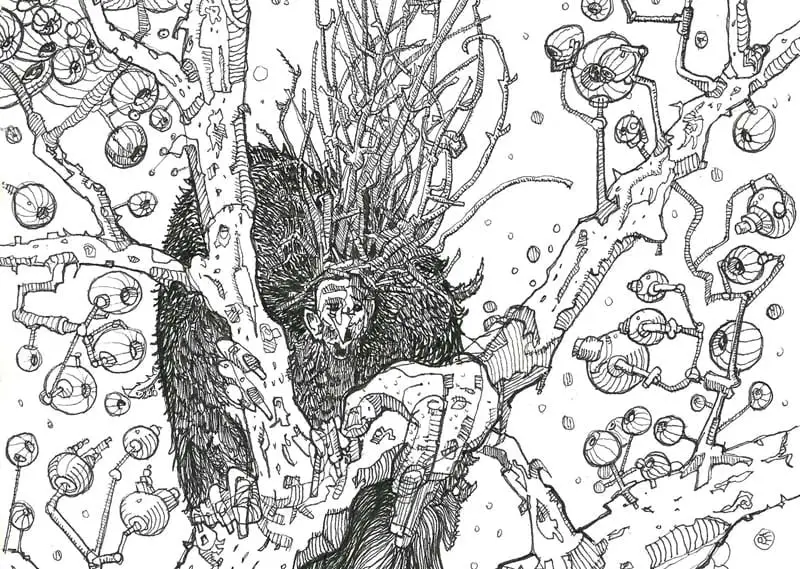
Once the dynamic between the two Swedes is in view, the story’s iconographic insetting comes into sharper focus. This is most visible in the two cartoons—one of the colonizer in a pith helmet, the other of the witch doctor.
If someone were to write a paper on this story, this would be a rich place to begin. I will approach the matter by using the terms colonizer/insider and colonized/outsider. In the New Yorker cartoon, the colonizer is the one who is shrunk for mouthing off to an African witch doctor. In the African version of the cartoon, the colonized witch doctor is shrunk for mouthing off to the colonizer. What shrinks the witch doctor?
British colonizers, of course, do not wield literal shrinking magic. What they do is more systematic. The business of the colonizer is to shrink the colonized by other means: to make them permanent outsiders, to demean and make small their cultural worlds, to manage and model their beliefs, practices, and lands. When Skaber makes a model of the witch doctor, he assumes the colonizer’s position. He takes it upon himself to define and contain what is foreign to him.
By the end of the story, however, the reversal is complete. It is the colonized outsider who shrinks Jon.
I would sketch it out like this:

I do want to say how much I dislike the word problematic, and that I hope it never becomes boilerplate in discussions of Lafferty. If you want to make an ethical judgment, do it the way lightning strikes an air terminal. If you want to make an analytical cut, do it with merciless precision—drive the lance straight into the incision site. Call the racist thing racist. Don’t call it problematic, a term that is everything from a placeholder to a euphemism, from a floating signifier to a weasel word.
Is “The Man Who Made Models” racist? Not by my lights. Others may disagree, and I hope they will say why.
Is “The Man Who Made Models” racialized? Absolutely.
Is everything that is racialized therefore racist? That, I think, opens a much more interesting conversation—especially when it comes to Lafferty’s art.
To be clear about how I see the matter: something can be racialized without being racist when it engages with ideas of race without asserting hierarchy, hostility, or moral judgment on the basis of race. There is a wide range of live possibilities here, and only the most absolutist anti-essentialist would fail to recognize that. In “The Man Who Made Models,” the hierarchy, hostility, and judgment are not grounded in race as such but in a cultural constellation, a displacement of old-world Scandinavian conflict, with its racialized difference, onto the terrain of Central Minnesota Normal.
It is that setting—Central Minnesota Normal—that concretizes the hierarchy. It is the institution that carries the hostility and judgment. Wrackwolf recognizes it for what it is. And then, quite literally, he sizes it down.

Lafferty was in his mid-twenties when Pope Pius XII said this. To the extent that one unqualifiedly opposes it, one takes issue with a position that is both orthodox and politically moderate, and one that Lafferty himself held. Moreover, if one finds it deeply repellent, then one is, quite simply, deeply repelled by a core component of normal Catholic identity. This position operates on a level distinct from racism. It lies much closer to the ethic of 1 Timothy 5:8.
For some readers, what “The Man Who Made Models” does well, it also does problematically. For them, Lafferty’s view of nation, race, and ethnos is simply off-limits. It is a conversation-stopper. Lafferty would have regarded this posture as historically uninformed, self-congratulatory, ideologically managed, and forgetful of the past.
Why do I say this with such confidence? Because within the story itself, we encounter precisely this kind of reader. His name is Greatglobe. He is Joe College. He knows he is smarter and wiser than people like Wrackwolf.
“Lyle would be sinister,” Rayona Harp once said, “except that he works so hard at being sinister that he becomes ridiculous instead.” And he came in now, just after Joe Greatglobe (Joe College) the purser left.
Joe College knows (he is Lafferty’s straw man, so I will appropriate him to be mine) that things like essentialism are always wrong. Today, he would have no patience for the idea that aspects of reality often framed as non-essentialist, such as structural racism, might nevertheless have ontological roots in fundamental features of the world that, on this view, do have essences.
This is why I find it comical that the readers most unsettled by the shifting nuances of the word problematic are often the same readers who said nothing about Lafferty’s antisemitism. They continued to read him, to recommend him, and to promote his work for years, without doing the work of making that enjoyment clean. There were reasons for this, some of them defensible, others not. I am inclined to think the causes had to do with reputation management, narrative control, the blurring of fannishness and scholarship, and, in some cases, career incentives. Others may reasonably reach different conclusions.
But I am sorry, folks: ethnos is not lurking subtly beneath the surface in Lafferty. This is not a matter of subtext. It is right there on the page. If you think its visibility is subtle, you are coarse.
At the same time, essentialists can, and often do, hold that racialized discourse is socially contingent on power, soft and hard, capillary and coercive. It is constructed mainly under conditions of underdetermination, and it is almost always marked by political injustice and historical suffering. Most sophisticated essentialists accept this. For that reason alone, the conversation around this dimension of Lafferty’s work ought to be far smarter than it has been.
Lafferty is already there, waiting with a knowing grin. He waits for both the traditionalist and the utopian, and he proves difficult for each. The alternatives are immature moral vocabularies or muddied critical ones.
Ethno-poetics is part of Lafferty's genius. It is also a measure of both his historical brilliance and his aesthetic blemish. Without it, one is left with stories like “Symposium.” This is dangerous ground, but I will mark a line that Lafferty does not cross. While ethnos is deeply important to his work, he does not elevate it above human nature. No human group, in his writing, has privileged access to being, truth, or goodness by nature. Even the chosen people receive that status, on Lafferty’s account, only within the history that follows the Fall—and they receive it as an ethnos.
This is why pre-Covenant figures in his fiction (such as Noah, who appears everywhere in Lafferty) are not Jewish but more universal than the Jew or the Gentile. Noah did not descend from Jacob. This is the kind of thinking one likely must engage in to approach the deepest aspects of ethnos in Lafferty’s writing. God himself created the Jewish ethnos by entering into a covenant with Abraham. Isn't this how Lafferty would have seen it? As always, we want to understand Lafferty on his own terms.
To close, I want to note four principles that always seem to be in play when Lafferty writes about race and ethnos.
First, ethnos is real and formative, but not morally or ontologically determinative. Cultural inheritance shapes perceptions, habits, and lifeworlds. But it does not fix moral worth, destiny, or access to truth. Even Lafferty’s antisemitism operates within this framework. Like Belloc, his quarrel with the Jew is a historical one about what happened following the Crucifixion.
Second, no ethnos now confers natural privilege. Only participation in the Church does so, transcending and binding disparate ethnoi together. (Read Lafferty's "Communion of Saints.") The privilege Abraham received was historical. Quite apart from this view, there are hard questions to be asked about whether Lafferty was a supersessionist like his hero Belloc. But even here, neither he nor Belloc believes there to be a strictly racial access to truth, goodness, or moral authority.
Third, judgment of human action is situational, not ontologized to ethnos or race. The ontological judgment has already been rendered in God’s decision that obsesses Lafferty. Man was cast out of the garden; man now builds and loses historical worlds; and he falls into states of amnesia about this, even after having been reconciled through Christ. Artists can now build counterfactuals because the last world, organized Eurocentric Christendom, became unstructured. Accordingly, moral evaluation responds to concrete actions and uses of power, not to ancestry or identity considered in isolation. Flatland looks like Flatland because the old order that made Christian grace visible in the lives of most Westerners has fallen apart. That is what Lafferty is saying, saying endlessly, in story after story and novel after novel.
Fourth, racialized symbolism in Lafferty is functional but historically informed. Difference is used to illuminate the dynamics of reduction, abstraction, and domination, or to affirm forms of human community. It is not used to justify racial hierarchy or any enduring pattern of exclusion that Lafferty covertly affirms. He is not that kind of writer.
There is much in this that may cause discomfort. I have presented the case as I believe Lafferty himself understood it, and that requires acknowledging that his work is shaped by a thick, pre-modern Catholic anthropology. This is a Christian anthropology many Catholics gradually set aside or, at least, dialed down as post-1965 liberal humanitarian rhetoric became dominant. It is also the case that Lafferty was irritated by this, and he wrote against that rhetorical shift in many of his later stories, including this one, which was revised and completed in the year he retired as a writer, 1984.
That newer Catholic language (whatever its moral and diplomatic appeal or practical benefits, and there have been many) is, in large measure, designed to avoid discussing the ways ethnos shapes perception, power, and practical moral orientation. Yet even in Lafferty, who has nothing of this in his Catholic talk, ethnos never determines moral worth or destiny. He and men like John Paul II are one on this point.
And let me show my cards. I acknowledge that my reading may appear to cheat. I take Lafferty’s use of ethnos to allegorize a particular religious tradition: Christianity. This is a Christian allegory, not just weird fiction, as is much of what Lafferty wrote. One could object that it is an empty allegory because Christianity is empty, or that it treats ethnos as being dangerously hypostatized, especially if one believes that Christianity is a fiction, and that the only real way out of the problem of reifying ethnos and race is to see it as a myth from the start.
Even so, my answer would be the same. The tradition Lafferty allegorizes through the Scandinavian magic in “The Man Who Made Models” is precisely that tradition, the old Christian tradition that had over 255 popes before Minnesota became a state in 1858, the same year that Minnesota's first teaching college was founded, Winona Normal, now Winona State University.
Most forms of Christianity claim to sublate ethnos in Christ’s reconciliation, not by erasing ethnos (that is, not by denying human particularity, culture, or non-religious tradition), but by ordering it toward a higher unity. It doesn't deny that some human populations have different molar root patterns stemming from genetic differences, such as the LKK gene, or that there are dark and light Swedes.
Its higher unity does not dissolve most of what is distinct. It preserves the particular within the universal. St. Paul thinks of himself as having a Jewish ethnos, yet it is St. Paul who writes, "There is neither Jew nor Gentile, neither slave nor free, nor is there male and female, for you are all one in Christ."
Theologically, this is just the claim that grace perfects nature rather than abolishing it, and that Christ’s universality does not erase concrete histories but gathers them into an ordered whole, the communion of the saints. Differences are reconciled rather than erased. Identity is fundamental. This, I believe, is how Lafferty's Catholic imagination understood the matter. In his work, ethnos is real and consequential, and it is not going away, even when it appears in ugly beliefs about human history, such as the denial of the Holocaust.
I like this story, perhaps even problematically, and I think I like it on the very terms Lafferty wrote it. Why shouldn’t I? It is a good story. It is smart. The more I think about it, the more interesting it becomes. Each time I return to it, I find something I had not seen before. Aspects of its thinking could get you into real trouble if you aren't wise. It is quintessential Lafferty.