"The Hole on the Corner" (1965/1967)

Updated: 18 hours ago

The persona is a complicated system of relations between individual consciousness and society, fittingly enough a kind of mask, designed on the one hand to make a definite impression upon others, and, on the other, to conceal the true nature of the individual. — C.G. Jung, Two Essays on Analytical Psychology
The only one of us (and he is not technically of us) who holds fully to the Third Revelation is Diogenes Pontifex. Diogenes is completely outside the liberal consensus. It is for this, more than for anything else, that he violates the minimal decency rule and may not be a member of the Institute. Diogenes speaks lightly of the revered things of the consensus as “all the easy little dishonesties”; he has even referred to the leader-emeritus of the consensus (bow your head for a moment at the mention of him) as the Brain-Rot Kid. In some ways Diogenes is not a very nice person. — Arrive at Easterwine
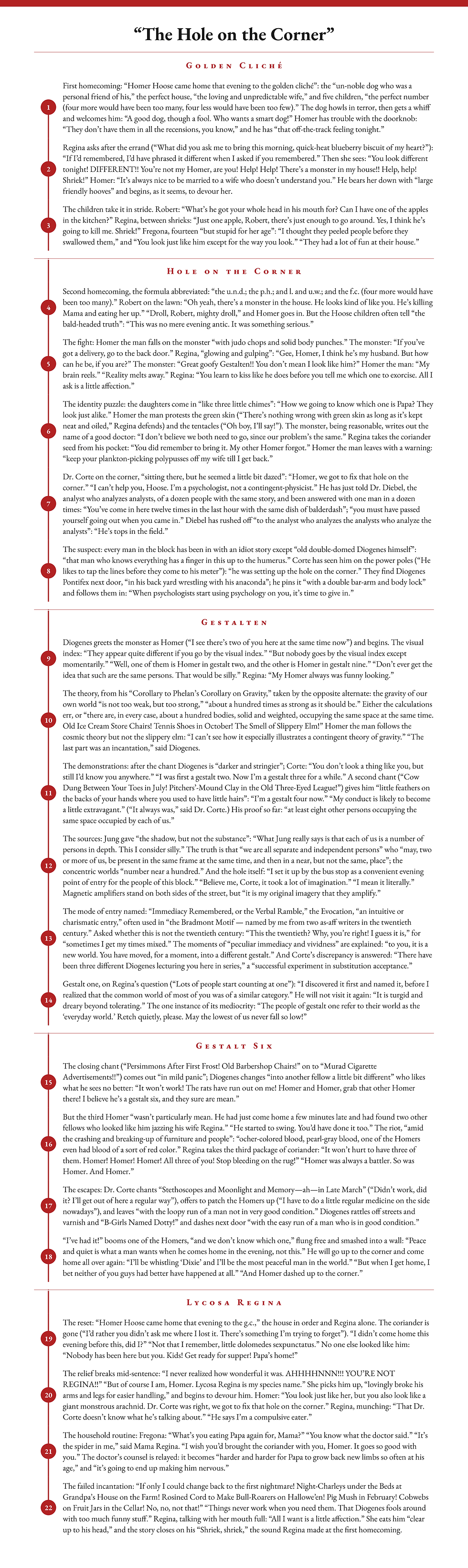
“The Hole on the Corner” is near the top of my favorite Lafferty stories. Given what he was doing at the time, I would go further: it is a perfect Lafferty story. Rather than offering a typical summary, I think it is more helpful to think through what is going on from Diogenes Pontifex’s perspective.
This is something Lafferty learned to do extremely well: think through a story and give us another story, more lively and colorful, by treating the secondary story as the primary one. In other words, the reader experiences the overlay as the story, but that story is epiphenomenal. So, how does this one work if we approach it through the man who couldn't make the cut for the Institute of Impure Science because of its minimal decency rule?
Let’s start with this. Diogenes is the only character in the story who knows what is happening and the only character who is completely okay with it, suffering no negative or disturbing consequences of the hole. Everything that upends the Hoose household and drives Dr. Corte to distraction is just Diogenes’s experiment, running on schedule. I think the story gives us enough information to reconstruct nearly every step.
Before any slapstick black comedy begins, Diogenes arrives at a unified theory of co-spatial worlds. He does this by synthesizing errors in two unrelated fields. Phelan (of “Snuffles”) had observed that gravity is anomalously weak on all worlds except one and concluded that the one world’s gravity was typical.
Diogenes, a natural contrarian like Lafferty, took the opposite view: that gravity everywhere is too strong, about a hundred times too strong, because approximately a hundred solid, weighted bodies occupy the same space at the same time. In other words, our experience of gravity results from all those other versions of us acting alongside the experienced “I.” The gravity anomaly is the sum of the masses of co-spatial worlds.

That is part one. Part two comes from Carl Jung, who thought that each person is "a number of persons in depth," a multiplicity within the psyche. Or such is Lafferty’s reading of Jung in this story. But Lafferty is going to do what Lafferty does: turn Jung inside out. Diogenes realizes this is "the shadow, but not the substance" of the truth.
Because he understands what Phelan gets wrong, he knows that multiplicity is real, but he also knows what Jung gets wrong: the co-spatial sum of mass means that the other selves CANNOT be intrapsychic. It is as if one’s psychic center is a pin going through a stack of maps. Our counterparts are separate, independent persons who bleed into our unconscious and dreams by accident, because they happen to occupy the same space we do.
From these two corrections, Diogenes cooks up his model: roughly a hundred concentric, congravitic worlds share the same spatial coordinates. Each is populated by distinct versions of oneself. He calls the worlds and their populations Gestalten, numbered in the order of his discovery. He has so far identified at least nine.
The story points to a long history of experimentation. Dr. Corte refers to a previous Diogenes experiment ("I believe that this is another of your experiments, like, Oh no! Let's not even think about the last one!") and cannot bring himself to finish. Whatever it was, it left a lasting impression. Corte also asks Diogenes to skip "the first part . . . about all the other scientists in the world being like little boys alongside of you.” Diogenes would not be an easy neighbor to have.
At one point, we learn that Diogenes conducts "experiments in other fields." When Regina asks whether this is the twentieth century, Diogenes is surprised. He says, "This is the twentieth? Why, you're right! I guess it is." He has been working across temporal and gestalt boundaries and has momentarily lost track of his own era.
In “Hole on the Corner,” we learn that Diogenes has made contact with his counterparts in other gestalten. They are "of like scientific mind" and "work together in close concert." All Diogeneses are apparently so outré that they have no problem being sympatico. This becomes the basis of the evening's demonstration. The one Gestalt Diogenes really recoils from is Gestalt 1: it is "turgid and dreary beyond tolerating." Its people call their world "the everyday world." He refuses to return.
We are now approaching where the story starts. Two days before the story's main events, Diogenes built the hole in the corner. He placed it by the bus stop "as a convenient evening point of entry for the people of this block." This is hilarious because Diogenes knows every commuter on the block passes through it on the way home. If you want to know what failing the minimal decency test looks like, here is Exhibit A.
The hole? Not visible. Homer walks right past it without seeing it. To make it, Diogenes "drew so deeply on my own psychic store to construct the thing that it left me shaken." The raw material is psychic imagery, the same intensely specific sensory images that power the incantations.
Diogenes has also installed magnetic amplifiers on both sides of the street, tapping the power lines (Corte saw him on the poles and thought nothing of it; Diogenes habitually steals electricity for his laboratory, another instance of him failing the minimal decency test). The amplifiers, we learn, amplify his "original imagery." The technology is secondary; what is really under the hood is imaginative.
So that is the hole: a passive, permanent, contrived mode of entry between gestalten that separates them out. Everyone has some experience of this reality, for natural accidental modes that point to the possibility of the “hole” already exist. They are moments of "peculiar immediacy and vividness" when the world seems fresher. Diogenes explains these as momentary involuntary gestalt shifts. In effect, the hole industrializes this process. Anyone who walks through it may arrive home in a different gestalt or find a counterpart from another gestalt already there. This is connected to the Bradmont Motif, more about which later.
From Diogenes's perspective, the two days between the hole's construction and the evening of the story have just been productive observation. He has been running his own unethical experiment on the neighborhood outside the minimal decency rule. Every man on the block has gone to Dr. Corte with the same kind of story: "They all come home in the evening, and everything is different, or themselves are different, or they find that they are already there when they get there." Corte has had a dozen patients with the same complaint.
Making all this funnier, Corte himself has been affected. He visited Dr. Diebel (whose name means “rogue”), the analyst who analyzes analysts, and was told he had come in twelve times in one hour, "each time looking a little bit different," each time acting as though he hadn't been there for a month. The psychologist Corte, because his view of the psyche is tied to the intra-psychic, not the extra-psychic world of Lafferty’s schizo-gash, is clueless. Lafferty writes:
"'I don't know, Corte,' he said to me. 'What do I do when one man comes in a dozen times with the same nonsense story, all within one hour, and he a doctor too?' . . . 'You,' he said. ‘You've come in here twelve times in the last hour with the same dish of balderdash; you've come in each time looking a little bit different; and each time you act as if you hadn't seen me for a month. Dammit man,' he said, ‘you must have passed yourself going out when you came in.'"
The next part is no surprise. Diogenes alone has not visited Corte. Why should he? He built the thing. Corte deduces his involvement from this conspicuous absence and from the memory of seeing him on the power poles. And when Corte and Homer come to collect Diogenes, they find him in his backyard wrestling with his anaconda. He pins it casually, with a chancery (an illegal headlock in boxing, thus violating, again, minimal decency), face punches, and a double bar-arm and body lock, and follows them into the Hoose house. He is in excellent physical condition and in no hurry.
Inside, he greets Homer the monster (gestalt nine, green skin, tentacles) without surprise: "Hi, Homer. I see there are two of you here at the same time now. No doubt that's what's puzzling you." Diogenes has been expecting this. Gestalt nine is "the furthest I have brought it so far," the most distant gestalt he has successfully made present.
Despite the radical visual difference from Gestalt Two Homer, everyone perceives the monster as Homer, because "nobody goes by the visual index except momentarily." The visual element in identity appraisal is small. This relates to much of Lafferty’s view of how social exchange works. A great example of these hidden enablers of communication and recognition is Lafferty’s “A Special Condition in Summit City.” Here is the rationale:
"They appear quite different if you go by the visual index," Diogenes explained. "But nobody goes by the visual index except momentarily. Our impression of a person or a thing is much more complex, and the visual element in our appraisal is small. Well, one of them is Homer in gestalt two, and the other is Homer in gestalt nine. But they are quite distinct. Don't ever get the idea that such are the same persons. That would be silly."
In any case, Corte then baits Diogenes into lecturing, knowing Diogenes cannot resist. What follows is a coordinated performance. Diogenes explains his theory (Phelan, gravity, Jung, the gestalten) and then demonstrates it live by cycling through gestalten via the incantation method, the Bradmont Motif. He delivers chains of hyper-specific nostalgic images ("Old Ice Cream Store Chairs! Tennis Shoes in October!"), and after each one, his audience is told to observe changes in his appearance.
After the first incantation, he is gestalt three: "darker and stringier," unrecognizable by sight alone yet unmistakably himself. After the second, he is gestalt four: feathered hands and toes, barefoot, conduct "likely to become a little extravagant."
Here is a digression on Lafferty satirizing science fiction. I suspect Lafferty was a little impatient with the purple in Ray Bradbury. Here, he has great fun with Bradbury and Charles Beaumont. The Bradmont Motif exploits what Lafferty thought of as fictional exploitation, that is, fiction that treats nostalgia as if nostalgia alone could transport you somewhere else. Lafferty’s rejection of this is something we see repeatedly. We see it in the long arc of In a Green Tree. We see it in short stories such as “You Can’t Go Back.”
This is perhaps Diogenes’s greatest violation of minimal decency, his willingness to go full high-honking Ray Bradbury-style nostalgic to induce gestalt shifts through rapid-fire chains of hyper-specific sensory memories. The Bradmont Motif satirizes the fictional techniques of Bradbury and Beaumont (Immediacy Remembered, the Verbal Ramble, the Evocation).

Now back to the story.
Diogenes then explains why he is so comfortable with the hole. He says, "I do not change from one person to another. There have been three different Diogenes lecturing you here in series." His counterparts (coordinated, scientifically in agreement with him, and lacking all decency) have been replacing him in sequence. The audience accepted each new Diogenes as the same person without noticing the substitution. This is itself the experiment: "a successful experiment in substitution acceptance." The lecture was a relay, and nobody knew.
Diogenes' control over the demonstration then starts to go awry. First, while discussing Gestalt One (the turgid, dreary world), he grows panicked. Its description seems to push him toward it. He is so repulsed, he incants Bradmont Motif style ("Persimmons After First Frost! Old Barbershop Chairs! Pink Dogwood Blossoms in the Third Week of November! Murad Cigarette Advertisements!!") and shifts away.
But the new Diogenes who replaces him doesn't like what he sees either. A Gestalt-six Homer has arrived or is about to. This Diogenes tries a second incantation ("Smell of Wet Sweet Clover! St. Mary's Street in San Antonio! Model Airplane Glue! Moon Crabs in March!"), and it fails. "It won't work! The rats have run out on me!"
Of course, no one in the story knows what is going on. He warns the others: "Homer and Homer, grab that other Homer there! I believe he's a Gestalt six, and they sure are mean."
Lafferty’s narrator steps in to undercut the claim. Gestalt-six Homer "wasn't particularly mean." He had just come home a few minutes late to find his wife with two other men who looked like him, plus two uninvited guests in his house. Again, this is why I think this is such a perfect Lafferty story, considering his development as a writer: what would make a guy meaner than this archetypal situation? "He started to swing. You'd have done it too." Let us just note that Diogenes' characterization of Gestalt six violates minimal decency. It deflects responsibility for the chaos his experiment has caused.
The brawl becomes quickly violent. Three Homers, powerful and quick-moving, bleed ocher, pearl-gray, and something close to red. Furniture and people crash and break. Regina tells all three Homers to stop bleeding on the rug. Corte, as many shrinks in Lafferty, is someone without much integrity; he abandons all pretense that his version of psychological understanding is going to help and attempts an incantation to escape ("Stethoscopes and Moonlight and Memory, ah, in Late March"). Not quite Bradmont, so it fails. He flees on foot "with the loopy run of a man not in very good condition."

Diogenes then tries his own verbal escape: "Old Hairbreadth Harry Comic Strips! Congress Street in Houston! Light Street in Baltimore! Elizabeth Street in Sydney! Varnish on Old Bar-Room Pianos! B-Girls Named Dotty!" Then he realizes a really smart guy knows when to quit a technique and simply runs: "I believe it's easier to just make a dash for my house next door." Yes, minimal decency again. He dashes out "with the easy run of a man who is in good condition."
One of the Homers, and we don't know which one, is flung free from the fight and decides to start over. He walks up to the corner, intending to wipe his mind clear, come home whistling "Dixie," and find everything normal. He has passed through the hole, of course. But the hole is still there. Little does he know that he is now in a gestalt where Regina is Lycosa Regina, a giant wolf spider who lovingly breaks his arms and legs for easier handling and begins to devour him:
"But of course I am, Homer. Lycosa Regina is my species name. Well, come, come, you know how I enjoy our evenings together." She picked him up, lovingly broke his arms and legs for easier handling, spread him out on the floor, and began to devour him . . . . "It's the spider in me," said Mama Regina. "I wish you'd brought the coriander with you, Homer. It goes so good with you."
Homer tries to incant: "Night-Charleys under the Beds at Grandpa's House on the Farm! Rosined Cord to Make Bull-Roarers on Hallowe'en! Pig Mush in February! Cobwebs on Fruit Jars in the Cellar!" This is what happens to Bradmont-style fantasy when it meets the real world, which, in Lafferty, does not look like our world, you and I being Gestalt 1 types. Nothing. "Things never work when you need them. That Diogenes fools around with too much funny stuff."
Throughout the story, Corte says, "We've got to fix that hole on the corner." It is repeated five times and never answered! Diogenes never agrees to fix the hole! Yes, minimal decency. He never shows remorse. He doesn’t even show concern. His last words in the story are about the ease of running home. He sees "a never-ending field of study in this."
“The Hole on the Corner” is one of Lafferty’s masterpieces: funny, tightly plotted, ingenious, dark, unruly, and brilliantly conceived and executed at every level, with more surprises per page and per sentence than almost any other writer. Really magical stuff.