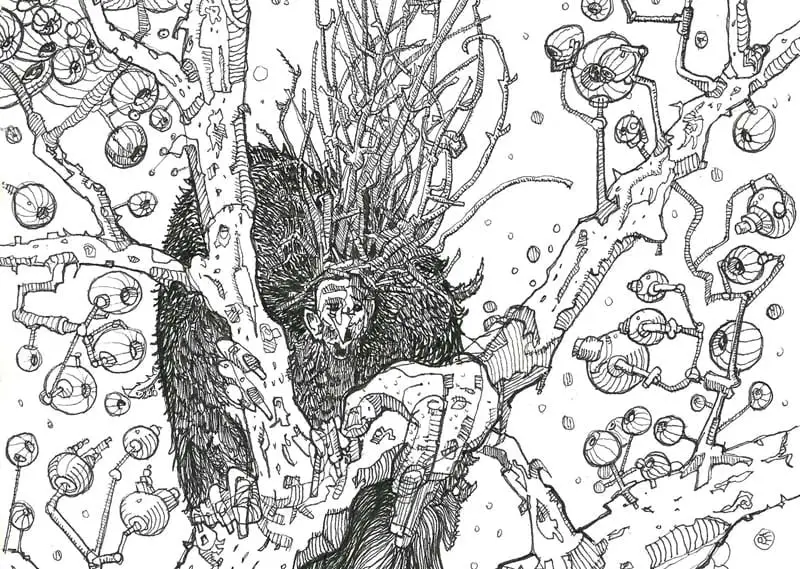
"Mr. Hamadryad" (1973/1974)

Updated: 14 hours ago

I do not deny in the least that the rational nature will always keep its free will, but I declare that the power and effectiveness of Christ's cross and of his death, which he took upon himself toward the end of the aeons, are so great as to be enough to set right and save, not only the present and the future aeon, but also all the past ones, and not only this order of us humans, but also the heavenly orders and powers. — Origen, Commentary on the Epistle to the Romans, Comm. in Rom. 4.10 (Books 6–10)
“That's the only point on the globe that God cannot see,” he said then. “Why not?” I demanded. “Ah, it is in the shadow of His own thumb,” Hamadryad said sadly. “He'll not be able to help us when things reach that point. No one willbe able to help us.”
Lafferty’s “Mr. Hamadryad” is a difficult story. At least it is for me. I’ll start with a summary and then work through some ideas about how it works, with the caveat that what I call phantasmetaxis is extraordinarily high here. Phantasmetaxis is a rhetorical strategy Lafferty often uses to build up the plot. We are given some surface coherence; it soon gives way to a deeper, hidden structure that one senses but must tease out on rereading. Characters anchor the story; over time, identities blur, split, merge, interact, and repattern, revealing a world that was there all along, waiting to be seen.
When it all locks into place, what at first seemed like willful strangeness or disorder becomes the means through which a concealed anti-secret is disclosed.
The logic of “Mr. Hamadryad” can be reconstructed. It takes a little work, so it doesn’t surprise me that practically nothing of interest has been said about the story. Lafferty here works with very personal themes in his increasingly private symbol system, spinning around like a dervish in ways one won’t find anywhere else, not only in his treatment of biblical themes but also in the conceit of multiple covenants and the implications of that. Pentecostals and other low Prots come in for some fire along the way.
Our unnamed narrator is a traveling coconut merchant. He meets Mr. Hamadryad at the Third Cataract Club in Dongola. Mr. Hamadryad is a weird, short man with a weird, long nose and a voice that sounds like muted bark. When our narrator asks, he identifies himself as a cosmologist. During their conversation, Hamadryad blends metaphysical thinking and prehistory, rejecting standard engineering theories regarding the construction of ancient megaliths. That is the jumping-off point for this story: where did all those big stone structures come from?
According to Mr. Hamadryad, the massive stones were moved using panthers. These are not the fauna that one can capture and put in a zoo. They are the mythologically rich panthers of Lafferty’s pan-animal, connected to his fantasia of primordial bears, and closely linked to his concept of the pantherium. The bar discussion with Mr. Hamadryad will be punctuated by food and booze, but also punctuated by the sound of invisible footfalls pacing in the corridor outside—heavy and barefoot. The first meeting with Mr. Hamadryad ends abruptly when a suave, feline man named Mr. Caracal enters the club, causing a tense confrontation that forces Hamadryad to flee. A caracal is a desert lynx, and so we are off to the races.
Five years later, the narrator bumps into Mr. Hamadryad again, this time in dusty Oklahoma City at the Sun-Deck Club. We seem to be in an alternative universe because there are cantons in America. Over a drink called a Ring-tailed Rouser, Hamadryad says the world's theological mechanics turn on a system of ransom in which two races are chained together to pay for ancient sins. In this cycle, one race acts as visible masters while the other serves as invisible slaves, entities often perceived by humans as "shoulder angels."
In the deep background is the idea that God’s first covenant wasn’t with Abraham, and the first Fall wasn't that of man. The cycle has happened many times before, and men got off easy. At one point, we are told, our primordial ancestors walked out of the garden, but Mr. Hamadryad’s fall was far more mythic than what gets called Judeo-Christian symbology.
Related to this point, Hamadryad explains that the dyadic structure of the fall his kind experienced means that fallen slaves and masters alternate in a cycle. It is the invisible slaves (in this instance, the panthers) who perform impossible physical labors, such as moving mountains and lintel stones, through mental anguish and soul-wrenching sacrifice.
We learn about a recent event in Oklahoma where a puma moved the Black Mesa nine inches through pure faith, tying to a recurrent Lafferty theme that comes to a climax in Not to Mention Camels (1976) and elsewhere: faith moves mountains.
Hamadryad goes deeper into the Fall that happened before mankind played his local drama in the Garden. Once there was a Floating Pavilion, a sea garden that drifted on the ocean before the postlapsarian event, caused by the conflicting wills of the masters and slaves. Mr. Hamadryad says that islands like Madagascar and Easter Island are just broken fragments of this original paradise. The world oscillates between two opposing eras: the chaotic, human Age of the Monkey and the meticulous, cruel Age of the Cat.
At this point, the reader might begin to suspect, I think rightly, that the story imagines the Genesis account as part of a larger cycle, an epicycle within a larger cycle. The narrator then puts it together: the weird-looking Hamadryad resembles a baboon or mandrill; he looks an awful lot like the long-faced statues of Easter Island, the idols of this outgoing monkey race, which is unsettling, because our own salvation cycle seems tied to theirs.
The final sequence plays out on Easter Island. It is speedily drifting into a geographical "blind spot" known as the shadow of God's thumb. Hamadryad explains that in this region, divine observation and natural laws are suspended, allowing for a cosmic "Turn-Over" where the roles of master and slave are reversed.
An amazing moment here recalls earlier moments in the story. Why, one might wonder, could a demiurge not slip in and fool us? Well, it’s because God has put his fingerprint on earth, and the whorls of the frozen waves in that area of darkness in the sea- the shadow of God’s thumb- are a kind of fingerprint test. Without the blind spot, we couldn’t know that God is really God.
And now, as the island enters this shadow of God’s thumb, Hamadryad fights an unseen enemy outside and returns bloodied to drink a Final Catastrophe, the eschatology and the boozing coming together. Mr. Hamadryad is upset about the end of his freedom, but he acknowledges that the time has arrived for the Monkeys to fall and the Cats to ascend. Yes, this is one of Lafferty’s pessimistic animal eschatologies.
As the Turn-Over takes place, Hamadryad fades into invisibility, becoming a slave who, in the dyadic flip, must now perform the heavy labor of the new era. At the same time, the nameless narrator experiences a spiritual fissure; his "human" identity schizo-gashes into invisible servitude, while his physical form is overtaken by a cool and cruel feline persona. The narrator, now at ease with the Age of the Cat, says that the chaotic coconut trade has been reorganized into a ruthless, efficient cartel, signaling the complete establishment of the new cosmic order. And we get a joke about coconut corporations and Holy Cats.

This is a hard story. The theology turns on the premise that the Earth is a penal colony governed by a cyclical system of debt and retribution known as The Ransom. I think it’s probably most useful just to call it that. In this story world, the Fall wasn't a singular event involving Adam and Eve, as I said, but a recurring catastrophe in which multiple pre-human races broke their towering covenants with God. Rather than annihilating these races, God instituted a system where they must work off their agony owed through servitude.
If you think man’s punishment of working by the sweat of his brow and woman’s punishment of childbirth labor is bad, look at Mr. Hamadryad and Mr. Caracal. It could be a lot worse, Lafferty seems to say. This creates an alternative version of Purgatory, usually figured as on earth, say in Dante or in Lafferty's “Picketwire,” where redemption is paid off through eons of physical and psychic labor. Move those big stones.
The mechanism behind this penance is the pairing of two opposing races—the Monkey-men (represented by Hamadryad) and the Cat-men (represented by Caracal/Panthers). This seems to map onto aspects of spiritual disorder in man. These races are chained together in an eternal cycle of dominance and submission. During any given era, one race is the visible Master (present, corporeal, and dominant) and the other is the invisible Slave (incorporeal, suffering, and subservient).
The Guardian Angel of Catholic tradition is reinterpreted here as the invisible slave attached to the Master's shoulder. This shoulder angel, though, is not a simple benevolent protector but a resentful entity serving a sentence, tasked with performing impossible physical feats—such as moving the massive stones of Easter Island and Baalbek—through mental anguish and soul-wrenching sacrifice.

If this is pessimistic, it’s because it is theological horror, spiced with Lafferty’s usual theological black comedy. God’s omniscience in this universe isn’t complete. It is limited by his own creation. That creates a complication. The fact that this God needs a fingerprint system tells us we are in Snuffles territory. This story world is one of Lafferty’s demiurgic prisons, which is why the story introduces the concept of a "blind spot" on the globe—located near Easter Island—which lies in the shadow of God's thumb.
This theological loophole implies that while “God” holds the world, his grip obscures a specific region from his own view. One might recall Snuffles's complaint about how hard it is to have all the information in view at once to create a perfect planet. In the shadow, divine laws of physics and protection are suspended, and God cannot help his creatures.
“The sun and the moon do not shine on the spot, and the stars do not. No birds fly over and no fish swim under. There is no luminescence in the depths there, and no gegenschein in the high air. Compass needleswilt and sag for there is no magnetism . . . It is the blind spot on the globe where map makers often put in notes or scales or explanations of Mercator's projection. So you can see that there is really nothing noteworthy about the spot. Except one thing.” . . . “The furrows and crests of the frozen or motionless waves, they have adesign; perhaps it is the original of all designs,” Drill said. “As the spotis the shadow of the thumb of God, so these undulative configurations are the shadows of the whorls and loops of God's own thumbprint. Those designs have all been recorded, and they are in the old archives and chants. You can see the value of this.” “No. What is the value?” I asked. “Why, we have positive identification,” Drill said. “If ever a false Godshould come over our earth, we would know the difference.”
It is in this godless pocket, a story world where the demiurge gets as close as it can to being the God of ethical monotheism, that the violent "Turn-over" occurs. That hole in the cosmic system makes it possible for the slaves to revolt and become the new masters without divine intervention.
Finally, when Lafferty goes dark, he becomes cynical, and this is cynical eschatology about the nature of humanity and order. The era of the Monkey—characterized by scatterbrained inefficiency, emotion, and free enterprise—is equated with what we consider being human. The theological peripeteia at the end of the story, which flips the magnetic poles like a switch, marks the Cat's era as one of "fastidiously ordered" cruelty and efficiency.
Because we are in Snufflesland, cruelty is not a sin but a “divine” attribute of the new order. The "Turn-over" is not an apocalypse that creates anything other than a bureaucratic reshuffling of the cosmic hierarchy, replacing human messiness with a cold, organized, feline tyranny. Lafferty is in one of his delightfully imaginative bad moods.