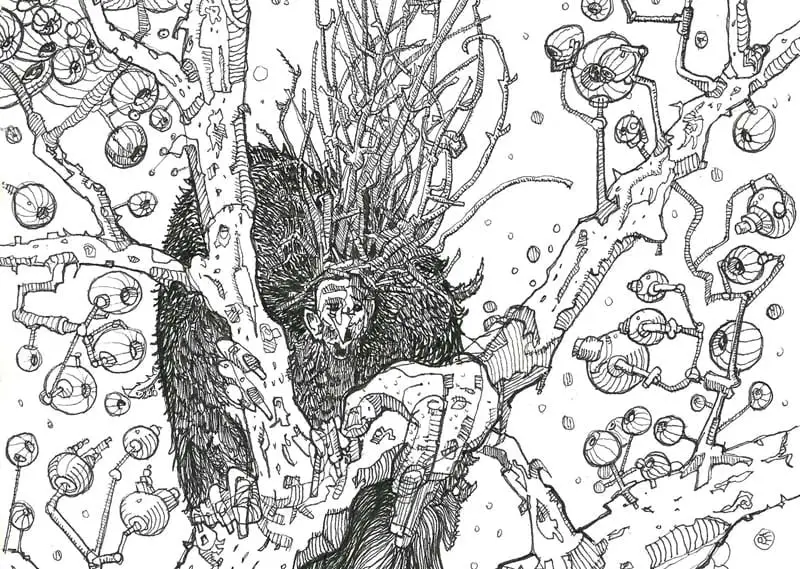
"Long Teeth" (1959/1960)

Updated: 14 hours ago

“He is fifty-three years, seven months, and nine days old. His calculated worth is three hundred and twenty-two thousand dollars (my own calculation but a close one); you are his heir, Clinton. He is, moreover, highly insured withsuch a multiplicity of policies that it is almost impossible to tabulate them, or even to be sure that I know about the mall. He is unsound of heart, liver, lung, kidney, and stomach; has high blood pressure, ulcers, and Evan's Disease; in short, he is the kind of man who might live forever. I have no faith in the early death of a man with a number of deadly diseases. Death often seems not to know which to select, and retires again shaking her head.”
In “Long Teeth,” we meet Carla, a designing woman married to a clueless simp named Clinton, who stands to inherit a fortune from his wealthy Uncle Nicholas. Carla grows increasingly impatient for Old Nick to die so that she and Clinton can come into their inheritance, and she justifies her lethal intent with a “froggish proverb”: “a person can grow a very long set of teeth while waiting to dine on a dead man’s leavings.”
Clinton is timorous, but Carla takes charge, orchestrating a series of odd events meant to hasten the death of the resilient invalid. Her attempts range from slipping a coral snake into his whisky to rigging an exploding grandfather clock. Yet, Nicholas survives them all—thanks to his own wits and a succession of food-tasting cats named Amenhotep who perish in succession.
In the final confrontation, Nicholas ends up thoroughly roasted, and Carla dies from a broken neck after accidentally setting herself alight. Clinton inherits the estate and takes over raising his nephew, Walter Jr., in the Old House. But this is a story about the cycle of greed. Years later, an aged Clinton is chilled and saddened to overhear Walter Jr.’s new wife, Charlotte, repeat the same froggish proverb about the long teeth of the waiting heir—revealing that Clinton has now become the target.
Andrew Ferguson has written well about this early Lafferty story, situating it within the genre history and the magazine world in which it appeared. He also notes that if Lafferty hadn’t broken into science fiction, this is the kind of genre work he might have written more of—a possibility Lafferty himself mentioned in passing. Ferguson points readers to Lafferty's great unpublished novel Mantis.
Lafferty doesn’t so much write mysteries as write from mystery. What he produces are puzzles. Conventional mysteries are puzzles, of course. But some puzzles open into further mystery; others do not. One might here think of the difference between conspiracy in Chesterton's The Man Who Was Thursday and conspiracy in Umberto Eco's The Name of the Rose. Lafferty's early stories are tidier puzzles than the later stories because the earlier ones are less open to the puzzlement of mystery itself. There is more rationalization in play. On the question of puzzle and story, Lafferty wrote in a letter to Hiroshi Inoue: “I do not mean to puzzle people with my writings, though any good story is the unraveling of a puzzle.”
Still, picking up on Ferguson's insight, Lafferty wasn’t made for mystery fiction. The genre depends on varieties of closure that don’t suit him; even when Lafferty restores order, he leaves mystery. That’s the irony of the classic whodunit: it works hard to create an initial moment of mystery, then solves it so entirely that the mystery is gone. To see the counter movement in Lafferty, compare any of the early mystery-adjacent pieces like "Long Teeth" to what he does in "The Funny Face Murders."
Since “Long Teeth” is not a mystery, finally, what kind of puzzle is being unraveled? If we aim high, the puzzle is the mapping of a recursive topology, an obsession that Lafferty develops repeatedly throughout his fiction. Consider how The Devil is Dead, which Lafferty first drafted in 1963, is topologically continuous with Finnegan's blackouts in the earlier Archipelago, such as its memorable 105-hour Finnegan blackout.
As others have recognized, The Devil is Dead trilogy, with its rich pattern of incident, has the structure of a Klein bottle, where what looks like a break or crossing in ordinary narrative space is a continuous loop. To return to Finnegan, his blackouts index the bottle’s apparent self-intersection—the point where the same surface crosses itself in projection. We are inside Archipelago, and then we find ourselves inside The Devil is Dead. Where are we? Inside both.
The mystery is that of form. Lafferty takes Carla’s “froggish proverb” and shows that it is the formula for a closed loop of greed. It is not a linear vector from non-wealth to wealth, but a Möbius strip: a non-orientable surface along which the hungry mouth moves on a single continuous side, only to arrive as what passes into another mouth, making this yet another of Lafferty’s self-consuming artifacts.