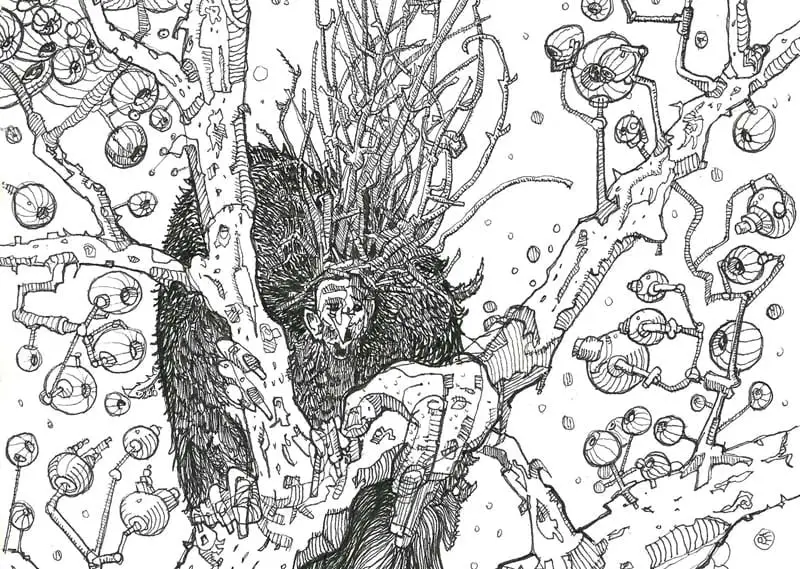
"Le Hot Sport" (1984/1988)

Updated: 1 day ago

This was the outrageous prediction: ‘Eleven-year-old Caspar Lampiste didn’t seem very much worried when I told him that he had only one day to live, that he would be killed by an automobile then. “What kind of automobile?” he laughed. “Shouldn’t I get to pick what kind of automobile I want to be killed with?” “It will be a foreign car named Le Hot Sport,” your faithful reporter, I, George Hegedusis, told him.’ “Oh wow. Oh wow. Oh wow!” young Caspar sang out.”
And the son Caspar Lampiste was seen on a scanning screen, running open-armed toward the insane car. The boy Caspar Lampiste had lost his wits, or his wits were trammeled. Le Hot Sport had braked and slowed, and it came to the encounter at no more than twenty-five miles an hour; and the boy, the Caspar-goat, was running open-armed toward it at at least half that speed. The way he went down when he met the car, it was clear that the joyous boy was killed instantly.
Lafferty completed "Le Hot Sport" on June 13, 1984, making it one of his final short stories. After Terry Carr’s death in April 1987, he was asked to contribute to Terry’s Universe (1988), a memorial volume edited by Beth Meacham to benefit Carr’s widow, Carol. Lafferty held Carr in high regard and wanted his contribution to be worthy of him. He called “Le Hot Sport” a very good story, and I think he was right. It’s one of Lafferty’s four-dimensional chess stories, this time exploring the nature of fate.
It centers on Romany characters, and begins with the four-day publication of the Dukkerin Daily, a short-lived newspaper. We are told it is witty, novel, and titillating. It is run by George Hegedusis. Hegedusis is a former showman, a violinist, and, by his own admission, a shameless confidence man. Hegedusis fills his paper's “Predictions" section with modern fortune telling, printed dukkerin. One of these is about a two-dollar guitar launching a local boy into future stardom. These claims attract the attention of Karl Staripen, a Romany police officer on the bunko squad, who confronts Hegedusis about the Dukkerin Daily, suspecting that what is happening is part of a con. Hegedusis doubles down on the truth of his predictions and challenges Staripen to prove him wrong.
This takes us to Hegedusis’s big prediction: "Caspar Lampiste, an eleven-year-old boy of this city, will be killed by a Le Hot Sport automobile about one o’clock this afternoon." The prophecy leads Staripen to take Hegedusis into custody and bring him to the fortified mansion of Caspar's father, Rich Frank Lampiste. There, in a top-floor executive suite with "bullet-proof and shatter-proof" glass, the executive attempts to defy fate, having confirmed that all known Le Hot Sports in the country are accounted for, safely immobile, and hundreds of miles away.
Inside the fortress, the plot takes a twist. Hegedusis reminds those present of his own death prediction, which is that he will be murdered by being flung from a window. He then exposes Rich Frank's attempt to trick fate, saying, "your son is not here." The boy present in Rich Frank’s fortress is a look-alike cousin, Roland. Rich Frank admits that the real Caspar was hidden in a bunker but has escaped. Through his own Romany powers, he sees his son running toward the mansion, crying out that he has a 'joyous encounter that I must keep.' At the same time, monitors track a fifth, stolen Le Hot Sport, airborne in a damaged aircraft and heading directly toward them.
Suffice it to say that the prophecy is fulfilled with flamboyant precision. The aircraft breaks apart, and the Le Hot Sport begins a high-speed glide toward the earth, with a sharp joke about how fast cars hover at certain speeds. The men watch on a screen as Caspar, the "Caspar-goat" (in the original the character had been named Joseph and was the “Joseph-goat”) runs with open arms toward the evil car and is killed instantly. In the aftermath, his cousin Roland is ecstatic. He says that a family curse is broken. "Now our family name is no more 'Lampiste' or 'scapegoat'," he says. "Our family name becomes 'Langa' or 'flame' now." Grieving, Rich Frank accepts Roland as his new son and heir, while Roland taunts the weakened Hegedusis, claiming his own "Days of Power" have begun.
The story concludes with two more deaths. Hegedusis, an old escape artist, frees himself from his shackles and steps out the window, executing his signature “Fallen Angel” act. He lands alive but is goaded by Roland to “Rise up.” Hegedusis does so, “slowly and torturously, like a zombie,” and drags himself a few feet before collapsing against a stone fence, “seething with black despondency.”
Seeing his rival in this state of dejection, Roland summons lightning, crying, “Strike, two-faced Strafil, strike!” A double-pronged bolt descends from the cloudless sky: one prong kills Hegedusis as he slumps against the fence, while the other enters the room and kills Roland. The story ends as Rich Frank mourns both boys and Hegedusis’s family arrives below, playing the everlastingly happy tune of “The Gypsy Hangman” on the violin.
One of the better-known lines in Virgil’s Aeneid is “Fata viam invenient” (“the Fates will find a way”), the attempt to outfox fate being a favorite theme of classical literature. The best example of this is Oedipus. Raised as the prince of Corinth, Oedipus was told by the Oracle at Delphi that he was fated to murder his own father and marry his mother. Believing the Corinthian royals to be his true parents, and horrified by this destiny, he makes the seemingly rational decision to abandon his home and never return. He wants to protect those he loves.
But as he runs away from his fate, he collides with it, for while traveling on the road toward Thebes, Oedipus comes to a place where three roads meet. He falls into a violent dispute over right-of-way with an older man in a chariot, and kills him in the Western canon’s best-known case of road rage. The man is his biological father.
Oedipus running away from fate and crashing into it is the reverse of Caspar Lampiste—the Caspar-Goat who accepts his fate and runs to it joyfully. Caspar’s death is, in fact, profoundly anti-classical in its complete lack of anxiety about fate, and essentially Christian in its logic: the logic seen in the deaths of martyrs and saints, who aspire to partake in Christ’s Passion. Facing his own violent death in the Garden of Gethsemane, Jesus asks that the cup pass from him, but if it cannot, he fully accepts his fate, praying, “not my will, but thine, be done.” Caspar’s father says he wants to trick some lesser demiurge. To him, it might look like rounding the planet to find Snuffles.
That might sound preachy, but it is Lafferty who places the question of the scapegoat at the dead center of “Le Hot Sport.” He knows the death of Christ is the typological fulfillment of the scapegoat in Leviticus, just as he knows Christ is the lamb of Isaiah (“He is brought as a lamb to the slaughter”).
We usually use the word scapegoat as if it were negative. For many, it is a quintessential figure of injustice, with no other meaning. That is not how it appears within salvation history. The scapegoat is not a patsy but a vehicle that precedes the sacrament of reconciliation. On one side, the scapegoat is redemption, so run that ye may obtain. The running Caspar Lampiste is the reverse of his name. He is no sad sack. With his flight is Thomas More’s “I die the king’s good servant, but God’s first” and all the other lines from the cloud of witnesses.
On the other hand is the condemnation of judgment, the doom that the running sublates, which Caspar’s cousin Roland learns the hard way. Lafferty gives us an image of these two faces of fate: Robert “fell across his dead brother-cousin Caspar Lampiste.” Perhaps they even form a cross. This duality is the happiness and sadness of the story’s violin.
Because Christianity so often emphasizes human choice and simplified versions of free-will theodicy, it might seem surprising that a Catholic writer like Lafferty would lean so strongly on the idea of fate, which here can look deterministic. Christians, of course, have a term for this, just as the non-Christian Greeks had the moirai: predestination and providence. Of this, Aquinas writes in the Summa Theologica:
I answer that, Predestination presupposes election in the order of reason; and election presupposes love. The reason of this is that predestination, as stated above (Article 1), is a part of providence. Now providence, as also prudence, is the plan existing in the intellect directing the ordering of some things towards an end; as was proved above (I:22:2). But nothing is directed towards an end unless the will for that end already exists. Whence the predestination of some to eternal salvation presupposes, in the order of reason, that God wills their salvation; and to this belong both election and love:—love, inasmuch as He wills them this particular good of eternal salvation; since to love is to wish well to anyone, as stated above (I:20:2 and I:20:3):—election, inasmuch as He wills this good to some in preference to others; since He reprobates some, as stated above (Article 3). ST I, q.23, a.4
Against determinism, single predestination—the doctrine that God predestines the elect to salvation but does not predestinate anyone to damnation—is one of the most useful ways to understand what happens in the story. How this differs from Calvinism is a matter of theological anthropology and would take us afield. Caspar’s collision with the car may look like compulsion from the outside but is inner compulsion, an active and willing flight into fate and death, the iconographic martyr’s smile.
When Caspar learns of Hegedusis’s prediction, he isn’t afraid; on the contrary, he is excited and curious. He marvels at the rarest car that will end his life—the seeming instrument of evil, Le Hot Sport. There are twelve of those cars, like twelve devils, and there is a clue in hot that points to more than combustion engines. His cousin, Robert, asks of the devil car, “Will you give it to me, Uncle Frank, now that Caspar is dead?” as if it could be controlled.
Caspar is smarter. He goes out of his way to meet fate, slipping through the supposedly impassable swamp like one of Lafferty’s many characters who pass through walls. Dead, his corpse bears a look of radiant happiness, one of Lafferty's weird saints or martyrs, a lamb, his end being his fulfillment. In this, he contrasts with the other characters, who behave far more like most men, who behave like Oedipus: “All understood too late.”