"I Don't Care Who Keeps the Cows" (1976/1994)

Updated: 1 day ago

Because of the trashiness of its origins, there has grown a sort of amnesia over the account of how we became as amazingly smart as we are now, and of how we were even smarter for a while there. This honest account should cut through the amnesia a little bit. "I Don't Care Who Keeps the Cows"
There is laughter, and there isn’t supposed to be. "Sex and Sorcery"
“I Don’t Care Who Keeps the Cows” rarely draws notice, but it deserves to be read. Not only for its searing grotesquerie, but for its laughter. Lafferty readers will recognize that laughter from “Nine Hundred Grandmothers” (1966), and they can hear it again in one of his strangest experiments, the unpublished, wise, and mortifying “Sex and Sorcery” (1973). In that story, a pornographer traveling with a team into the future keeps hearing the same chuckling. Lafferty uses it to shape his version of the theology of the body. It is the laughter that erupts when moral idiocy and a failure of imagination go too far.
"Cows" does this by posing a question: What would happen if humanity did an end run around the Law of Intellectual Constancy? Science fiction, of course, loves that kind of question, but so does Western storytelling more broadly, from Prometheus and Icarus to the Sorcerer’s Apprentice and Dr. Jekyll. For historical exemplars, there is Simon Magus in antiquity, Roger Bacon in the Middle Ages, Faust in the Renaissance, and Victor Frankenstein in the Romantic era. In our own time, the examples are too numerous to count. Lafferty adds his voice to that long tradition.
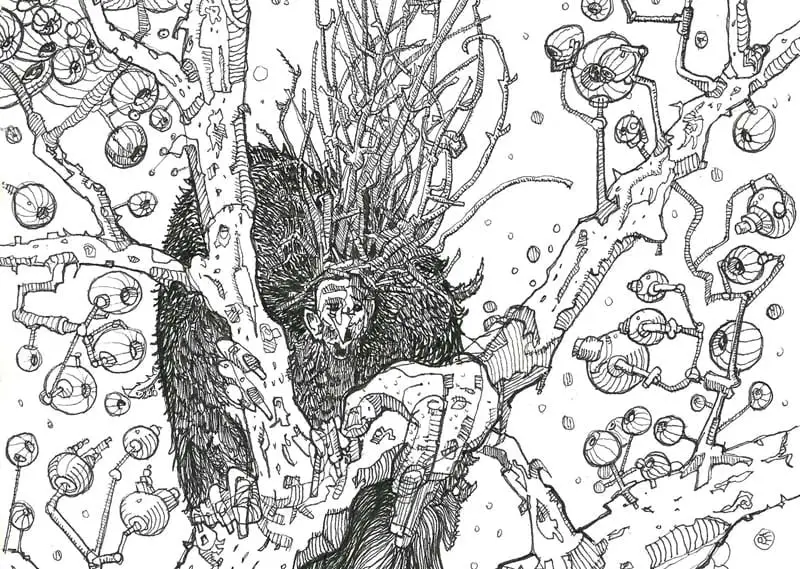
In the story, human intelligence seems to take a huge leap when people begin using special steroids and other gimmicks. Three main "smart" groups form: the Scar-Tissue Clan, who grow extra brain tissue; the Necklace Clan, who wear their brain extensions as jewelry that links them to information centers; and the Little Red Wagon People, who pull their added brain mass behind them in wagons.
A small group called the Quacksalvers (led by Jerome Blackfoot and Ferndale Whitehead) stays "normal" by choice, selling these brain upgrades without using them. As the world grows "smarter," new kinds of conflict emerge, eventually ending in a showdown between the brain-boosted masses and the unimproved few. But just as intellect peaks, the brainy modified humans realize they have become the intellectual equivalent of cows being milked. Someone laughs—and the spell breaks.
This is the third post on the Law of Intellectual Constancy in Lafferty, so I’ll keep the focus narrow. A few points stand out. First, there is a forgetting of the old budget—a kind of amnesia, as the narrator calls it. This reflects Lafferty’s idea that the law of intellectual constancy in modernity often comes with a kind of loss of memory, which I discussed in the previous two posts. The story uses this forgetting to riff on what happens when the intellectual budget is overspent.
Intelligence, once a shared human potential, becomes instrumentalized, a commodity to buy, to own, to rank, or, in the allegory of the story, livestock rather than a person. But the attempt to cheat the Law causes it to snap back, hard. Government hierarchies reassert scarcity. The Quacksalvers outmaneuver everyone. And in the end, the new economy of intellect collapses into laughter.
There are many ways to interpret all this. The one that makes the most sense to me is a double elastic snap. What looks like a break in the law ends up rebalancing itself. The ordinary cunning of the Quacksalvers shows that when the law is disturbed, occult compensation must overspill. This is the first snap: the Quacksalvers extract intellectual milk from the Scar-Tissue Clan, the Necklace Clan, and the Little Red Wagon People. At this point, they have rigged the system of occult compensation in their favor.
The second snap comes when their scheme collapses in the face of human laughter, fully restoring the law and confirming its nomological necessity.
But another of the super-brains laughed. There was a chasm, and there shouldn't have been. There was maladjustment, and a ridiculous bridge was the best that could be thrown over it. They broke it, and they lost part of it when they broke it. The whole apparatus of being so smart crumbled, even though a lot of the smartness would remain. The top of the mountain of it was gone. We'll never be that smart again.