"Flaming Ducks and Giant Bread" (1973/1974)

Updated: 4 days ago

There is an old canard that twins are less fertile than singletons. This probably has its source from the fertility difficulty that the heifer co-twin of a bull calf is likely to encounter. —Alan F. Guttmacher, Pregnancy and Birth, 270.
canard, n. “A false or unfounded report or story,” especially “a fabricated report”; from the French, literally “duck.”
And still there were the flaming ducks, all of them capons, stenchy and outrageous, thudding, thudding, thudding to earth day and night. One does get tired of burnt duck.
Advanced Lafferty.
For some time I have wanted to do a close reading of “Flaming Ducks and Giant Bread,” because Lafferty uses his sources in unusually obscure ways. The story is nominally about the Institute of Impure Science, but the Institute is largely window dressing. A full account must explain how Lafferty brings together Exodus, Numbers, and Psalms; Chesterton’s lines on giants in Orthodoxy; Dante’s whore and giant as figures of the Avignon papacy; the Pope Joan legend; eucharistic imagery; Bierce’s pseudo-scholars; several dirty puns; and local trivia about Bristow, Oklahoma.
Such an account needs more room than a blog post allows. It belongs in a podcast episode. Here I will only sketch the story’s design.
In “Flaming Ducks and Giant Bread,” the Institute of Impure Science cycle goes esoteric. All the techniques that make Lafferty’s later work difficult are present. The story is therefore a good place to think about fully nucleated Lafferty as he appears in the novels of the 1970s. If “Through Other Eyes” is Munchkin Country, “Flaming Ducks and Giant Bread” is Gillikin Country. No account of the Institute of Impure Science is complete without an understanding of this story.
The bewilderment the story produces shows the limits of reading any piece of Lafferty chiefly as a succession of strange events. Until one sees the sort of thing he is doing here, much of his fiction after a certain point in his career will be obscure. I think I understand the story now. That understanding came from tracing its sources and working out a way to read Lafferty as a whole.
The story could easily sustain several hours of discussion. The key to it, I think, is Lafferty’s response to Roe v. Wade and his annoyance with Planned Parenthood. The decision was handed down earlier that year. He was especially careful to conceal the mechanics of his anti-secret this time. His method was to construct a form of anti-pornography out of intensely sexual coding.
Let's start with Alan F. Guttmacher (1898–1974).

Alan F. Guttmacher was a Jewish American obstetrician and gynecologist who became a leading advocate of contraception and the liberalization of abortion laws. After training at Johns Hopkins, he became director of obstetrics and gynecology at Mount Sinai Hospital in New York. In 1962, he became president of the Planned Parenthood Federation of America. His work in that office made him a much-reviled figure in the Catholic press. He sought to make contraception and legal abortion broadly available, and he helped transform “birth control” from a reform movement into an established field of medical practice and public policy.

Guttmacher was also associated with the American Eugenics Society. Chesterton and Lafferty, by contrast, vehemently opposed eugenics. Both would have regarded the historical relationship among the birth-control, population-control, and eugenics movements as plain. These facts explain how Guttmacher found his way into the Institute for Impure Science. Lafferty’s objection to him, however, extended beyond particular policies.
In Chesterton’s terms, Guttmacher was a modern heretic. By “heretic,” I mean more than a man who held opinions that one dislikes. In Heretics, Chesterton argues that particular opinions are expressions of a prior view of reality. He writes, “The most practical and important thing about a man is still his view of the universe.”
Guttmacher’s heresy is to make a modern notion of freedom sovereign over the sexual act: appetite and activity may be separated from generation, and generation from completion. Lafferty would have regarded this as a rebellion against God, since a thing cannot be liberated from the ends that make it what it is without being destroyed. The story gives this rebellion comic expression in an aside: “Satan, in his person of Lucifer, was the first of the Flaming Ducks, and he is the father of them to this day.”
Lafferty picks up Guttmacher’s line about canards and heifers by literalizing the canards as ducks. The joke is transitive, but it depends upon an equivocation. If Satan is the father of ducks, he is the father of canards; since canards are lies, he is the father of lies, as Christ calls him in John 8:44.
The relation between Heretics and Orthodoxy is not tangential to this argument. Chesterton wrote Orthodoxy as the positive counterpart to the largely negative argument of Heretics. This probably explains why Lafferty quotes Chesterton’s image of the triangle from Orthodoxy. A triangle that escapes the three sides that make it a triangle does not become free; it ceases to be a triangle.
Amor is a culture built upon this heresy:
Love was the theme of Amor Town, and the triangle was the symbol and shape of that contingent society; the triangle, and its solid form, the tetrahedron. The sound of it was triangular, the groupings were triangular, and its prismatic light was triangular. Joan Hedge-Green herself formed an immediate love triangle with her two lovers, the Clown-Devil and the Maid of Wands. (“Glory, love, and love some more for Babylonian Jane,” as Rudyard said, but not quite.) Every person in Amor Town was a ravening lover. (“So I move mountains and I love them not, then I am nothing,” as Paul said, but not exactly.) Each lover had its own Ares and its own Aphrodite, and each was by turns Ares and Aphrodite to others. This was the triangle repeated over and over again in the love plane, the interlocking loving that is not accountable ever. (“Blessed be that love that shatters all its offspring on the stones,” as the Psalmist said, but not precisely.) But the plane does not go up far enough, and it sure does not go down far enough. But, in addition, each lover had its masked lover or Hermes. This additional masked lover placed each lover in three love planes instead of one. This worked to construct the love pyramid, or love in depth. It was a nesting, close-fitting form, and it multiplied endlessly. It was the most simple crystal possible, and it propagated itself forever. It filled, or would fill, or might fill all the worlds and all the universes. (“And, for your love of love, lead apes in hell,” so Will the Bard said, or almost said.) (“I love the jupe, I love the jape, I love the Tartarusian ape,” so Joan of Amor said.) This was the inward-turning construct that had no limits, and it had very few needs beyond itself. There was food in the Fleshpots of Egypt district of the town; there was other food in the Rivers of Babylon district; and there was very strong food in the Ovens of Moloch purlieu.
So that is Guttmacher, and that is why Epikt and the Institute crowd discuss him at the surface of the story. Lafferty makes this connection radioactive by having an uncertified person write directly to Epikt:
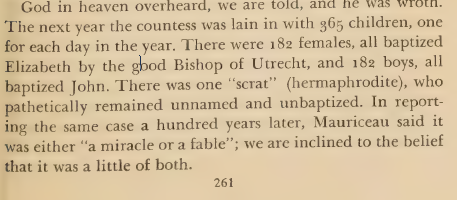
“Epikt, this is from Guttmacher's Pregnancy and Birth: ‘In 1313 Lady Margaret, Countess of Hagenau, was laid in with three hundred and sixty-five children. . . . all baptized John, and one "scrat" (hermaphrodite), who remained unnamed and unbaptized.’ I thought you might be able to do something with the above.”
Next, I want to turn to what I have called the didactic and palimpsestic axes of Lafferty’s fiction. His technique becomes especially clear in this story once you know his source materials, and the overt reference to Guttmacher is a surface-level didactic move. I make this distinction because a reader needs a way to cut through what looks like hallucinatory fat in Lafferty but, in fact, carries displaced meaning. The displacement makes the didactic argument seem less didactic by defamiliarizing it.
Together with counterfiguration and antisecret, these terms form a set of concepts central to how I make sense of Lafferty. They direct attention toward real objects and help a reader avoid apophenia on one side and bewilderment on the other.

Knowing those sources also explains one of the story’s strangest features: the steamboats. They puzzled me when I first read the story. At the time, I had not read Guttmacher, so I did not know that Lafferty drew from his book not only the premise of a woman giving birth to a horde of children, but also details he never attributes to Guttmacher. A few pages after the birthing passage, for example, one finds an aside on the Pied Piper of Hamelin, who of course shows up in Lafferty’s story.
For the moment, however, let us set aside the full complexity of Lafferty’s use of Guttmacher (it goes a lot deeper than steamboats) and concentrate on the steamboats. They are an interesting lesson in the relation between the didactic and the palimphanic modes in Lafferty’s fiction.
The didactic argument comes first. The didactic point of “Flaming Ducks and Giant Bread” is plain, although readers have often missed it. Typical is this from a good Lafferty reader: "Not sure what to make of this one. I enjoyed it, but not one of my favorites." The story attacks contraception as a practice that preserves sexual pleasure while severing the sexual act from its final cause, the generation of children. Lafferty drives the point home through monstrous overfertility. This also explains why ROMA is reversed into AMOR: love itself runs in the wrong direction.
What is especially interesting is the slyness with which Lafferty hides semen in the story. He knew that many of his readers would be hostile to his view and therefore turned Guttmacher’s account of spermatozoa traveling toward fertilization into a lesson about Amor, where appetite and activity are severed from generation and completion. The image becomes palimphanic because Lafferty allows medical, biblical, calendrical, technological, theatrical, card-playing, and eucharistic associations to show through its didactic argument. He builds more associations into that argument than ordinary decoding can contain.
Hence, few readers, when recalling “Flaming Ducks and Giant Bread,” are likely to think of the steamboats, although the boats form a major part of its symbolic design. This density is one reason that, apart from Arrive at Easterwine, “Flaming Ducks and Giant Bread” and “Bird-Master” are by far the least understood works in the Institute sequence.
The passage we need to understand the steamboats appears early in Guttmacher’s chapter “Impregnation.” Guttmacher writes, “the usual time of ovulation is day thirteen or day fourteen.” This explains why, he writes, “impregnation is most likely to occur in mid-cycle” (Pregnancy and Birth, 5). The numbers already suggest a story about the world becoming contaminated by the lost year 1313. The palimphanic becomes unmistakable when Lafferty places his stranded steamship “in the middle of Fourteenth Street,” at the same number and position Guttmacher draws a circle around during ovulation.
Guttmacher next describes the medium that makes fertilization possible. During the fertile part of the cycle, the cervical canal is “filled with a profuse, transparent, watery mucus which furnishes a highly favorable environment for sperm cells and through which they swim with ease.” At other times, the mucus is “scant, sticky, opaque,” and many spermatozoa are “entrapped and halted in it like flies on flypaper.” The reproductive journey thus depends upon a medium that may either facilitate motion or arrest it.
On the following page, Guttmacher develops the journey through a series of geographical and nautical figures. This, I think, prompted Lafferty’s palimphanic leap. Some spermatozoa “bog down on the way, getting hopelessly stranded in little tissue bays and coves.” A small number enter the uterus and begin an “upward two-inch excursion.” Guttmacher asks whether they advance by their own swimming or are assisted by “fluid currents and muscular contractions of the uterus.” The successful spermatozoa are “the undaunted ones, those not stranded in this veritable everglade,” who continue their journey through the Fallopian tubes (18).
Guttmacher’s scientific explanation is already a miniature adventure story. It contains swimmers, a difficult journey, watery channels, currents, bays, coves, an everglade, stranding, and a destination. On the following page, that destination even becomes a “trysting site.” The spermatozoa become competitors: “The one sperm of the 2000 that achieves its destiny has won against gigantic odds, several hundred million to one.” Guttmacher says that the winner may possess the strongest constitution, may be the swiftest of “the contestants entered in the race,” or may merely be “the luckiest in finding a fluid current leading straight to the ovum.” The successful sperm completes its five-inch journey in thirty or forty minutes and engenders a child.

Lafferty reverses the journey. Guttmacher moves from the thirteenth or fourteenth day to fertile fluid, from fertile fluid to the sperm’s journey, and from the journey to fertilization and a child. Lafferty allows the journey to end in stranding. He does so because he does not believe for a moment that Guttmacher stands on the side of life. Guttmacher will therefore pay with his own toy boats.
The steamship first appears before Epikt projects Amor. Glasser must make a detour when he encounters this anomaly, anchoring the ship exactly on Guttmacher's numerical day of ovulation:
Glasser also was going to the Institute. He had to go several blocks out of his way. There was a steamship in the middle of Fourteenth Street; it had the whole thoroughfare blocked. And there was not near enough water to float it, though it had rained a bit during the night.
This is a giant, stranded sperm, and Lafferty knows that most readers will not recognize it. At this point, its strangeness has no explanation beyond an eruption from another order. It stands beside the holy cow, the strange children, and the people dancing the chorea. The image begins palimphanically: a ship stands in a street after a light rain, and its incongruity sets several lines of association in motion.
Inside Amor, the image begins to disclose its didactic meaning. Lafferty calls the city’s technology “anachronistic and atrocious”:
There were the steamboats which could not have been if that were a proper sequence year. But the steamboats were there and, especially in the mornings, were always blocking dry and rubbled streets. It is believed that they steamed out on the morning dew and were stranded when the dew dispersed.
The correspondence with Guttmacher is close. Guttmacher’s spermatozoa travel through a temporary watery medium and become “stranded in little tissue bays and coves.” Lafferty’s vessels move through morning moisture and become stranded when it disappears. Cervical mucus has become morning dew, spermatozoa have become riverboats, and the reproductive tract has become a dry city street. Guttmacher’s metaphorical geography has been exteriorized as physical setting.
The didactic meaning is stated in Amor’s motto. Lafferty unites this anti-natalism with the city's very architecture:
There was no maturity about them: they did not desire maturity. And at the same time there was nothing of the childlike: they sure did not desire children. There was the taut interruption, the jerk back from the momentous. (“That no thing come to term!” was another of the high Amor mottos.)
It is the Ouden principle, which one can see by pulling "no" and "thing" together and hypostatizing that Nothing come to term. "We will close down the worlds and make an end of life. It will be nothing, nothing, nothing, forever, for ever, for never, for never. And when all has ceased to be, it will also happen that nothing has ever been. We will pull the hole in after us. We will put out the stars, one by one and billion by billion." Here, it is all given sexual treatment.
The stranded boat is the visible sexual correlative of Astrobe's spiritual and political condition in Past Master. The steamboat has an engine. In theory, it could move. But it lacks the water needed for real voyaging. Each morning, it moves a little before the dew disappears and leaves the steamboat stranded once more. The boat never completes its passage. It is like the false appearance of wind in Amor, where wind signifies ruach or pneuma.
At one point, Guttmacher casually compares fertilization to civic office. After describing the successful sperm, he writes, “The baby it engenders has a far greater chance of becoming president than the sperm had of becoming part of a baby.” This must have annoyed Lafferty, because he divides the comparison into separate narrative events.
In Amor, babies walk and talk on the day of their birth. One week later, “the children of the large birthing of the week before” have “taken over most of the city offices.” Lafferty is here laughing at Guttmacher, detaching civic office from maturation just as sexual pleasure has been detached from generation. Lafferty completes the joke by naming one of the stalled showboats The Big Casino. Chance has become the governing principle of both fertilization and public order.
I am tempted to leave the matter there, but the Exodus complex also bears on the steamboats. Two biblical sources govern this part of the story: the manna and quail narratives of Exodus 16 and Numbers 11, and St. Paul’s account of love in 1 Corinthians 13. From Exodus and Numbers come the quails, morning dew, manna, and bread from heaven. From St. Paul comes the authentic language of love, which Amor severs from final causation.
Numbers 11:9 elaborates upon the account in Exodus: “when the dew fell upon the camp in the night, the manna fell upon it.” Lafferty makes the scriptural pattern during a debate over the nature of the flaming ducks, when Epikt’s extension connects the imagery (by way of Dryden) to Numbers:
"But scripture does not mistranslate," the Johnny Greeneyes extension of Epikt said. "Quails they are, the quails of the flesh-pots. Huge, it's true, but quails. We have the holy words for evidence: ‘We loathe our manna, and we long for quails.'"
Much more could be said, but Epikt’s two extensions themselves embody the severing of final cause from efficient cause. That is why he has two extensions in this story. One is the ancient scribe, who combines Moses and St. Paul. The other is Johnny Greeneyes, the Guttmacherian image of birth as The Big Casino. Their separation divides what Jeremiah holds together: “Before I formed you in the womb I knew you.”


. . .

Finally, an Easter egg: the cows, and the regret that I don't have time to discuss all the other aspects I mentioned in the first paragraph, all of which give the story so much of its richness and weirdness.
The Hamburger Kings were a small group of Oklahoma hamburger cafés, unrelated to the later Burger King chain. The first one opened in Bristow in 1923 under Mansour George Macsas. Soon, related restaurants appeared in Shawnee and Ada. Macsas later sold the Bristow café to Johnny Horany, who ran it until the 1960s and advertised it over KVOO. Lafferty probably liked these places. Picture old-fashioned lunch counters serving inexpensive griddle hamburgers, chili, sandwiches, and pie.
When time begins to hemorrhage and contaminate itself, Lafferty reproduces an actual KVOO radio commercial and blends it into the sensory overload of the twinned cities, Amor of 1313 and the Institute’s Tulsa:
. . . the radio wavicles that mutated till they brought programs from the distant past . . . and from the distant future (“Station KVOO, Bristow, Oklahoma, bringing a program sponsored by Johnny Horany the Hamburger King”).
So what is going on here? The KVOO Hamburger King advertisement plainly belongs to the story’s cattle imagery. Long before the projection begins, Lafferty sends a cow to the Cow Palace, a slaughterhouse. As Charles Cogsworth walks to the Institute, he is trailed by a weird cow:
“Clank, clank,” went the cowbell. “Can you tell me the way to the Cow Palace?” the cow asked, or else she didn't: this point remains in dispute . . . The Cow Palace was a slaughterhouse, and no good could come to her there.
Skip ahead in the story back to the year 1313. Joan feeds her people “holy cow” and unborn calves. The latter are roasted alongside unborn children in the Ovens of Moloch. Lafferty lays on the antinatalist horror of the feast:
She fed them on holy cow; and on unborn calves and colts, on unborn lambs and kids, on unborn cubs and children, all of which were roasted in that part of her court called the Ovens of Moloch.
Skip ahead once more. The Horany commercial arrives as a broadcast from the “distant future.” After the projection ends, the Institute members eat “holy cow” in a hard-times sandwich seasoned with Moloch mustard. Valery’s offer to Gregory shows that the boundary between Epikt’s projection and their reality has broken down:
“Here, Greg, I'll make you a good hard-times sandwich, break-bone bread, holy cow, flamed—ah—grackle, blood pudding, offal—no, really, they say it's good for you—yellow sulfur, and that good new Moloch mustard. Here, eat it hot, Greg, eat it hot.”
The cattle imagery passes from the Institute’s present into 1313 and back again. The investigators have either entered the missing thirteenth floor, or the thirteenth floor has opened into their time. As the story has already explained, the thirteenth floor is the spatial equivalent of the omitted year 1313. Gregory establishes the equivalence early in the narrative:
“It is discovered one day that it does have a thirteenth story after all, one not built by the builders, one that is only entered by accident, one that is a crazy jumble of insane things and happenings, one that isn't measurable in normal space . . . Such is the year which we will now make the subject of our study.”
Horany’s commercial joins these episodes into a single sequence: cow, slaughterhouse, oven, sandwich, hamburger.
The sequence reverses the usual biblical meaning of cattle, although the Golden Calf supplies the crucial exception. Cattle ordinarily belong to sacrifice, fecundity, nourishment, and providential abundance. Lafferty plays directly with the promised land’s milk and honey when Amor serves heifer milk and wasp and hornet honey. The Golden Calf, however, is a false sacred animal that Moses burns, grinds to powder, scatters upon water, and makes Israel drink. That exception brings Johnny Horany into the Exodus complex. The hamburger grill becomes cross-associated with both the burned holy cow and the Ovens of Moloch.
A cannibalistic logic turns on the parallel between child and calf and between person and cow. The cow goes to the slaughterhouse as the Pied Piper’s children later go to the reservoir. “Holy cow” becomes food, while unborn calves and children are roasted together. The heifer is an anti-mother, giving milk without having calved; the ox appears as an anti-father, castrated in advance. Finally, “holy cow” becomes sandwich meat. The generative order of cow, calf, mother, and father has been turned toward slaughter, sterility, and consumption. Poor Johnny Horany. His burgers were supposed to have been good.





Comments