Consensus Reality I

Updated: Sep 4

"There's a kind of group amnesia that blocks out the details. But it didn’t end in Armageddon."
I have pet theories about how Lafferty handles consensus reality, especially in the two novellas in Apocalypses, where it takes on its most nightmarish shape. What I want to do here is to explain how it works in those works, or at least how I think it works, as plainly and neutrally as I can. I’ll do this in three parts. The first will focus on Enniscorthy Sweeny. The second will turn to Sandaliotis. The third will look at how the idea of consensus reality differs between the two, which is important. These are dense, intricate texts. One could revise endlessly. But my notes feel close enough for now. I hope they prove useful to anyone who wants to dig deep into the writing.
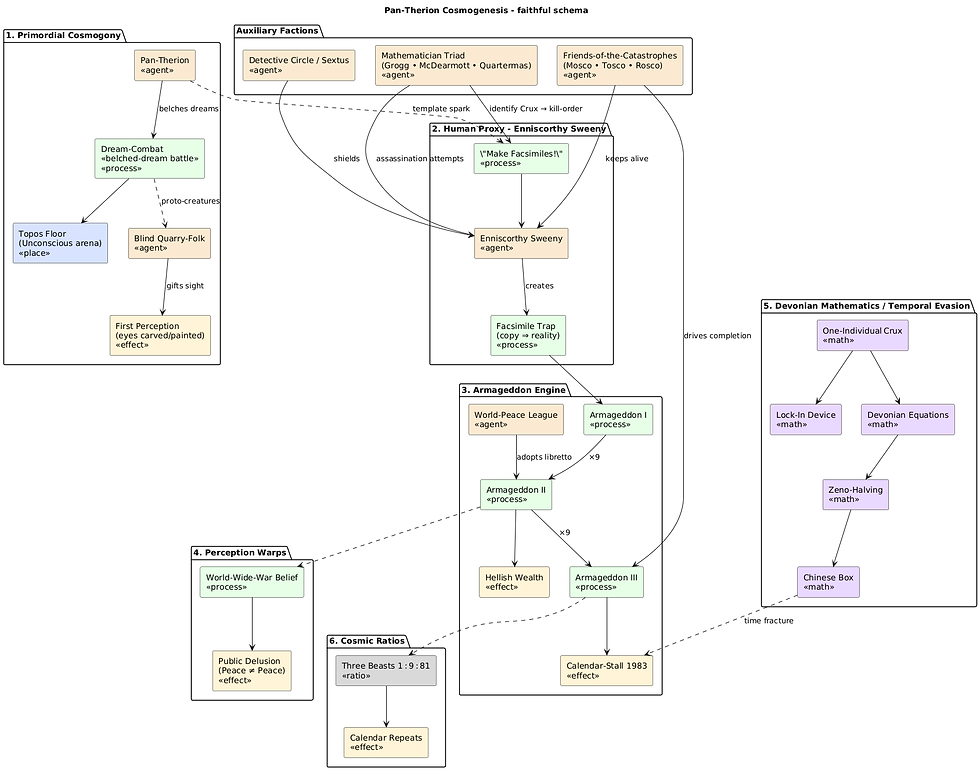
In The Three Armageddons of Enniscorthy Sweeny, a pivotal event for understanding the big picture occurs in 1910, when Dr. Henry Devonian writes a mathematical paper that reveals the nature of the world. The paper introduces a system of equations—General, Special, and Particular—that describe the hidden mechanics of time.
At the center of Devonian's work is the General Equation. It shows that each “Time-Enclave,” or Consensus-Time, depends on a single “Crux-Individual.” If that person is removed, the entire era collapses. Chicago mathematicians Grogg, McDearmott, and Quartermas solve the system, with their results pointing to sixteen-year-old Enniscorthy Sweeny as the key figure of their age. This discovery explains why the novella revolves around him and why his fate holds such importance.
Significantly, Devonian’s General and Special Equations include a set of “Protect-Our-Own” corollaries. These give rise to an invisible force known as the Friends-of-the-Catastrophes. Their role is to protect the Crux-Individual and to ensure that predicted disasters unfold on schedule. This will be important for much of the ancillary action, which can become confusing. When Grogg attempts to kill Sweeny, he is shot first. The moment reveals the corollary in action. Sweeny’s operas (especially Armageddon I and II), his plays, and even his stray “notions” are blueprints predicted by the Devonian Equations and appear to shape the course of reality. The theological drama comes to the fore when, in a letter, Sweeny quotes Pope Kyril I as describing them as “blueprints... for diabolical destruction."

Another example. A casual caricature Sweeny draws of a friend’s jaw ends up reshaping the friend’s actual face. These stories gain power as they are amplified by mass media such as print, radio, and opera, and by the enthusiasm of Armageddon cults that spread them widely. In time, entire audiences come to believe the operas are real. One result is the rise of the World Peace League, a sect of a million people who genuinely remember a global war that no one else recalls. When belief reaches critical mass (when more people, animals, plants, rocks, and machines accept one chain of events over any other), that story hardens into reality. The result is a stabilized Variant World, such as the battlefield visions presented in Armageddon I.
Sweeny, now acting as the "recording angel," writes down the new facts. This act prompts Consensus-Time to retroactively restitch itself, making the altered past appear as though it had always existed. Because the simultaneous presence of multiple narrative tracks would destabilize both minds and machines, a state of amnesia is triggered to suppress all memory of alternate timelines. If this suppression fails, physical systems such as machinery and human brains begin to break down. In some cases, they explode.
To keep the entire narrative loop running, we get Marshals Mosco, Tosco, and Rosco. They are described as “hellish fiends” who place an invisible iron collar around Sweeny’s neck that tightens whenever he stops producing visions. At the same time, a group of six detectives (who later merge into a single representative entity named Sextus) protects Sweeny from human assassins.
The system has two possible failure points. One is a Time-Collapse, which happens if the Crux is killed. In that case, the entire era disappears. The other is a period known as the Empty Years. This occurs when no single story takes hold, and history itself stalls. One example is the span from 1964 to 1972.
The plot, in brief: Devonian’s equations identify a single human as the focal point. That person begins to imagine stories. As belief spreads, one story crosses a critical threshold. Reality then rewrites itself to match. Contradictions vanish from memory. Meanwhile, demon-mathematician enforcers work to keep the cycle going. But if belief weakens or the Crux dies, the entire structure collapses. That is the high-level map of consensus reality in The Three Armageddons of Enniscorthy Sweeny: Creation -> Amplification -> Solidification -> Enforcement.