Argo Cycle 1: Reality in the Argo Cycle


Making sense of the Argo Legend can be hard going. Its unconventional structure, shifting genres, fluid timelines, connections to the Coscuin Chronicles, and metaphysical oddities will confuse first-time readers.
The Legend is like one of its great images: the always simmering crock that Melchisedech Duffey sets up inside the Pelican Press [A:132–134]. Everything goes into it.
So, what are these notes for? They are a rough-around-the-edges introduction, here to help you gain some traction. I made them to help me, and I hope the Argo you come away with is better than mine. There are now things here that I would put differently. They exist to outline the Argo Legend with minimal interpretation and address:
Once you see the big picture, it becomes easier to make sense of the thousands of small details in Lafferty's ambitious and astonishing masterwork.
Before diving in, what is the Argo?
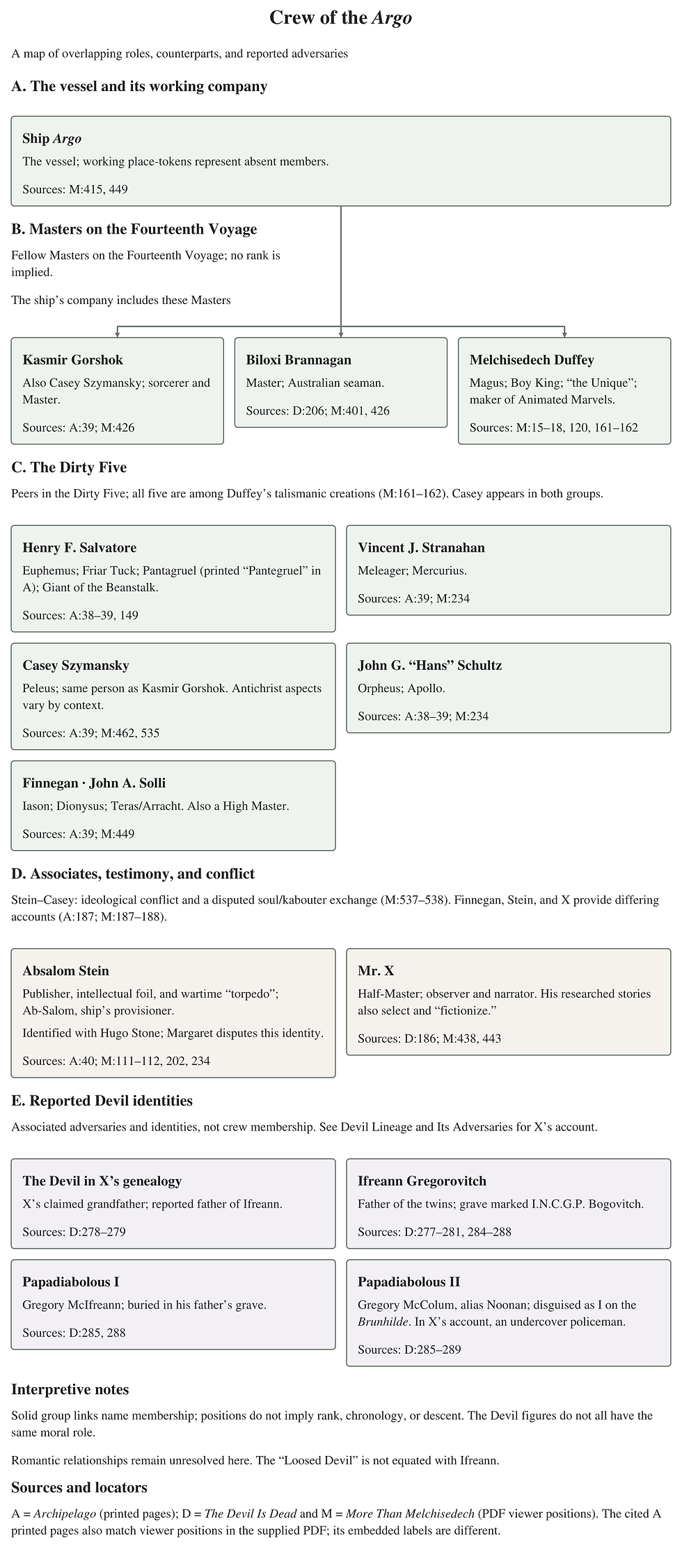
It is the most important ship in the world, crewed by the central figures of the story cycle, the Dirty Five, who are at the same time the mythological Argonauts: Finnegan as Jason, Hans as Orpheus, Vincent as Meleager, Casey as Peleus, and Henry as Euphemus. The ship's identity is rooted in myth and connected to the ancient vessel from the Greek story of the Golden Fleece.
Throughout the sequence, the Argo appears in different forms. Casey calls their ship the "ship named Argo," even if only for a single night. Later, in a daydream, Finnegan travels in a canoe he recognizes as the Argo. The magical ship also moves through time, passing through alternative present and future versions. It is as much a metaphysical condition as it is a physical craft.
It may also possess awareness. We know it carries a logbook with records spanning thousands of years. Its wheel is embedded with a piece of talking oak that tells the origin of artifacts. It may also follow a path of its choosing.
The Argo Masters include Melchisedech Duffey, Biloxi Brannagan, and Kasmir Gorshok, who is also Casey. And you already know that Casey is Peleus. The mysterious Mr. X serves as a Half-Master or assistant in a lower capacity. Effigies add to the strangeness. These are surrogates for Masters who are not always physically present on the Argo but continue to be working members of the crew. A returning Master dons his effigy, which becomes part of him.
The Argo also has a storied history. It has carried notable passengers, including St. Paul, Godfrey of the Gate, and Mark Twain. Dotty recalls an instruction: ordinary people found on shore must be reformed out of their ordinariness.
It moves against wind and current. Unseaworthy by usual standards, it needs constant attention. Herman Hercules cobbles things together in the rigging, and Finnegan makes emergency repairs beneath the hull. Despite its state, it cannot be sunk, not in any final way. In this way, it is like Lafferty's view of the Catholic Church: ultimately indefectible.
Its most extraordinary quality is its ability to travel through time and across dimensions. It moves between different moments and enters the Sea of the Seven Lost Years. In this sense, it is a temporal archive, with entries that reach far into the past and future.
From the outside, the Argo can be physically small enough to dock in confined harbors. Inside, it opens into a vast and twisting space with many levels. It holds unfamiliar rooms, shops, booths, storage areas, coffins, unknown animals, and a chamber called the Bread and Wine Room.
The ship is also tied to strange and singular events. Its past includes many identities. Once a Saracen vessel captured by King Richard, it has sailed as Navicula Petri, Abd-Aliah's flagship, Sindbad's ship, the Brunhilde, the Land of Behest, Salle du Roi, the Flying Serpent, and the Catherine. It carries relics, including a plank embedded with Noah's molar and the talking oak of Dodona set into the helm.
Finally, the Argo is a Quest Ship, like the Church Militant. Its purpose is to travel the world, carry passengers and cargo that no other ship can bear, reveal hidden truths, reach obscure ports, and bring joy to bleak places. At one point, Lafferty calls it the Hope Ship.
I. Scope of Reality in the Legend
"For though the ship be in trouble, still it is the ship. She alone carries the disciples, and receives Christ."
St. Augustine, Sermon 25 on the New Testament
The Argo Legend takes on some of life's biggest questions. One way it does so is through its odd variety of beings. Readers will learn of another form of humanity [D:240–242; A:39], the Teras [M:107, A:258], Devils [D:23], Gargoyles [A:6; M:170], Ghosts [M:475; A:87], Oreads [D:137], and Neanderthals [M:170, M:400], and other creatures. Characters will sometimes appear in more than one reality simultaneously, which Lafferty refers to as different lives. For example, Finnegan has an upper and a lower life [D:11]. He is Finnegan of the Two Lives [A:92]. Melchisedech Duffey remembers three childhoods occupying the same years [M:6–7]. The contingencies around Finnegan and Duffey ripple and take shape on different planes of existence.
The publication history of the Legend is complicated, but you can find material in three novels if you look. These notes cite those novels.
Archipelago (A): This novel forms the starting point of the Argo Legend. It presents a version of mid-20th-century history that may seem recognizable, though it is reshaped by Lafferty's style and idiosyncratic sense of reality. It introduces the "Dirty Five" (Finnegan, Hans, Casey, Vincent, and Henry), five soldiers bound by friendship during their World War II service. While Archipelago explores their personalities more deeply in its second half, it begins amid events, as one might expect of an epic. We read about the Sydney furlough [A: Ch1], the canteen crash [A:10–15], the beer-drinking contest [A:19–23], and the hijinks involving Absalom Stein [A:37–57]. These episodes are said to echo the journeys of the original Argonauts, though the meaning of that connection emerges throughout the Legend. Themes that will reach full expression in the third novel appear early in this book. For example, a strange perspective from Papua suggests that the subconscious holds all people and places, tied to a belief in the "Well of the World" [A:37]. An etiological myth explains the origins of different islands: the Aegean from a shattered Electrum cup, the Malayan from a broken bronze bowl, and the Papuan from sea turtles ripping a mat apart [A:35]. Readers are introduced to Pentanesia [A:35], a five-island cluster that Finnegan says was the original form of each archipelago; Naxos is one of the original Aegean five. These groups of five islands share a strong connection with the "Dirty Five" as they appear across time. Lafferty notes that the word "archipelago" originally referred to the sea surrounding the islands, not the islands themselves [A:35]. Lafferty identifies the "Dirty Five" as the Argonauts [A:38–39], and their qualities emerge through short stories, dialogues, and chapters that blend ordinary experience with mythic dimensions—one of Lafferty's signatures. Many key elements of the cycle are established here and return with greater depth: personal identity, the nature of reality, close connections, disappointment, and unusual threats.
The Devil Is Dead (D): Continuing after the war, this dreamy adventure novel resembles a kind of Chestertonian nightmare, combining high-seas drama with a mystery that resists resolution. The story centers on the Brunhilde's voyage, focusing on memory and the nature of evil. The central conflict pits Papa Devil (Papadiabolous II, or Noonan) against Saxon Seaworthy, and their obscure link to Finnegan. It is one of Finnegan's many lives, providing more about his double (Doppio di Pinne [D:89]) and elaborating on his uncertain deaths and survivals. The book courts ambiguity throughout, exploring deception, hidden identities, and a cosmic conflict in an island-hopping setting. Its mystical tone may reflect Finnegan's alcohol-related psychosis, something you will have to judge for yourself. However you interpret it, this novel deepens the strangeness and danger first introduced in Archipelago. It's the easiest of the three to acquire a copy of, which is unfortunate. It really is an intermezzo.
More Than Melchisedech (M): This novel radically expands the scope of the Legend, shifting attention to Melchisedech Duffey, now revealed as the central figure of the Argo Legend. He appears as Magus, creator, and cosmic agent. The book portrays post-war New Orleans, including the Pelican Press and The Bark. It explores the theological and philosophical implications of Duffey's "Animated Marvels" alongside Lafferty's intricate cosmology, including the Pristine and Molasses Worlds, Time, Aeon, and Eternity. Its structure blends embedded texts, dialogues, and Duffey's inner reflections. The novel recounts the 1946 release of the Devil, the tangled Antichrist storyline involving Casey, and the Seven Contingencies, possible futures, some of them world-ending, told through an increasingly fragmented treatment of time. The Additional Material in the version used here—“Great Day in the Morning,” “The Casey Machine,” “Promontory Goats,” and “How Many Miles to Babylon”—forms an integral part of the work. These pieces extend and, at times, reinterpret the central narrative, reconfiguring storytelling. Its concluding essay [M:475–479] provides a metafictional moment in which Lafferty addresses the reader directly, refusing closure and affirming a vision grounded in multiplicity. The tone is playful and serious at once, returning to Archipelago's open conclusion.
Anyone reading the Argo Legend will be struck by Lafferty's one-of-a-kind prose, with its lightness and informational density, neologisms, layered allusions, juxtapositions of the sacred and profane, humor, puns, strange orality, and shifting registers. His language is not ornamental but a part of the legend's themes and complex worldview. Argo is also about language.
One entry into the Legend's metaphysics comes through Zabotski's distinction in More Than Melchisedech between two worlds that occupy the same space in different ways: the "Pristine World" and the "Everyday-or-Molasses World" [M:279]. The first is Zabotski's real and essential world, where time moves quickly—"overflowing years" can pass within "a day or two" of ordinary time [M:279]. The second is marked by repetition, slowness, and diminished substance; Zabotski calls it a "stuck-in-molasses world" [M:277]. This duality helps explain the capacities of characters like Duffey, who creates people with talismans [M:18, M:151], commands giants [M:5, M:15], and generates gold [M:5, M:39], and the Argonauts, like the Dirty Five introduced in Archipelago, whose lives defy conventional sequence. This duality shapes the Legend's structure, which loops through memory, recollection of other lives (anamnesis [M:178]), and temporal breaks. The world's survival depends on its "central institution," the Ekklesia [M:450].
Throughout the books, change outruns stability, or perhaps stability contains continual change. The world includes overlapping people and seemingly alternate endings [M:475–79], a complex multiverse where identities shift and intermingle (seen in Duffey's multiple childhoods [M:7] or Finnegan feeling he inhabits a stranger [A:92]). Reality can dissolve, most dramatically in “Great Day in the Morning” [M:481–501], when natural laws collapse: coffee is served without cups [M:484], newspapers lose dates and pagination [M:486], and walls are removed while buildings remain standing [M:489–490]. Belief, or its absence, alters the physical world. The suggestion that the story may be "A GHOST STORY" [M:475] heightens the uncertainty. In Archipelago, Casey recounts twelve dream worlds of his own [A:156–161], further layering reality.
In “The Casey Machine,” Lafferty offers a pseudo-technical explanation of mental awareness and memory, linking them to forces like Earth Magnetism [M:510]. Mary Virginia Schaeffer invokes legends of "nine discarded worlds" God made before this one, while denying them scriptural authority [M:291–292], suggesting a Legend of repeated creation and rejection. In Dotty Yekouris’s letter, the "World of Record" is the shorebound life in which the Argonauts wake and sleep while their voyages continue elsewhere [M:180]. Argo provides many explanations but no final answers.
From the start, time is not treated as a forward-moving line. In Archipelago, Vincent Stranahan posits his "Uncreated Creation" theory, suggesting the world might be only minutes old, with memories fabricated. At the same time, Finnegan counters that it "hasn't happened yet" [A:56–57], highlighting time's conditionality. The Argo itself functions as a "dating clock" [M:411], able to exit the normal flow of time and reach temporal anomalies like the "Seven Lost Years" [M:71].
Lafferty's treatment of time is shaped more by consciousness than causality. It resembles a terrain filled with levels, breaks, and the potential to move across points. The "Seven Lost Years" [M:71, M:290] are not simply missing from the calendar; they are a realm Duffey enters and later revisits [M:290, M:445]. Elsewhere, Bagby’s letter describes an "out-of-time case" [M:248]. The Argo carries Duffey through years outside ordinary sequence [M:71]. In this world, memory is not just a record of the past—it stores knowledge of other timelines or lives (Finnegan moving between his two lives [D:11] or Duffey his multiple pasts [M:6–7]), contributing to the layered identities of characters. Even Finnegan's sense of reality blurs when he cannot tell whether his wanderings are happening now or at another time [A:200], showing how memory and experience become unstable.
This allows for reversals and overlaps, evident in states like Duffey's "creative stasis," where he seems to operate outside ordinary time, existing in the present intertwined with the past [M:199, M:445, M:448]. It is extended through inventions like the Casey Machine [M:514]. Even history becomes unstable: Royal Pop History denies that Athens existed [M:337], and Zabotski suggests that the Dark Ages may have originated in a sick boy’s chronicle [M:282].
The future, too, is not singular. It opens into "contingencies" [M:294–296], as explored in the Seven Roads play; the later account identifies the Argo’s fourteenth voyage as the one contingency certain to happen [M:300]. Stein suggests that events can fail to become fixed and fade into “unhappenings” [M:339]. In Zabotski’s account, time in the Pristine World holds more experience than in the duller and slower Everyday World [M:279]. This is more than a contrast in speed. Zabotski describes the Everyday World as containing duplications and non-valid persons and situations excluded from the Pristine World [M:279].
All this arises from Lafferty's theology. Drawing on Augustine, Boethius, and Aquinas, he gives the reader a tripartite model: Time (the duration of material beings, measured through successive change), Aeon (the duration of immaterial beings, admitting before and after), and Eternity (perfect, without succession, existing as a single instant) [M:468–469]. At the heart of this cosmology is the abiding instant of Eternity [M:468–469]. Characters move through these strata. For Duffey, Zabotski, and the Argo Masters, time is not measured but shaped by metaphysical force. Zabotski, for instance, experiences "overflowing years" within days [M:272, M:277, M:279]. The Legend explores time as conditional, shaped by belief, theology, and narrative, and subject to manipulation through magic, talismans [M:18], machines [M:514], and the possible providential will of the Argo itself [M:402, M:405].
Lafferty's fragmented treatment of time is the deep structure of the Legend. He uses it to create the layered identities of his characters, disrupting traditional narrative logic and showing how Time, Aeon, and Eternity are not just imagined but experienced.


Comments