30 Misc Laff: Cúchulainn and The Devil is Dead


No, I can’t recommend any good Irish myths or legends in translation. I have a copy of the John Strachan STORIES FROM THE TAIN which I have been meaning to translate for some years now, but it’s too damned difficult. It does have a glossary, but that covers only the unusual words. I have to go to my Dineen’s Irish-English dictionary a dozen times a page and it usually will not have the word, it being of modern Irish and the Tain being old Irish. But I have adapted several of the stories in various places, mostly in THE DEVIL IS DEAD. Finnegan, I am pretty sure, is Cu Chulainn as well as Fingall. And sometimes you can do better if you don’t quite understand a story than if you understand it perfectly. I believe the reason there are no good translations of the early stories is that there are very many versions of most of them and each is pretty sorry and incomplete by itself. There are many good adaptions, as distinguished from translations: several of the best are IRISH FOLK STORIES AND FAIRY TALES by W. B. Yeats himself, and CELTIC MYTHOLOGY by Proinsias MacCana . . . —Letter, November 3, 1972.
Small post, small puzzle. What did Lafferty mean when he said he had largely adapted the Cúchulainn material in The Devil Is Dead?
Some background. Cúchulainn is the great warrior hero of the Ulster Cycle, the body of medieval Irish tales centered on King Conchobar and the warriors of Ulster. His birth name is Sétanta, but he earns the name Cúchulainn, “Culann’s hound,” after killing a smith’s guard dog and offering to take its place:

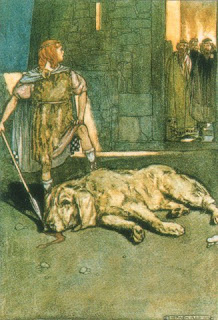
In the Táin Bó Cúailnge (The Cattle Raid of Cooley), Cúchulainn defends Ulster against the invading army of Queen Medb of Connacht, though he is still a teenager.

He is a weird hero: physically beautiful, but in battle he undergoes a terrifying frenzy, the ríastrad, often translated as “warp-spasm.” This causes his body to twist into monstrous shapes. Lafferty's fullest use of Irish myth came in his follow-up to Space Chantey, "Hound Dog's Ear."
Going through John Strachan’s Stories from the Táin (1908), with the Old Irish reader, notes, and a glossary that Lafferty mentions, I find a few possibilities.
The most interesting might be the entire setup of The Devil Is Dead. In Strachan’s Stories from the Táin, Cúchulainn has a strange encounter among the dead. On a battlefield at night, he meets a half-headed man carrying half his brother. The man tries to make Cúchulainn carry the burden, then wrestles him to the ground. This looks like some of the ur-material for the Papadiaboli and the encounter with Seaworthy. Then there is Seaworthy’s dream and the corpse that won’t be buried. That theme recurs in the novel with Don Lewis’s account of spending the night beside a dead soldier, though the commotion turns out to be just rats.
A second possibility is Finnegan’s transformation. In the Táin, Cúchulainn’s body warps when he fights. Something similar happens when Finnegan becomes an ape-cat or living gargoyle, capable of feats beyond an ordinary man. His transformation marks the passage from the novel’s phantasmagoric first part, which readers tend to remember best, to its noirish second half, culminating in X’s disclosure of the Neanderthal conspiracy. My bet is that Lafferty had Cúchulainn’s warp-spasm in mind when Finnegan finally leaps into action. It happens in the dead center of the novel.

Finnegan's cat-gargoyle warp-spasm would then be one of the primary rivets joining the nightmarish voyage of the Brunhilde to what follows. Some readers have found the novel too long, its second half an afterthought or a lapse in authorial control. If the warp-spasm supplies this structural link, The Devil Is Dead has a stronger internal architecture than those readings perceive.
Some parallel passages.