12 Misc Laff: When the Music Breaks

Updated: 15 hours ago

One question in Lafferty’s thinking about the end of contingent worlds is how to measure a life against the world’s. Everyone grows older and sees worlds fade. That is, anyone who is lucky enough to live long enough to experience that kind of loss. Lafferty certainly went through it. He was probably haunted by this more than most people (I think) because his father was so old when he was born, and he was the baby of the family. His grandparents were a century older than he. He liked the older world, that of his uncle and father and their stories, and their world was already faded in his childhood.
Then there is the question of his own remarkable belatedness. He joined the military, older than most of the men he served with, and he said that he felt he should have experienced the islands when he was younger, though he was still young. He started his professional writing life later than most professional writers. And so on.
Yet I think he was right about the double whammy, the unstructuring of Christendom that went terminal in his lifetime. He felt that loss acutely, and as he aged he felt it more intensely. He was not someone who thought one could go back. Whatever the West had been, it was over. Something new needed to happen. The spirit would need to descend again, as his fiction repeatedly says. In his darker moods, it doesn’t happen. God gives up on mankind. A different kind of future belongs to Ginny or to any number of other nightmarish successors.
All this is to say that Lafferty was sensitive to two very different scales of historical loss. The first is the inevitable one that comes with being a mortal who lives a certain number of years. The other belongs to an educated 20th-century Westerner who was especially attuned to both the crisis of Christendom and quirky fragments worth remembering that were being forgotten. Much of his work recovers these fragments, from the interurban trolley system to the detritus of a mass culture that has been cycled through, and reconfigures them through a Christian imagination.
In his fiction, Barnaby Sheen in Green Tree is the man who perhaps feels the appearance of Flatland most painfully. Sheen’s father and grandfather belong to the older world, and Sheen is cut off from the future by his daughter Loretta's death. Something magical happens to Sheen, a gift that Lafferty gives Sheen, in the recovery of Austro, who shows that the past is never quite over.
So it is not surprising to me that Lafferty attributes one of his more melancholy poems to Barnaby Sheen, “When the Music Breaks.” There are two versions of it. It is an allegory for the precariousness of human ambition and the brittle nature of the ideal worlds we create. The central metaphor is the grand human endeavor—be it art or civilization—constructed to elevate us above the brute realities of fallen existence short of the eschaton, which the poem describes as the "Pinnacles of Hell." Lafferty draws attention to the gap between human desire and human limitation.
The player-genius in the poem wants to keep up a magnificent citadel but is "rather small" compared to the instrument, and the poem warns that "small hands were never meant to stretch so far." That sounds like a reflection on what Lafferty was trying to do in his art. The beautiful world anyone tries to hold onto is inherently unstable, "tenuous" and "collapsible as any house of cards." It is an impossible performance.
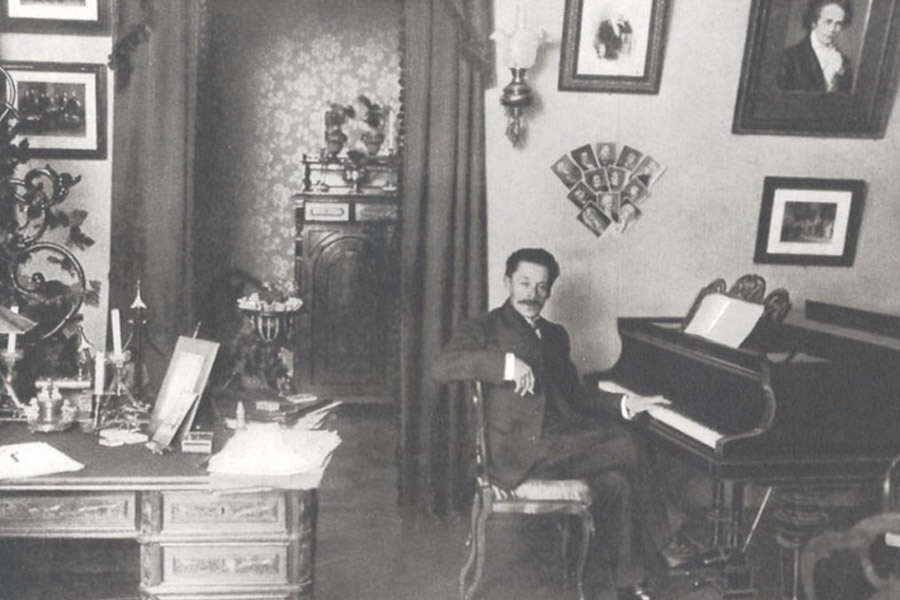
It’s one of my favorite little-known Lafferty pieces because it explores the inevitable and catastrophic collapse of these big illusions when human capacity reaches its limit. It starts with an anecdote about a dead man continuing to play the piano. As a pianist myself, I’ve thought about it several times recently while playing, specifically the idea that art might, for a moment or two, seem to defy mortality, but it doesn’t hold out against the decay of the "Nocturne of the Worm." When the music breaks, it is likened to a star bleeding or the moon crumbling. Lafferty critiques society's fickleness; the audience revels in the "Blessed City" and its beautiful sound, but then it will "revile / The shattered carcass" when the artist's strength gives out. The poem is an elegy.
After Lafferty quit writing, he felt compelled to write a few last stories, final statements like “The Story of Little Briar Rose” and “The Man Who Lost His Magic.” He didn’t end on the note sounded in “When the Music Breaks,” but with something more affirmative.
Another from my Lafferty playlist.