02 "The Bank and Shoal of Time" Again


By anybody’s standards, this was a beautiful place. The folded, rolling hills were covered with clover, or they were covered with grapes. Everywhere the three explorers walked the air was pleasantly noisy with bees. There were a dozen heavy white cattle grazing belly-deep in clover, there were exposed rock strata of shale and slate and chalk. There were beech groves. “I have never seen time piled up so deep in a place,” Ethan Farquharson said. “Not insufferably ancient time, but historical and para-historical time going back to the glaciations. These are the centuries and the thousands that we want to explore, and I never saw them piled up so beautifully. The banks of the North Border of the estate were once the shore of the Gulf of Lions. What a place to start from! If only ‘it’ is really here! But there are no hidden valleys on the estate, and we have seen everything big enough to matter.”
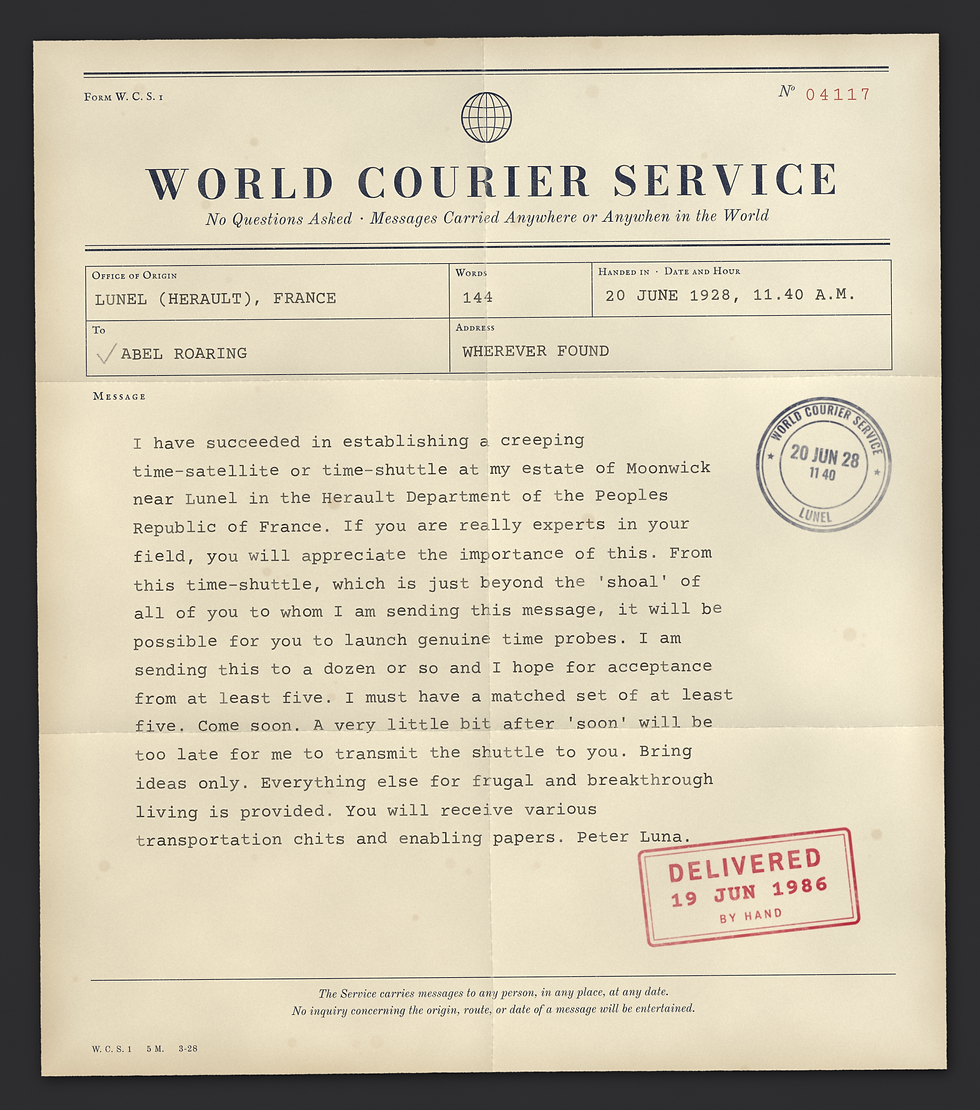
“You could have taken the time-road five seconds ago, of course, but I desired your company for this little while.” —Peter Luna, “Bank and Shoal of Time,”
I'm working on a few things, but I reread "Bank and Shoal of Time" last night and wanted to jot down a few thoughts.
Fred Saberhagen said that when he first read it, his heart sank a little. He was assembling an anthology about exploring the past without the usual time machines, inspired by the idea that time machines can get in the way of time exploration because they are for people in a hurry, people who want to whoosh back and forth, adventure-fashion, across the time stream. Why did Saberhagen’s heart sink? Well, Lafferty drops his idea about a time-satellite and a time-shuttle almost immediately.
“I need not have worried,” Saberhagen writes in his introduction to Lafferty’s contribution to the anthology. Whatever Lafferty had concocted in his time-satellite, it was unlike Wells’s glittering invention, fashioned from ivory, nickel, and rock crystal, with its saddle seat, brass rail, and twin levers used to navigate time. Saberhagen wraps up his headnote with two passages drawn from the story: time at Moonwick is a mulch many meters deep, and its accumulated centuries have been piled up beautifully.
“Bank and Shoal of Time” is one of my favorite Lafferty stories. I’ve written about it before, and while revising my earlier post, I found my views haven't changed much. But in that earlier post, I didn’t really get into why I think Lafferty wrote the story or what he was doing. I was interested in understanding how it worked.
Saberhagen is a good jumping-off point for thinking about the why question: why write such a strange story at all? In the introduction to A Spadeful of Spacetime (1981), Saberhagen says something interesting that I agree with. He says our dependence on automobiles can prevent us from discovering the pleasures of walking. A machine that takes characters into another period so efficiently can leave us with a journey that doesn’t matter much. Just as soon as the time traveler arrives, the past becomes another present in which the plot starts ticking off its beats, an instance of what Lafferty calls heroic tedium:
We are shot into the past, or the future, and at once begin to interact with what has become only a different kind of present. The pleasures of the journey have been denied us.
So, for his anthology, Saberhagen wanted writers to imagine other ways of approaching the past. I am, of course, biased, but I think Lafferty’s story meets the brief better than any other story in the anthology.
Lafferty finished “Bank and Shoal of Time” on October 25, 1978. The Tulsa archive description lists the agreement granting Saberhagen permission to include it in the anthology, dated April 10, 1979. It looks to me as if Lafferty wrote the story for the anthology, but I can’t be sure.
Taken literally, Lafferty has failed to meet Saberhagen’s brief. He delivers a lot of what Saberhagen wanted to avoid. After all, Moonwick is a time-satellite. Its owner has built it. Furthermore, a specially equipped 1928 electric truck carries visitors from their year into his. There is a lot of self-aware play with time-travel talk: calculations, mechanisms, quotations from the Encyclopaedia Britannica about the nature of time, the aura-amplifier that is so important to the final scene in the story. Yet one measure of Lafferty’s success is that, though Moonwick Estate is a gadget of a kind, it doesn't feel like a time machine. The closest thing we get to that is the bascule coil and its connection to Peter Luna’s aura, and the joke about how the clock at Moonwick will stop when Luna dies.
Nor is the story much of a puzzle. Peter Luna has already solved the whole time-travel problem before his five guests, who seem to me to be variants of the five wise virgins, arrive. Note the allusion to the parable in Luna’s “You know not the day nor the hour.” If the objection is that a time machine gives its author a convenient means of moving people into the past, Moonwick, too, does that. One funny thing about the story is that the initial act of time travel, the really important one that gets the five guests past the shoal of time, is over within the first few pages.
The story becomes a story about trying to understand the nature of occupied time.
The five investigators arrive at Luna’s estate in southern France. Each takes an eccentric approach to time travel, and each faces the obstacle that keeps them from pulling it off. They cannot enter the years in which they already exist. Their own thirty years of life form a shoal across the entrance to the past. Luna brings them across the shoal to Moonwick Estate, a place from which they can begin their exploration of time. So “Bank and Shoal of Time” is a story in which time travel happens, but it is also a story that concludes on the brink of a time-travel adventure.
There is no secret to any of this. Peter Luna tells them that they are already before their births:
“Oh, I’ve already solved it,” Peter Luna said. “I’ve solved it by the time-satellite that I’ve built here. By it we are already beyond and previous to a shoal, and by using it you five are back before you were born. As to myself though, I’m still in my proper life, right at the end of it, as it happens.”
They can see the satellite. Yet they continue looking for it. Even after they have traveled through time, they still try to figure it out. So they inspect the house, its rooms, its cellars, its grounds. Nothing is locked. Nothing seems to be concealed. Where is the time machine?
The reader faces a similar difficulty. We may search each of the five’s explanations for the theory of time that will make the story intelligible, treating the house, sunshine, food, and company as so much extra material surrounding the real business. Yet Moonwick Estate is the point: it is an icon of the expanded life the investigators want to achieve through time travel.
Lafferty has made the distinction between elapsed time and experienced life absurdly, vividly concrete. Luna says that accelerated travel into the future is a really bad bargain: someone might live thirty years in three minutes, undergo a shallow version of those years, and arrive prematurely at his own death. Don’t wish your life away too fast. At Moonwick, five seconds slow-jog into what feels like days. There is time enough for four meals, several shaves, tennis, squash, arguments, exploration, relationship building, and new ties of affection. As Annabella says:
“We’re not wasting very much time here,” Annabella said, “something less than three seconds since we’ve been here. And we’ve had four good meals here and now I’m hungry again. I’ve had a good night’s sleep here, though it was at bright noontime. This is really the most filled-to-overflowing less-than-three seconds that I ever spent in my life.”
That is what I think Lafferty is up to in this very tricky story. He wants to draw our attention to how much of life a person can inhabit.
There is a moment in “Bank and Shoal” when this comes into the foreground. Peter Luna says that he looks forward to leaving this “token shadowland” for the “main show.” Annabella immediately objects. She says this life already belongs to the main show. Whatever greater existence follows it, we have no warrant to overlook this fact:
“Oh, Peter, this is part of the main show,” Annabella insisted. “It’s at least the first act of it. I think it’s a full show, five or seven acts at least, and at the end of each of them we die and are then reborn on a more vasty plane. But there aren’t any skimpy acts in our main show; surely the first act isn’t; and it’s criminal for us to skimp any part of it. We must range forward and backward through the act we are living in; we must learn every direction and dimension of it. We have an obligation to understand and to explore, in every way. Life is made up of this compacted emotion and experience and happiness, and if we cut ourselves off from any dimension of it then we live the less. We must unclot it and open it all up. The ‘Road to Yesterday’ must be one of the opened roads, or we are the less for it.”
In the story, her dreams encompass “the entire accumulation of the human affair.” The past contains an immense quantity of experience from which we are ordinarily excluded, and, if we could get over the bank and shoal, maybe we could open a road into a larger participation in life.
This leads to one of the story's wonderful moments: Peter Luna’s death cake. Annabella has baked it for Peter Luna’s death-day during the slow-jogged last seconds of his life:
“It’s rather good cake,” Peter Luna said as he took a forkful of his own Death-Day Cake.“For a rather good guy,” Annabella told him.
This shared moment of eating in dilated time, of enlarged human contact, is what Peter Luna wants. This is a story about how people can experience time in communion with each other.
Lafferty’s epigraphs are usually important. “Bank and Shoal” is no exception. Anyone who reads the story will be enriched by also reading Belloc’s “On an Unknown Country.” It describes literature's power to reveal a desired country beneath familiar landscapes. What is Moonwick Manor if not the kind of place sought by the eccentric reader in Belloc’s essay? Belloc writes:
Little friends, my readers, I wish it could be done in prose, for if it could, and if I knew how to do it, I would here present to you that Unknown Country in such a fashion that every landscape which you should see henceforth would be transformed, by the appearing through it, the shining and uplifting through it, of the Unknown Country upon which reposes this tedious and repetitive world.
I’m tempted to write more about all this. Like so much of Lafferty, "Bank and Shoal" should be better known. A story about an old man who loves life by an old man who loves life. Peter Luna uses his final moments to try to give it more abundantly to others rather than disappearing into the past alone. As Luna says:
“But I do wish mightily to build a time-bridge that can be used by all interested persons. I don’t have to die today, you see. I could flee into the past alone and forget about today. But if I want to open a workable bridge, if I want to transmit what I have built to you five, then I do have to die today: or I have the particularly rank superstition that I have to.”


There is a funny moment in “Bank and Shoal of Time” where the five time attempters read the Britannica account of the CPT theorem. According to the theorem, the laws of physics come out the same if you do three things at once: just swap every particle for its antiparticle (C), reflect space as in a mirror (P), and run time backward (T). Annabella MacBean calls this “too simplistic,” saying it leaves out a “Rank Superstition Factor.” I made this little film (set to Bach's brilliant crab canon) to show what the Britannica passage means. My idea was to use Abel Roaring’s picture of time as a pile of transparencies. One muon decay gets recorded on four lantern slides. Printing the slides as negatives stands for C, turning them over for P, and showing them in reverse order for T. Each altered film is compared with what real particles do. The negative turned over shows a real antimuon decay. The backward films show processes. All three changes together show the theorem:



Comments