"Pine Castle" (1983)

Updated: 14 hours ago

Yesterday I received my copy of The Man Who Lost His Magic. It’s every bit as attractive as you’d expect, and in terms of color and cover design, it may be my favorite volume so far. I began with Gary K. Wolfe’s introduction. It’s lively, and Wolfe makes the smart choice to quote Lafferty often, a decision that always works. The frequent quoting leaves less room for deep analysis, but it gives the intro energy and helps with a difficult assignment: pulling together random slabs of Lafferty.
I have just one objection, which I’ve made before: the standard way of writing about Lafferty has become so limp that it obscures the work. This is not a critique of Wolfe, but rather the way people do Lafferty talk. Too often, those introducing his work act like tour guides who only show you the gift shop. They fall back on the familiar image of the Lafferty as science fiction's weird O. Henry (my name for this Lafferty made of straw) and offer commentary that doesn’t line up with what’s actually on the page. This does him no favors.
One example from Wolfe’s introduction captures the problem precisely: “Lafferty seldom dealt with social issues quite this directly.” Wolfe is a perceptive critic, but this is not a perceptive remark. Almost everything Lafferty wrote addresses social concerns—often directly, often obliquely, but unmistakably. To suggest that such engagement is rare misrepresents the nature of his work. And the phrase “quite this directly” amounts to little more than critical fog. Wolfe himself worked on Past Master for the Library of America. Are we to believe that Past Master isn’t fairly directly about social issues? Again, not about Wolfe: about Lafferty talk.
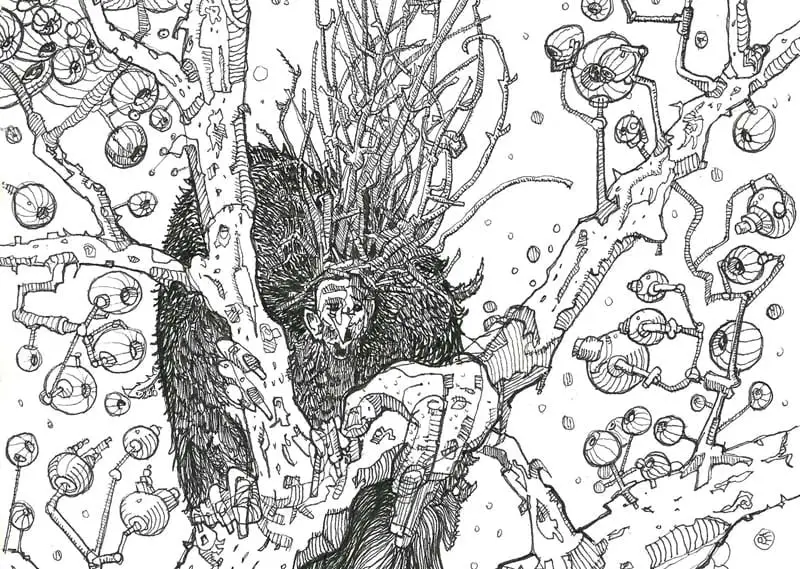
One of the stories that punches most above its weight in the collection, for me, is “Pine Castle.” It seems like a minor piece, and it is. But it is also a keyhole view onto some of Lafferty’s deepest concerns. In a college course that tackled Lafferty, "Pine Castle" would be the kind of story to have students cut their teeth on. By genre, it belongs to the long line of tales that follow from Poe’s “The Premature Burial.” It almost reads like something from EC Comics, a ghoulish conte cruel with a touch of Lafferty's sardonic humor in place of the Cryptkeeper's.
If you’ve read Proust’s Remembrance of Things Past, you’ll remember the long passages where the narrator reflects on the strange fact that people can remember who they are when they wake up. Most of us have had the experience Proust describes—waking and thinking we’re somewhere else, in a room from another time in our lives, or finding the space around us suddenly unfamiliar. This fascinates Lafferty as much as it did Proust, which is unsurprising: both artists are apostles of memory. The entire plot of Finnegan’s lower life in The Devil is Dead turns on being unable to break through that kind of confusion. And in Archipelago, Finnegan’s upper life shows what follows from it.
“Pine Castle” strips it all down. Its narrative machinery is as spare and functional as the pine box of its title. The story takes place in total darkness, in a sealed space, within the consciousness of a single man. It becomes a memory theater, a reversal of the centrifugal chaos we see in Finnegan. Here, memory contracts. It presses down. It becomes centripetal. And finally, it becomes judgment and punishment. In its concentration of design, the story comes close to what Goethe called an Urphänomen, a basic form that lets us see into the others.
The title of the story refers to three spaces at once: the tavern where everyone drinks, the pine box in which Stephen wakes, and a memory castle in the classical ars memoriae tradition. That is, a mental structure used to arrange and preserve memory.
The story blends these spaces through sensory spillover. It’s too dark. The walls are too rough. Stephen feels splinters. The place is narrow. He can’t even strike a match. There’s a weight on his chest. These small physical details are signs of the coffin intruding into the tavern, as if the two locations were bleeding into each other, causing mental disorientation. The horror comes not from gore or shock, but from this slow collapse of space, as the bar becomes the premature burial.
As Lafferty matured as a writer, he grew more inventive with large casts of characters, though he had always liked to bring many into a story. One of the pleasures of reading him is seeing how he handles the formal problem of too many characters. “Pine Castle” shows him thinking through that challenge. In just a few pages, he introduces a surprisingly large group, an impressive number when you stop to count.
He uses the structure of a known pattern—a circus group. He gives them etymologically charged names that work as mnemonic devices. None of the characters is more than a type, but they are not meant to be. Each drinker is an emblem, a memory marker linked to one of the “archetypal human fears.” Together, they help Stephen and the reader navigate the “castle” and uncover the truth.
Molly O’Lolly, aviatrix → Fear of Falling (1st fear)
Jude Bushmaster, snake-handler → Fear of Snakes (2nd)
Claud Noyer, wrestler/strangler → Fear of Drowning/Suffocation (3rd; noyer = “to drown” in French)
Gregory the Great, magician → Fear of the Walking Dead (4th)
Niccolo Chort, devilish figure → Fear of Fire/Hell (5th; chort = a demon in Slavic folklore)
Snake-Eyes Simpson, gambler/enforcer → Fear of Being Murdered (6th)
Stephen Nekros, the debtor → Fear of Being Buried Alive (7th; nekros = “dead” in Greek)
This list forms a mnemonic ladder that leads the plot to its anagnorisis.
To go a little deeper, we can bring in a little narratology. First, focalization: the story stays tightly inside Stephen, his “clammy” hands, chest pressure, broken thoughts, and, most telling, his amnesia. Stephen “had forgotten how he had got into his present vague situation, and [feared] that he might remember it.”
Second, time: the tavern reads as present-tense, but it functions as a delayed flashback, a half-hallucinated prelude that leads to the recollection of murder (“the six doing him to ‘premature’ death by the strangling hands of Claud Noyer”), which in turn drops us into the coffin’s present with Diamond Johnny, the anesthetized snake on his chest. The shape is a spiral of memory: scene, true past, fatal now.
Third, retrieval cues: Stephen’s refrain—“Why can’t we have more light in here?”—and the repeated descriptors (“rough,” “narrow,” “clammy”), plus the rising count (“first… second… third…”), move the reader toward the story’s real subject: the moral darkness of usury and credit. The counting enacts counting-into-clarity—the stressed mind imposing order—which neatly mirrors the arithmetic world of finance and the countinghouse. (Since Lafferty translated Goethe, one could even hear an echo of “Mehr Licht!")
Returning to Wolfe, what first looks like a story about being buried alive turns out to be a very Lafferty-style treatment of two kinds of debt: financial and spiritual. And it is directly about these social pathologies. You only have to look directly at it to see this.
There’s more to say, of course, but I’ll leave it there. If you have the new Centipede volume, take a moment to read this very short story. It touches many of the deep themes that run through Lafferty’s work from beginning to end. It only pretends to be an EC comic.