32 Misc Laff: Snuffles DNA

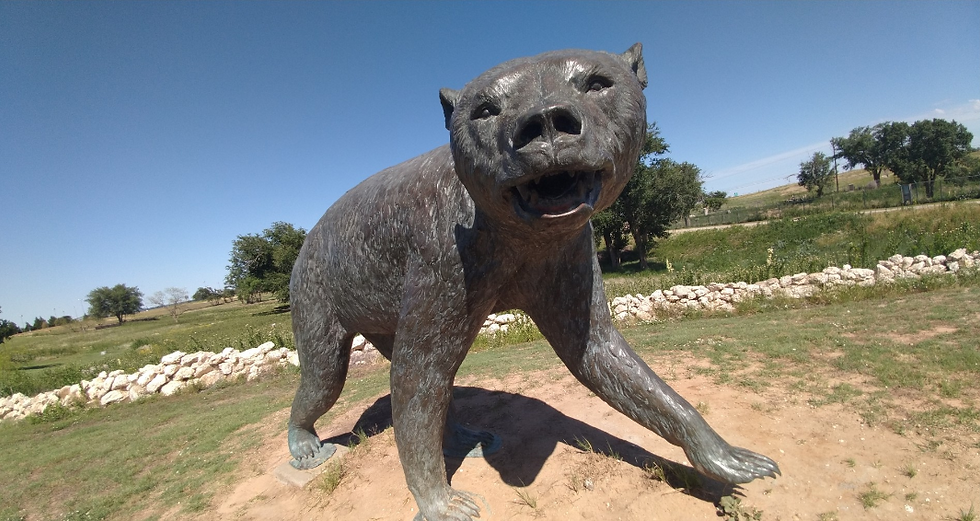
“It is the only animal that children dream of without having seen or been told about. Moncrief by his recall methods has studied thousands of early childhood dreams. Children universally dream of bears, Tahitian children subject to no ursine influence in themselves or their ancestry, Australian children, town tikes before they ever saw a bear toy. They dream of bears. The bear is the boogerman. Bears live in the attics of old childhood houses. They did in my own and in thousands of others. Their existence there is not of adult suggestion, but of innate childhood knowledge.“But there is a duality about this boogerman. He is friendly and fascinating as well as frightening. The boogerman is not a story that adults tell to children. It is the only story that children tell to adults who have forgotten it.”
“To you, Marie, everything symbolizes grown man in his fundamental aspect. Now the boogerman is also philologically interesting, being actually one of the less than two hundred Indo-European root words. Though Bog has come to mean God in the Slavic, yet the booger was earlier an animal-man demiurge, and the Sanskrit bhaga is not without this meaning. In the sense of a breaker, a smasher, it is in the Old Irish as bong, and the early Lithuanian as banga. In the sense of a devourer, it survives in the Greek root phag, and as one who puts to flight it is in the Latin fug. We have, of course, the Welsh bwg, a ghost, and bogey has been used in the meaning of the devil. And we have bugbear, which rounds out the circuit.”
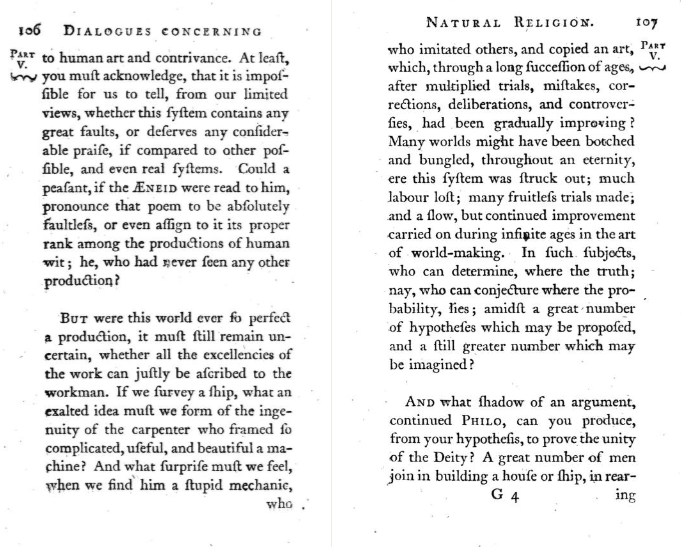
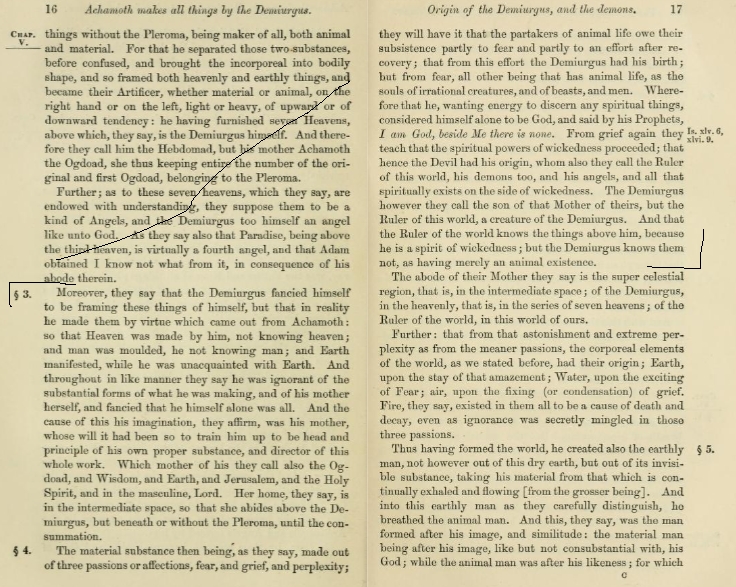
More than a few readers have identified Snuffles as a Gnostic demiurge, and they’re right. But that accounts for only part of his DNA. My pet theory is that Lafferty combined the bogey etymologies in Fiske’s Myths and Myth-Makers and Sikes’s British Goblins with the ignorant demiurge he read about in Irenaeus. Some of Billy Cross’s speech can be pieced together from those two books and Lafferty’s well-loved Gaelic etymological dictionary. Lafferty may then have grafted that figure onto the inexperienced creator imagined in Hume’s Dialogues Concerning Natural Religion.
Pass all that through Lafferty, and you get a vain craftsman who takes his creation of Bellota as proof that he made everything. He needs praise and threatens to remake his ungrateful creatures. Lafferty may have read Fiske firsthand; if so, I suspect he also encountered him through Sikes. Of these possible sources, I’m least confident about Hume, though it was Hume who made notorious the idea that a less than perfect creator might learn to make a more perfect world through successive failures. Lafferty’s ending is a blackly comic version of that conjecture, which Hume voices through Philo, his mouthpiece in the dialogue. All this just to say that there is as much reason to read "Snuffles" alongside a philosophy textbook as alongside Irenaeus, to whom most of its critics have turned. That Hume gets the final word is another reason I believe this is one of Lafferty's closed storyworlds.
These are bits and pieces that the Snuffesholic should know about.



This is about as close as I can get right now to my ideal 1960s Gumby-style version of “Snuffles.” I put a bunch of AI agents to work on it, and it does amuse me. There are weird audio cuts and plenty of other glitches, but it’s getting closer to what I asked for. It’s all part of my private fixation with finding a way to opt out of our current dystopian media ecology by using its frontier technologies, which my hard drive is filled with. And all the glitches? Snufflean. Another way in which our reality is becoming more Laffertian. I will say, though, that my ideal Snuffles has a lot more dog in his face. I want the snarl when he shows offense.


